
28,500 Readers, One Week, And Still Counting

There’s something quietly significant about that number. Not as a boast, not as a passing metric, but as a reflection of choice. 28,500 people didn’t just scroll past, they stopped, they read, they stayed with the argument across an entire week. That is not passive consumption, it is engagement, and in a media landscape built on distraction, that still matters. So thank you. Properly.
It also puts things in perspective. Midlands GRIT is now drawing more weekly readers than the typical attendance at Walsall FC, whose final game of the season I will be watching, and stretching down to Bromley FC, still the only Football League side with a Tory MP. That little quirk says rather more about the current state of the Conservative Party than any conference speech ever could. With local elections this Thursday, and a general election always hovering somewhere on the horizon, the message is simple. Turn up. Vote.
Monday, Peaky Truths And A Proper Birmingham Pint
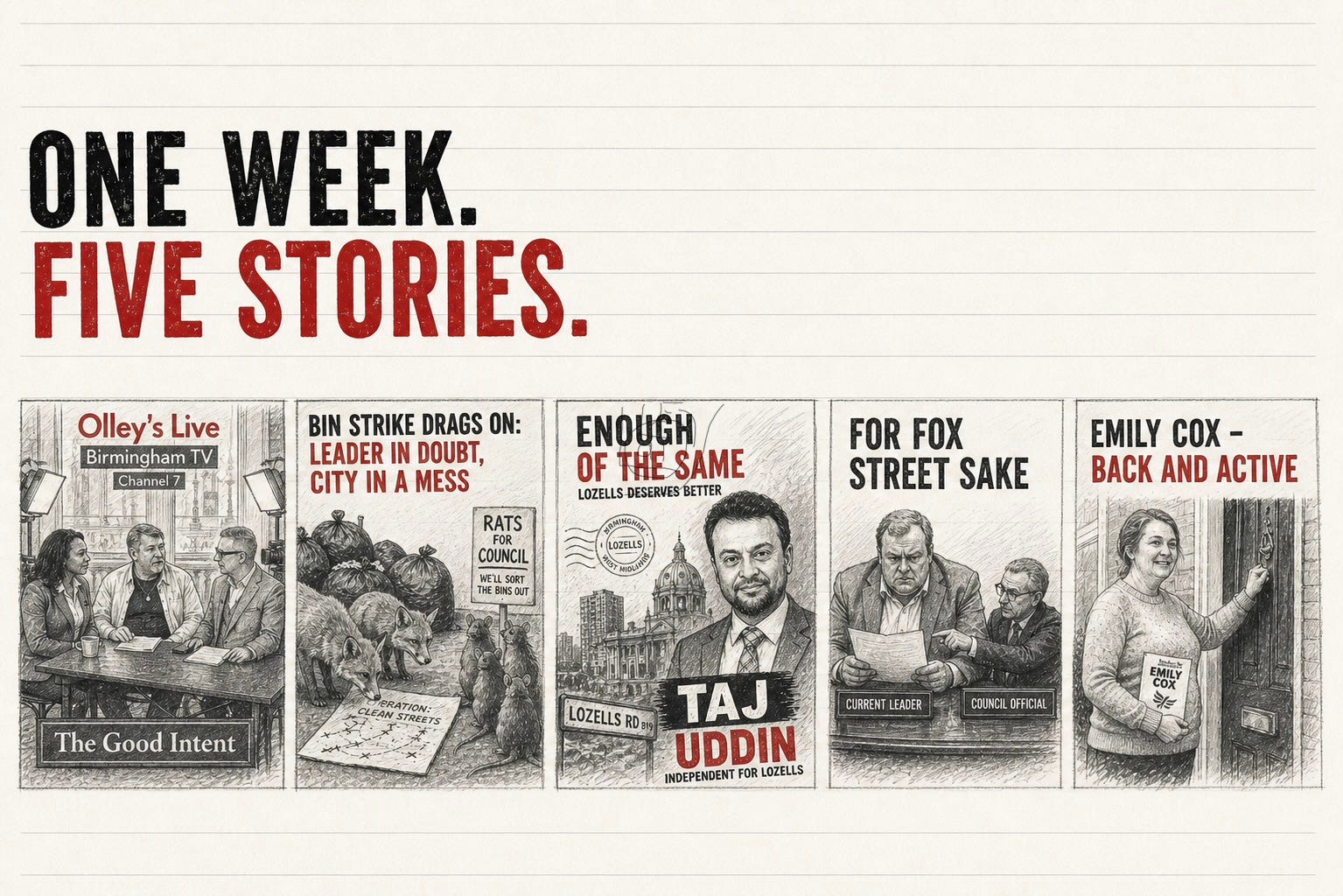
Monday began where Birmingham makes most sense, not in policy papers or press briefings, but in lived experience. Episode 2 of Series 3 of Olley’s Live took us into The Good Intent, tucked inside the Great Western Arcade, a place that manages to be both unassuming and quietly remarkable. A pub that gives its profits to charity is rare enough. One that still holds warmth, conversation and authenticity is rarer still. It was the right setting for the right conversation.
Across the table sat Professor Carl Chinn MBE, one of the city’s most important chroniclers. His latest book, Peaky Blinders: The Real Gangs and Gangsters, does something the global television phenomenon never quite attempts. It removes the romance. The real Peaky Blinders were not sharply dressed icons moving through stylised drama. They were products of harsh conditions, poverty, overcrowding, violence and limited opportunity. Crime was not cinematic. It was often desperate, sometimes brutal, and rarely noble.
Carl tells that story with clarity and honesty, giving Birmingham its history back without embellishment. And then, in the way this city always seems to manage, history folds in on itself. His great grandfather once stole a leg of bacon from my own great great grandfather’s shop. That is Birmingham in a single moment. Not grand, not distant, but connected, human, and never quite as large as it pretends to be.
Filmed as live, without edits or reconstruction, the programme allows conversation to unfold naturally. Lorraine and I present together, and that balance matters. It creates space for something genuine. When filming ended, people came over, not to pose, but to talk, to share memories, to continue the discussion. That does not happen in studios. It happens in places like this. Because if you want to understand Birmingham, you start with the people who have lived it.
Tuesday, Five Versions Of Reality, One Mountain Of Rubbish
By Tuesday, the tone shifted from heritage to dysfunction. Birmingham’s bin strike has now produced five competing versions of reality, each delivered with confidence, none fully aligning with the others. Unite signals progress and near resolution. Council leadership suggests a deal is close but delayed. Other voices insist no such offer has even been made. Opposition parties warn of financial fallout, while Liberal Democrats question whether any agreement could legally stand.
Meanwhile, residents have endured fifteen months of something far more tangible than political positioning. Overflowing bins, missed collections, the steady presence of rats and foxes, and the creeping sense that no one is actually in control. That is the real story. Not the statements, not the briefings, not the carefully timed announcements.
A major European city has allowed a basic civic function to become a contested narrative. Five explanations exist simultaneously, yet the outcome remains unchanged. The bins are still full. Until that changes, everything else is noise. Another load of old rubbish, dressed up as resolution.
Wednesday, Lozells Breaks The Script
Wednesday struck a chord because it touched something deeper than party politics. It challenged assumption. Lozells has long been treated as a Labour certainty, the kind of ward where outcomes were considered inevitable. That certainty has now been removed, and what replaces it is something far more unpredictable. A genuine contest.
Into that space steps Taj Uddin, standing as an Independent, but not in the traditional sense of a placeholder candidate. This is a structured, organised, properly resourced campaign. His politics are not built on ideology but on observation. Cleaner streets, safer roads, enforcement on housing, fairness in transport. It reads less like a manifesto and more like a set of accounts that do not quite add up and require correction.
What strengthens his position is not just policy, but presence. He has lived and worked in Lozells for nearly twenty-five years. He is not arriving for the election cycle. He is already there. That distinction is increasingly important in modern politics, where voters are becoming more attuned to authenticity.
Labour’s position is complicated further by internal and external pressures. The selection of Samarah Zaffar raises quiet but persistent questions about continuity and inheritance. Overlay that with broader issues, Gaza, rising council tax, financial instability, declining services, and the ground begins to shift. Taj’s claim of being 95% confident may sound bold, particularly for an accountant, but perhaps the numbers really are moving in ways Labour has not yet fully absorbed.
Thursday, Selling The Future One Asset At A Time
Thursday turned to something more structural, the way Birmingham governs itself, and the decisions that shape its long-term future. Fox Street is not peripheral land. It sits beside Curzon Street, at the centre of the HS2 gateway, in one of the most strategically important areas the city possesses. Land of that nature is not simply an asset. It is leverage. It is future value.
Yet Cabinet approved its disposal. Scrutiny raised concerns, questioning whether the council had properly assessed the balance between immediate financial need and long-term strategic gain. The response felt familiar, a report revisited rather than reconsidered. Scrutiny objected. Cabinet proceeded.
This pattern raises a question that is becoming harder to ignore. Are decisions being made by elected members exercising judgement, or by officers presenting conclusions that are simply endorsed? The memory of the NEC Group sale hangs heavily over this. Sold for £307 million, resold within three years for around £800 million, and now reportedly approaching £1 billion. Confidence existed at every stage. But confidence alone does not equal competence.
Fox Street feels uncomfortably similar. A city under financial pressure, guided by unelected commissioners, moving assets in the name of necessity. Libraries close, services contract, transparency thins. And within the language of reports, residents themselves begin to appear as liabilities rather than citizens. That is the deeper risk. Not just what is sold, but how a city begins to view itself.
Friday, Not My Party, But One Of The Good Ones
By Friday, the lens tightened again, because politics ultimately returns to individuals. Emily Cox stands out not because of party alignment, but because of persistence. Our paths first crossed in a Tyburn by-election around 2000. I was the Labour councillor, she was the Liberal Democrat challenger. She lost. But she did not leave.
That detail matters more than it might seem. She went on to win in Moseley and Kings Heath, building a reputation not through messaging, but through visibility and work. Even as her party declined nationally, she maintained her position longer than many. Eventually the broader tide caught up with her, as it does with most.
Now she returns, standing in Brandwood and Kings Heath alongside Cat Wagg, and making something clear through action rather than words. She is present. Knocking doors. Listening. Engaging. Not performing a campaign, but doing one.
This is not a fixed ward. Its political history shifts, Conservative, Liberal Democrat, Labour, and now potentially open again. Labour faces pressure from multiple directions, while Greens and Reform begin to take slices of the vote. In that environment, the candidates who actually put the work in become more visible.
Agreement is secondary. Effort is not.
The Week In One Line
From Birmingham’s past to its present, from pubs to politics, from bin collections to billion-pound land decisions, the thread remains consistent. People. How they act, how they decide, how they represent, and increasingly, how they are held to account.
28,500 readers followed that thread this week.
Next week, we go again.