


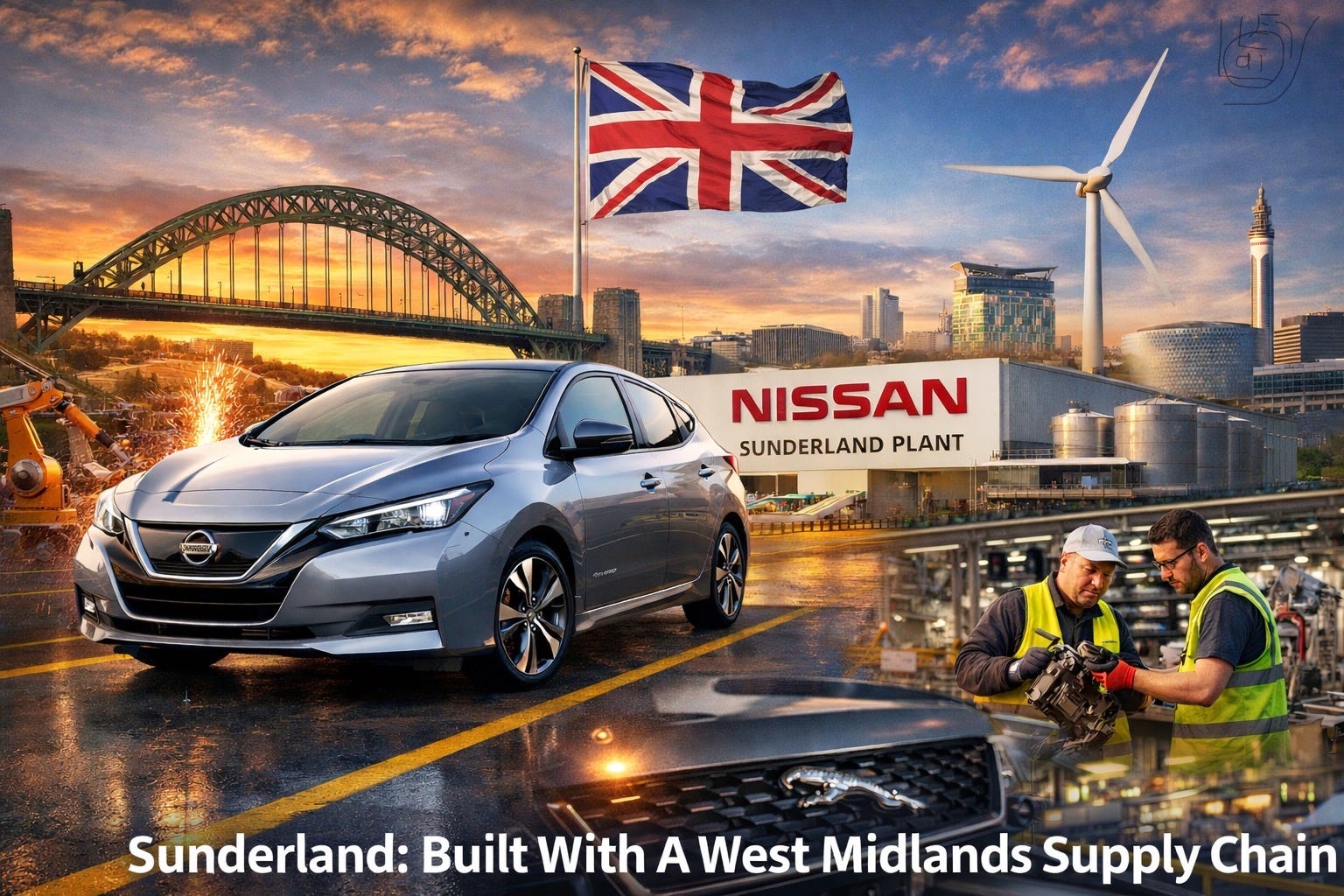
Every so often, the UK car industry gets a headline that does not read like an obituary. Nissan has begun production of the third generation LEAF at Sunderland, and it matters because it is not a concept car, not a promise, not a future plan wrapped in corporate fog. It is metal, batteries and workers, doing the job, on British soil.
This is the kind of moment you can feel in the supply chain, long before the public notices.
Professor Dave Bailey, Birmingham’s own and a leading academic at the University of Birmingham, has welcomed the news as a rare bit of relief for a battered UK car industry. He has been blunt about the forces squeezing the sector, from Trump era tariff shocks to the turbulence felt across UK manufacturing when Jaguar Land Rover went into shutdown. You do not need to be a political obsessive to grasp the knock on effect when the biggest players hit the brakes. The ripple travels fast and it travels straight into workshops, toolmakers and component firms that keep the Midlands moving.
What makes Bailey’s view land even harder is that it is not just academic positioning. Dave has owned three Nissan LEAFs himself. He knows what the car has meant in real life, not just in policy papers. I will add my own experience. I have also had a Nissan LEAF and then moved on to another British built electric vehicle. As an all round performer, I would give the LEAF a sturdy nine out of ten. It did almost everything well. The one weakness was range, but when I bought it, that was simply where EVs were. That is what they did then.
Now the numbers are different. The new LEAF is being sold on the promise of up to 386 miles of range on the larger 75 kWh battery option, and it qualifies for the full £3,750 Electric Car Grant. That combination is not decoration, it is mainstreaming. It is the shift from early adopter pride to everyday practicality.
There is scale here too. Sunderland is the UK’s largest car factory, employing around 6,000 people, and Nissan has put more than £450 million into getting this model into production, including over £300 million into its UK operations. The plant built more than 282,000 LEAFs across earlier generations, and it turned out 284,000 vehicles in 2024, even in a difficult market. This is a serious industrial platform, not a vanity project.
It is also not just about Nissan. Battery supply matters, and Sunderland has a nearby AESC gigafactory capacity coming through, strengthening that local ecosystem and making the UK offer feel more complete.
Now let us talk West Midlands, properly.
This is good news for us because supply chains do not respect regional boundaries. The West Midlands automotive network reaches far beyond the region and Sunderland’s success feeds work, contracts and confidence into the wider UK ecosystem. That is why this announcement should not be framed as North East good fortune alone. It is a national industrial pulse, and Birmingham, Coventry and the Black Country are part of that circulatory system.
There is even a practical policy hook for the region. Government has talked about new regional EV supply chain pilots in partnership with the North East and the West Midlands metro mayors. If those pilots become real tools rather than brochure language, they should be used to lock in Midlands capability, not leave it dangling on short term contracts.
Nissan has, frankly, fallen behind in recent years. Others have moved faster and the global EV race has not been kind to hesitant players. This is why Sunderland matters. It is an attempt to reclaim leadership through production, not through slogans.
So yes, in summary, this is a rare bit of good news, and it deserves to be said plainly. The UK car industry has been battered by tariff shocks and shutdown drama, and by a wider uncertainty about what, exactly, Britain wants to make and keep making. The third generation LEAF entering production is not the end of the story, but it is a strong new paragraph, and the West Midlands should read it as opportunity, not just somebody else’s headline.
I'm thinking of replacing my mini EV and may well go back to the Leaf - nice to hear your endorsement 👍
Great news story indeed. I've driven it, and the new Leaf is a big step forward. It's also already in the running for World Car of the Year 2026!