

A Week in Plain Sight: Power, Systems, and the Things That Actually Work
From quiet honours removals to a vote of no confidence in Birmingham, this was a week that revealed how Britain really functions, not in theory, but in practice.

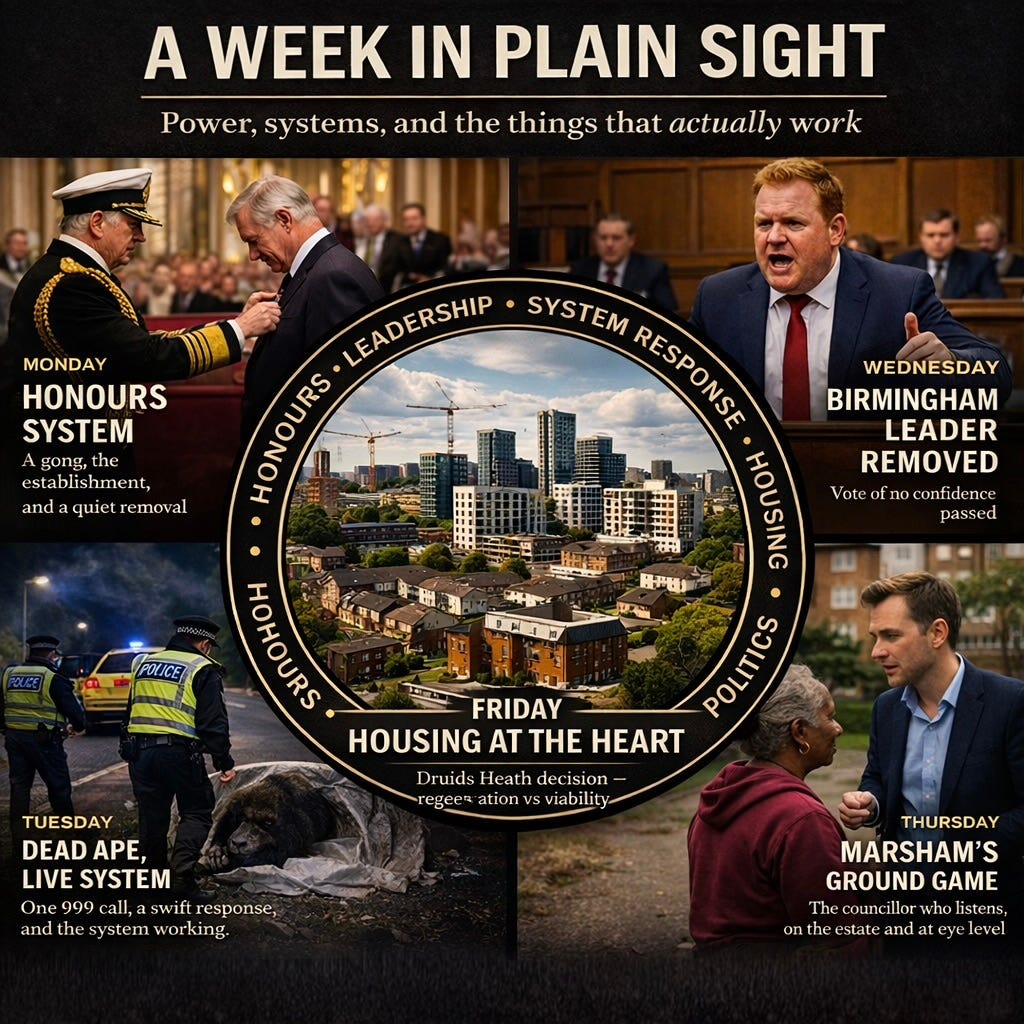
There are weeks in politics that feel like noise, where events crowd in on one another without forming any coherent picture. And then there are weeks like this one, where a pattern begins to emerge if you take the time to step back and look at it properly. Not a single defining headline, nor one moment that explains everything, but a series of developments that, taken together, reveal something more instructive about how systems actually operate.
The week began with the honours system, that longstanding mechanism of recognition which presents itself as calm, dignified and merit-based. That is certainly how it appears when honours are awarded, with ceremony and public attention. But when honours are removed, the process is altogether quieter. There is no comparable moment of visibility. Instead, the decision appears in the formal record, often unnoticed, handled with administrative finality rather than public explanation.
That contrast tells its own story. The system does not operate as a constant guardian of standards, intervening at the first sign of difficulty. Rather, it appears to function by threshold. Action is not taken when questions arise, nor even when concerns become widely known. It is taken when the position becomes settled, when the facts are no longer contestable, and when the cost of inaction outweighs the cost of intervention. It is, in that sense, a system that manages reputation as much as it recognises contribution.
Once that pattern is visible, it becomes easier to recognise elsewhere.
By midweek, attention turned to Birmingham, where events in the council chamber moved beyond the usual rhythms of local government. A vote of no confidence was passed in the council leader, an outcome that in itself is not unprecedented. What followed, however, was more revealing. Within hours, the public response suggested that nothing of consequence had changed, that leadership remained in place and the work of the council would continue uninterrupted.
The difficulty with that position is straightforward. Authority in a chamber is not sustained by assertion. It is sustained by confidence, and once that confidence has been lost in a formal vote, it does not reappear through messaging. The event exposed not simply an individual vulnerability, but a deeper structural issue about how leadership had been established and maintained. Where authority is shaped externally rather than secured internally, it may hold under normal conditions but becomes fragile when tested.
That moment, like the honours system earlier in the week, did not represent a sudden failure. It was the point at which an existing weakness became visible.
Set against this was something altogether smaller in scale, but no less instructive in what it revealed. A call to 999 to report what appeared, at least initially, to be a dead ape on the A5 is not the sort of situation most people expect to find themselves in. It sits precisely in that space where hesitation takes over, where the instinct is to question whether it is worth troubling the emergency services without absolute certainty.
What followed, however, was not irritation or dismissal, but a calm and measured response. The call was handled professionally, the information was taken seriously, and the situation was assessed in a structured way. The fact that the animal may ultimately have been something more ordinary does not diminish the response. If anything, it reinforces it. The system functioned as it should, recognising that uncertainty is often the very reason people make contact.
It is easy to overlook these moments because they lack drama. They do not generate headlines or sustained attention. Yet they represent a form of reliability that is essential to public trust. Systems are not judged only by how they respond to major crises, but by how they deal with the ambiguous, the unexpected, and the slightly unusual.
By Thursday, the focus shifted again, this time to a single councillor stepping down from his role. There was no controversy attached to the decision, no sense of departure under pressure. Instead, it was a measured choice, shaped by professional and personal considerations, taken at a point where continuing would have required compromise elsewhere.
Lee Marsham’s approach to local government reflects a strand of politics that rarely dominates public discussion. It is not performative, nor is it driven by the need for visibility. It is grounded in casework, in direct engagement with residents, and in the steady resolution of problems that rarely appear in strategic documents but define everyday experience. The example of a family rehoused after prolonged exposure to poor conditions is not an abstract policy success. It is the practical outcome of persistence within the system.
His decision to step back, while retaining a clear connection to public service, offers a contrast to more dramatic political narratives. It suggests an understanding of limits, and a willingness to leave a role without diminishing the work that has been done within it.
The week concluded with a return to a larger and more structural issue, that of housing and regeneration in Birmingham. With the publication of viability figures for schemes such as Druids Heath, the debate has moved beyond process and into substance. The numbers indicate a gap between projected costs and returns, alongside a reliance on market conditions to determine whether delivery proceeds.
This raises a more fundamental question about the model itself. The current approach places the council in the role of facilitator, assembling land and enabling development, while the private sector determines what is viable to build. There is nothing inherently flawed in that arrangement from a commercial perspective. Developers act according to profit, and where profit is uncertain, activity slows or stops.
The difficulty arises when this model becomes the primary mechanism for delivering housing that is not, by its nature, highly profitable. The tension between need and viability becomes more pronounced, and the outcome less certain. What is presented as a long-term strategy begins to resemble a dependency on conditions that are not within direct control.
Taken together, these developments do not point to a system that is uniformly failing. Nor do they suggest one that is functioning without strain. What they reveal is something more nuanced. Institutions operate within constraints. They adapt, they manage pressure, and they respond when required, though not always at the earliest opportunity.
Some elements continue to work with quiet consistency. Others show signs of fragility that only become apparent under scrutiny. The week has not been defined by a single failure or success, but by the exposure of how different parts of the system behave when tested.
That, ultimately, is what makes it instructive.
Because it shows Britain not as it is often described in broad terms, but as it operates in practice. Imperfect, occasionally strained, but still capable, in certain moments, of doing exactly what it is supposed to do.