

An Open Letter to Birmingham Labour Councillors - the weekend read
At some point, inconvenience becomes dysfunction. And dysfunction, when allowed to persist, becomes a political choice.

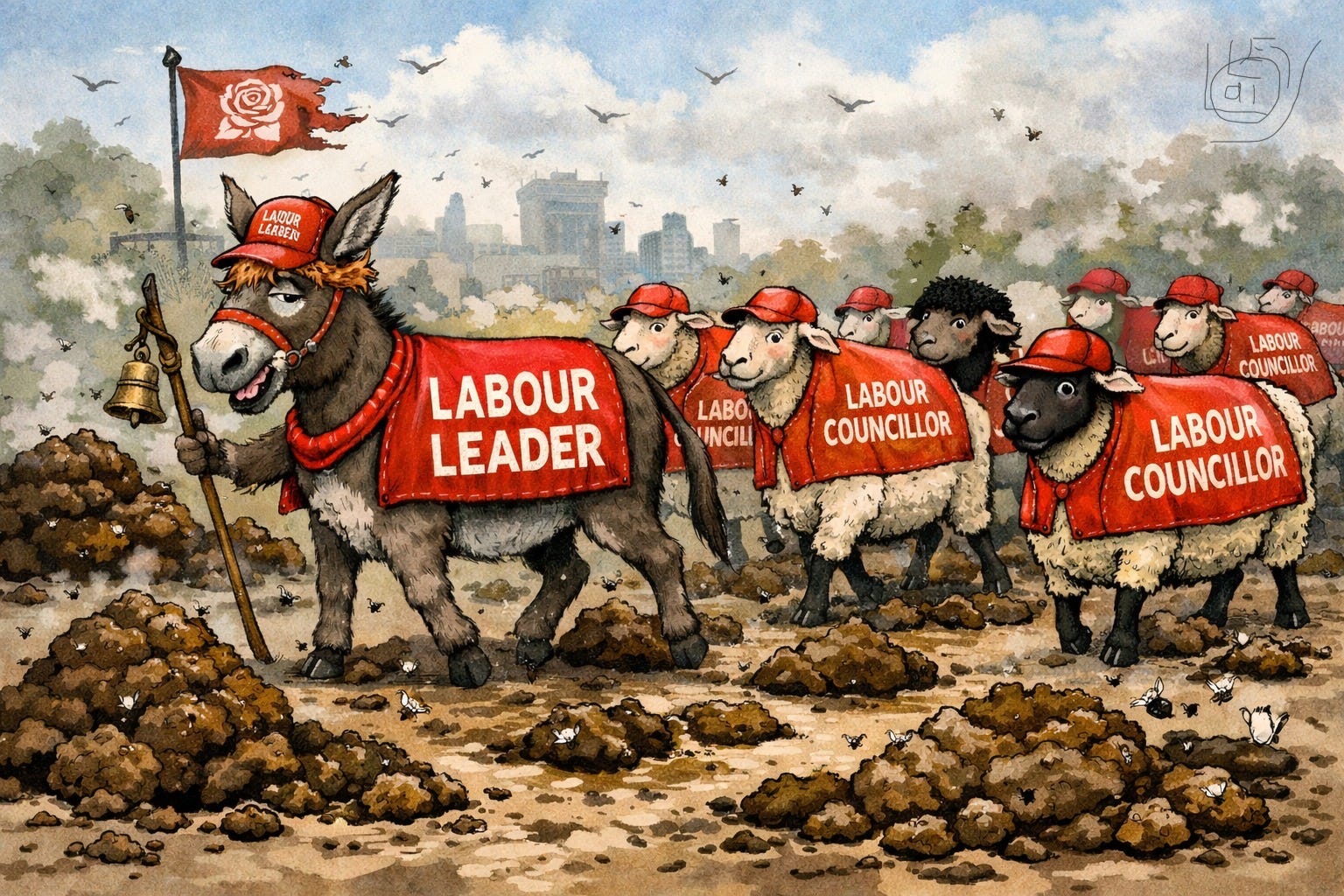
Twelve Months of Rubbish and a Wall of Silence
This is written as an open letter because, after more than a year, quiet conversations no longer feel adequate.
By any reasonable measure, Birmingham’s bin strike has gone on for far too long.
I am not talking about weeks. I am not talking about a difficult winter, a stalled negotiation, or a short-term crisis. I am talking about over twelve months of accumulated failure, visible on streets, alleyways, and driveways across the city.
My own bins tell part of the story. Recycled waste sitting untouched for more than a year. Garden waste still piled up, despite having paid for a subscription service that has not been delivered. There has been no proactive offer of a refund, no apology, and no clear explanation of when or if that service will resume.
I will not be alone. There will be tens of thousands of households across Birmingham in the same position, quietly adapting to something that would once have been considered unacceptable.
At some point, inconvenience becomes dysfunction. And dysfunction, when allowed to persist, becomes a political choice.
This is not about ideology. Refuse collection is not left-wing or right-wing. It is one of the most basic civic functions a council performs. Councils exist, at the most elemental level, to keep the city liveable. When they fail to do so for a year, something fundamental has broken.
The facts of the dispute are now well established. Hundreds of refuse workers have been on strike following proposals that would have cut pay by up to £8,000. The council has pursued effective fire-and-rehire tactics. And now the dispute has crossed a more serious line. Compulsory redundancies have taken place.
This matters. A strike is a dispute. Redundancy is an ending. People have been forced out of their jobs. Some, according to media reports, are late in their working lives and may never work again. That is not leverage. That is a human cost.
What I find most striking, however, is not simply the dispute or its length, but the total absence of public dissent from within the Labour group.
Not a single Labour councillor has publicly said that this has gone on too long. Not one has stood up, even cautiously, to question whether the handling of this dispute has been competent or humane. Not one has said, “Whatever the rights and wrongs, this cannot be allowed to drift for another year.”
When no one speaks, the public draws its own conclusions. The impression left is unavoidable: either Labour councillors support the way this dispute is being handled, or they are unwilling to challenge it. Both possibilities are deeply damaging. Silence is not neutral. In politics, silence is read as consent.
I understand party loyalty. I served as a Labour councillor myself and had a good record with the whip. I know how collective discipline works. But loyalty has limits. Loyalty does not mean backing something that is plainly failing simply because it comes from your own side.
When people get things this blatantly wrong and you support them anyway, that is not loyalty. It is collective denial.
What makes the silence harder to justify is that Labour councillors are not powerless spectators. Within the Labour group, councillors can raise issues. They can force discussion. They can table motions. They can put resolutions forward to oppose the handling of the bin strike or to show support for bin workers and their communities.
If such a motion were debated and lost, then collective responsibility applies. At that point, you keep your mouth shut and move on. That is how politics works.
But to the best of my understanding, none of that has happened. No resolutions. No recorded internal opposition. No visible attempt to challenge the course being taken. Just a year of silence while rubbish piles up and people lose their jobs.
It is difficult to believe that this is what Labour’s traditions were meant to produce. It is hard to imagine Keir Hardie looking at a year-long collapse of a basic public service, enforced redundancies of working people, and a political class saying nothing, and concluding that this was comradeship in action. Labour was founded to give working people a voice, not to mute it when things become uncomfortable.
There is also the matter of paid-for services. Residents have paid for garden waste collection that has not been delivered. The council knows it cannot simply retain subscription fees for a service it does not provide. The principle is not in dispute. Yet many residents have seen no proactive approach to refunds. That silence compounds the sense that inconvenience has been normalised and accountability deferred.
And hanging over all of this is the electoral reality. Polls are bleak for Labour. Many councillors are likely to lose their seats in May. Perhaps that explains the reluctance to speak. Perhaps silence feels safer when the ground is already shifting.
But silence is not a shield. It is a signal. When voters look at this dispute, they do not see nuance or internal party management. They see bins not being emptied, money taken for services not delivered, and a council apparently unable or unwilling to resolve a crisis. They also see Labour councillors saying nothing.
Unite has been unusually blunt about where this leads. In its communications to supporters, the union has made clear that councillors must end the dispute or be held accountable in May. It plans to contact every council candidate to sign a pledge of support, and if the dispute is not resolved it will make every effort to ensure residents are informed of candidates’ positions. This is not rhetorical flourish. It is electoral pressure, born of frustration that normal accountability has failed.
When a union feels compelled to turn a refuse dispute into an election issue simply to be heard, it tells you how far the system has drifted.
There is still time for one Labour councillor to lead. Not to grandstand, not to posture, but simply to say publicly that this has gone on too long, that silence has become damaging, and that working people and residents deserve better than drift.
If that happens, it should be welcomed. If it does not, then the silence of the past year will be read for what it is: a collective decision to let failure pass without challenge.
If any Birmingham Labour councillor believes I am wrong, about the facts, about the internal processes, or about what has or has not been attempted within the Labour group, I genuinely invite correction. Labour councillors do contact me when they think I am wrong. I welcome them doing so again.
Because if I am wrong, the city deserves to know.
And if I am not, then the silence speaks for itself.