

Balanced on Paper. Bankrupt in the Chamber
"Today’s adjournment is a damning indictment of Labour’s incompetence… This is not leadership – it’s chaos." Tory Leader,Councillor Robert Alden.

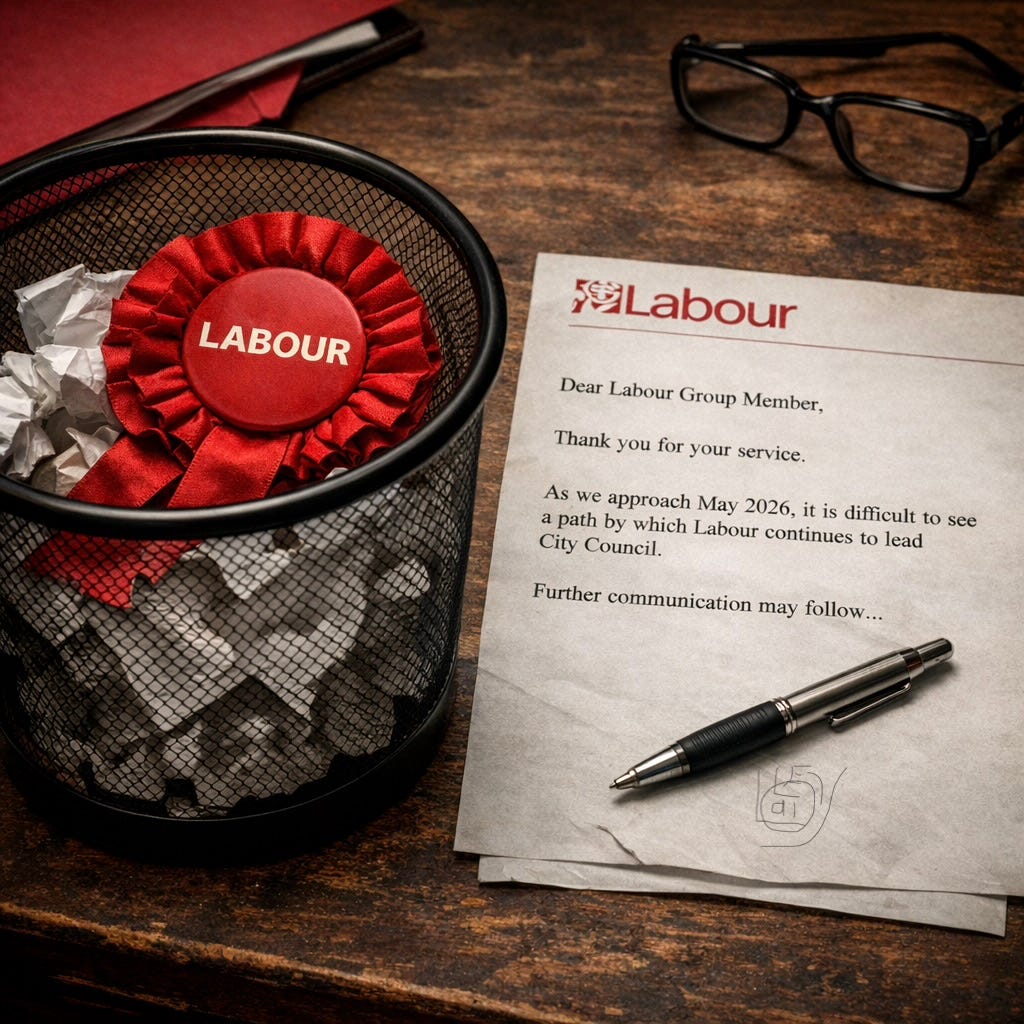
It was only weeks ago that Councillor John Cotton, Leader of the Labour Group and Leader of Birmingham City Council, began emphasising that Birmingham is no longer bankrupt.
The message was simple. The books are balanced. The emergency phase is over. Stability has returned.
And yet this week, the balanced budget did not pass.
It was adjourned.
Because Labour did not have the numbers.
Not defeated after a dramatic floor fight. Not derailed by a clever amendment. Simply withdrawn because the ruling group could not guarantee enough of its own councillors would vote for its own budget.
The Conservative with their helpful press release did not overcomplicate matters. Labour admitted it lacked the votes to pass its own proposals .
Councillor Robert Alden, Leader of the Conservative Group, put it plainly:
“Today’s adjournment is a damning indictment of Labour’s incompetence… This is not leadership – it’s chaos.”
Councillor Robert Alden is generally an upbeat presence in the chamber. Even so, it is hard to imagine him watching this particular spectacle without a private moment of enhanced satisfaction. A ruling group, still nominally in control, unable to pass the single most important vote of the municipal year.
Let us be precise. A delayed vote does not automatically mean the council is formally bankrupt again. Statutory processes exist and deadlines exist.
But politically, the symbolism is devastating.
Because while the council may no longer be financially bankrupt, the Labour group governing it increasingly looks politically bankrupt.
Twelve months ago or so, Labour controlled 65 of the 101 seats. It could pass what it liked. Discipline was assumed. Authority projected.
Today the group stands at 52, facing a combined opposition of 47.
Resignations. Defections. Deselections. Two deaths. Suspensions.
And in the background sits the role of regional Labour officials in the West Midlands, inserting themselves into selections and internal disputes in ways that hardened divisions rather than healed them.
Loyal councillors were driven out. Long-serving members were blocked from re-standing. Experience was treated as expendable.
For what?
Control. Internal dominance. Displays of authority that may have looked decisive in party meetings but now look catastrophically short-sighted in the council chamber.
The result is arithmetic. Cold, unforgiving arithmetic.
The group that once strutted through votes may soon be reduced to the thirties. Some suggest even into the twenties once elections and enforced departures finish their work.
And those elections are not some distant storm cloud.
The May 2026 local elections are only weeks away.
This is not abstract speculation. This is imminent exposure.
Councillor John Cotton, Leader of the Labour Group and Leader of Birmingham City Council, has staked much on the narrative of recovery. Yet recovery requires more than spreadsheets. It requires cohesion, authority, and confidence.
What we saw this week was none of those things.
We saw a headcount. We saw uncertainty. We saw a tactical adjournment because the votes were not there.
What would a stable majority do after such an embarrassment?
It would regroup. It would approach wavering councillors and attempt reassurance. It would reassert discipline and try to make the next vote safe.
But here is the structural problem.
Labour’s difficulty is not simply rebellious councillors. It is that the party brand itself is under strain. Nationally and locally, the mood is unsettled. If you are a political activist choosing where to invest your time, is Birmingham Labour the obvious home right now?
Or does it look like a shrinking platform with diminishing leverage?
And how does Councillor John Cotton persuade members who would not vote for yesterday’s budget to vote for the next one?
What does he offer?
Future advancement in a group that may soon halve in size?
Security in seats that face imminent electoral testing?
Influence in a structure where regional officials have already shown they are prepared to override local judgement?
You cannot threaten irrelevance when irrelevance is already stalking the corridor.
You cannot promise long-term security when the short-term arithmetic is failing.
This is what political bankruptcy looks like.
Not empty coffers.
Empty authority.
A majority that exists on paper but not in practice.
A leadership operating on an overdraft of credibility, and when that overdraft, as large as Councillor John Cotton’s now appears to be, keeps expanding, the bank eventually calls time.
Balanced spreadsheets do not compensate for fractured trust.
Financial recovery does not equal political solvency.
And when the flagship vote has to be pulled because the governing party cannot rely on itself, the phrase “no longer bankrupt” begins to sound like a slogan shouted into an empty room.
Birmingham may have stabilised its accounts.
But the Labour group running the council is visibly, unmistakably bankrupt in political capital.
Unless the numbers return quickly, that bankruptcy will not be debated, it will be confirmed.
Because in politics, confidence is everything.
And once confidence goes, collapse follows.