


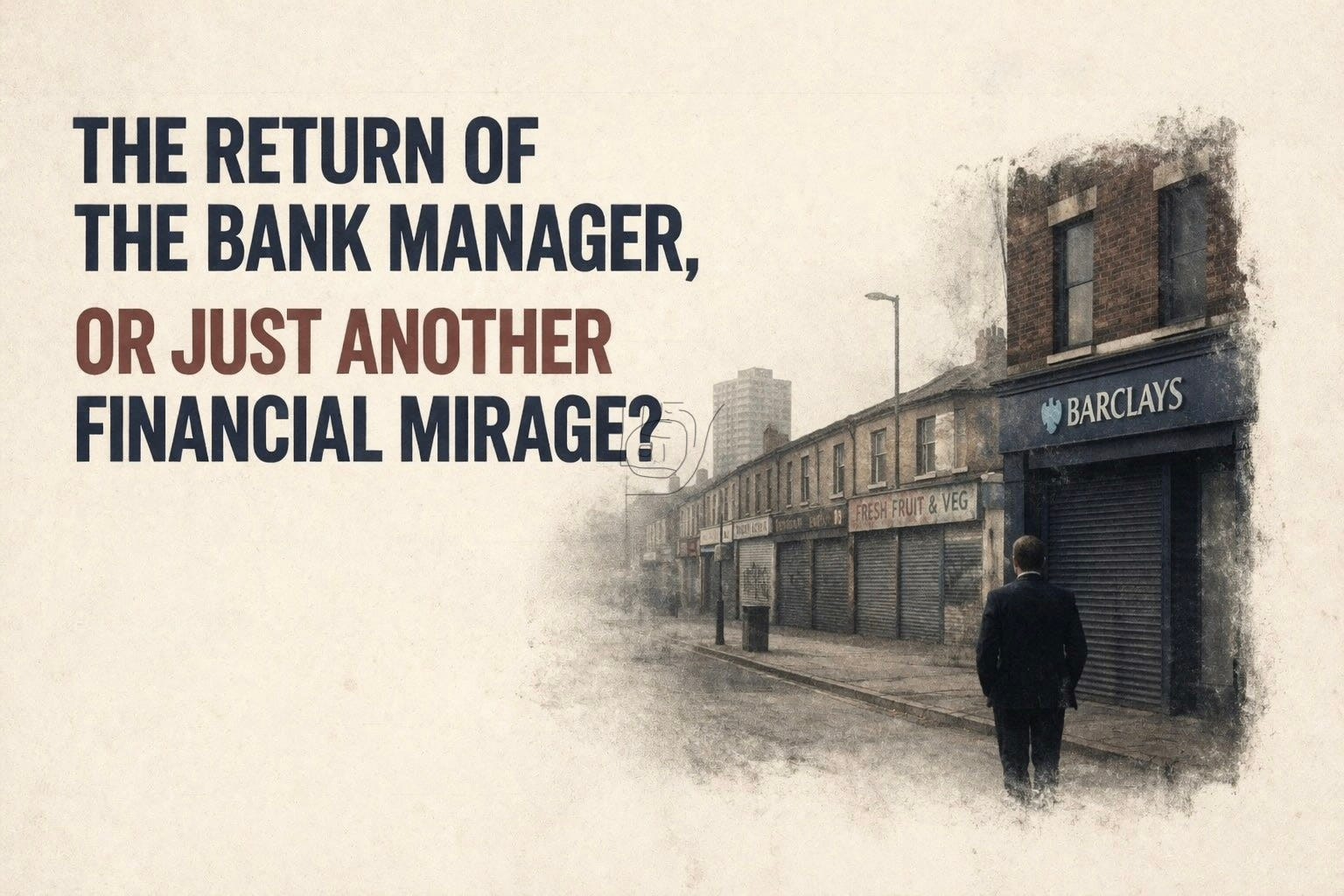
Human Where It Matters, But Who Decides What Matters?
Walk down Harborne High Street and you can still see what banking used to look like. Solid frontage. Recognisable names. The sense, however faint now, that money was not just processed there, but understood.
Drive out to Alum Rock and the picture changes. Units shuttered. Services thinned out. Banking, where it exists at all, is functional, fragmented, often displaced into the Post Office or pushed onto a phone screen.
That contrast is not accidental. It is the result of a decade of decisions, taken in boardrooms far removed from both places, in which the UK banking sector convinced itself that it could become something else entirely.
Birmingham is not just an example of this shift. It is a preview of it.
Few cities compress so many different banking realities into such a tight geography. Within a short drive, you move from high-income, asset-rich neighbourhoods to areas where cash is still dominant, where small businesses operate on thin margins, and where access to financial services is not an abstraction, but a daily concern. It also remains, quietly, an SME city. Traders, independents, workshops, service firms, the economic fabric is not just corporate, it is granular, and that matters because SMEs do not always fit neatly into automated lending models. They rely, or used to rely, on relationships, on someone who understood the business, the street, the context. That is precisely the space the traditional banks vacated, and the challengers never fully entered.
Barclays’ recent signalling, talk of pausing closures, expanding branches, reintroducing bank managers, should be read against that backdrop. Not as a bold new strategy, but as a quiet acknowledgement that the last one did not quite work.
For years, the industry pursued a single idea with near total confidence. Close the branches. Cut the staff. Push customers online. Reduce cost. Increase efficiency. It was presented as modernisation, as inevitability, as progress.
And then along came the challengers.
Monzo. Revolut. Wise. They did not dismantle the old system, they simply ignored it. No branches. No legacy. No cumbersome infrastructure. They focused on the easy parts of banking, payments, transfers, budgeting, foreign exchange, and they did them well. Fast, clean, intuitive. The appeal was obvious, a well-designed app, instant notifications, low fees, and the occasional perk, a neatly packaged offer, even the promise of something as trivial and effective as a free monthly coffee. In doing so, they exposed just how clunky the traditional banks had become.
But there was always a quiet truth beneath that success. The challengers did not reinvent banking, they cherry-picked it. They built their models around the simplest, most scalable, most profitable elements of the system. They avoided the complexity, mortgages, business lending, restructuring, the messy, human, judgement-heavy parts of finance. The parts that require conversation, discretion, and often accountability.
Traditional banks, for all their faults, never had that luxury. They carried the full weight of the system. The pensioner who wants to sit down and talk. The small business on the edge of viability. The mortgage that does not quite fit the algorithm. The customer whose life does not reduce neatly to a data point. That weight made them slower, less flexible, often frustrating, but it also made them complete.
There is also a timing dimension to this that is only now becoming clear.
Challenger banks tend to win customers early in their financial lives. The first account, the travel card, the budgeting app, clean interfaces for relatively simple needs. But customers do not stay simple. They age. They accumulate assets. They inherit money. They get divorced. They start businesses. They encounter complexity not as an exception, but as a normal part of life.
And at that point, the model begins to strain.
Automated systems that work perfectly for simple transactions become rigid when faced with edge cases. Customer service, optimised for scale, becomes impersonal under pressure. The absence of physical presence, once a cost advantage, becomes a barrier when reassurance is required. What challengers describe as “complex needs” are, in reality, simply normal banking needs at a later stage of life.
This is the gap Barclays is now trying to step back into. Not because it has rediscovered a moral commitment to community banking, but because it recognises a commercial opportunity. The challengers have captured the entry point. The traditional banks can still compete for the journey beyond it.
The competitive shock from the challengers forced a response, and that response now looks increasingly crude. Cost cutting became the weapon of choice. Branches closed at scale. Staff numbers reduced. Local knowledge stripped out. Decision-making centralised. Call centres expanded, often far removed from the communities they served. The logic was simple, if challengers can operate cheaply, so must we.
But banking is not just a cost equation.
What was removed in that process was not just overhead, it was trust. When something goes wrong, and in banking something always does, a chatbot does not resolve it. A call centre operative, reading from a script somewhere in the world, does not reassure. What customers reach for in those moments is not efficiency, but accountability, a person, a name, a place they can go.
That is what the industry forgot, and now, quietly, it is remembering.
The return of the bank manager is not about nostalgia. It is about reintroducing a point of trust into a system that has become too abstract. The individual who knows the area, understands the customer, and has at least some discretion to act.
This is not a return to the past. There will be no widespread reopening of branches in the manner of the 1980s or 1990s. The economics simply do not support it. What Barclays is signalling is something more selective, more controlled, and ultimately more revealing.
“Digital where it works. Human where it matters” sounds balanced, even reasonable, but in practice it raises a harder question about who decides where it matters. If you map that principle onto Birmingham, the answer becomes clearer. Harborne gets the manager. Solihull gets the advisory suite. Sutton Coldfield gets the relationship banker. Alum Rock gets access.
Not because it does not matter in any human sense. If anything, the need is often greater. More cash reliance. More vulnerability. More dependence on face-to-face support. But because, in banking terms, it does not generate enough return.
That is the distinction that sits just beneath the language. It is not that communities like Alum Rock do not matter. It is that they do not matter commercially in the same way. Banking, for all its talk of service and trust, is still a commercial system, and so “human where it matters” becomes, in practice, human where the margins justify it. Everywhere else, the system adapts, hubs, shared spaces, digital nudges, functional access in place of relationship.
It can all be presented as progress, as modernisation, as inclusion, but strip the language back and the logic is older and simpler. Service follows money, and where the money is thinner, so too is the service.
There are risks in this recalibration. Trust, once lost, is not easily regained. Communities that have seen their branches disappear may not be persuaded by a selective return elsewhere. The reintroduction of bank managers will only matter if those individuals are given real authority, not simply rebranded roles within a still centralised system. The economics remain unforgiving, and if these branches do not deliver returns, they will not last.
What emerges from all of this is not a return, but a rebalancing. The challengers exposed the inefficiencies of the old system, but are now encountering the limits of their own simplicity. The traditional banks cut too far in response, and are now attempting a partial reconstruction.
In Birmingham, as elsewhere, the banker may return. Suited, named, visible. But not to every street, not to every community, and not for every customer. Beneath the language of access and innovation, the underlying principle remains unchanged.
Banking follows value.
And value, as ever, is unevenly distributed.