


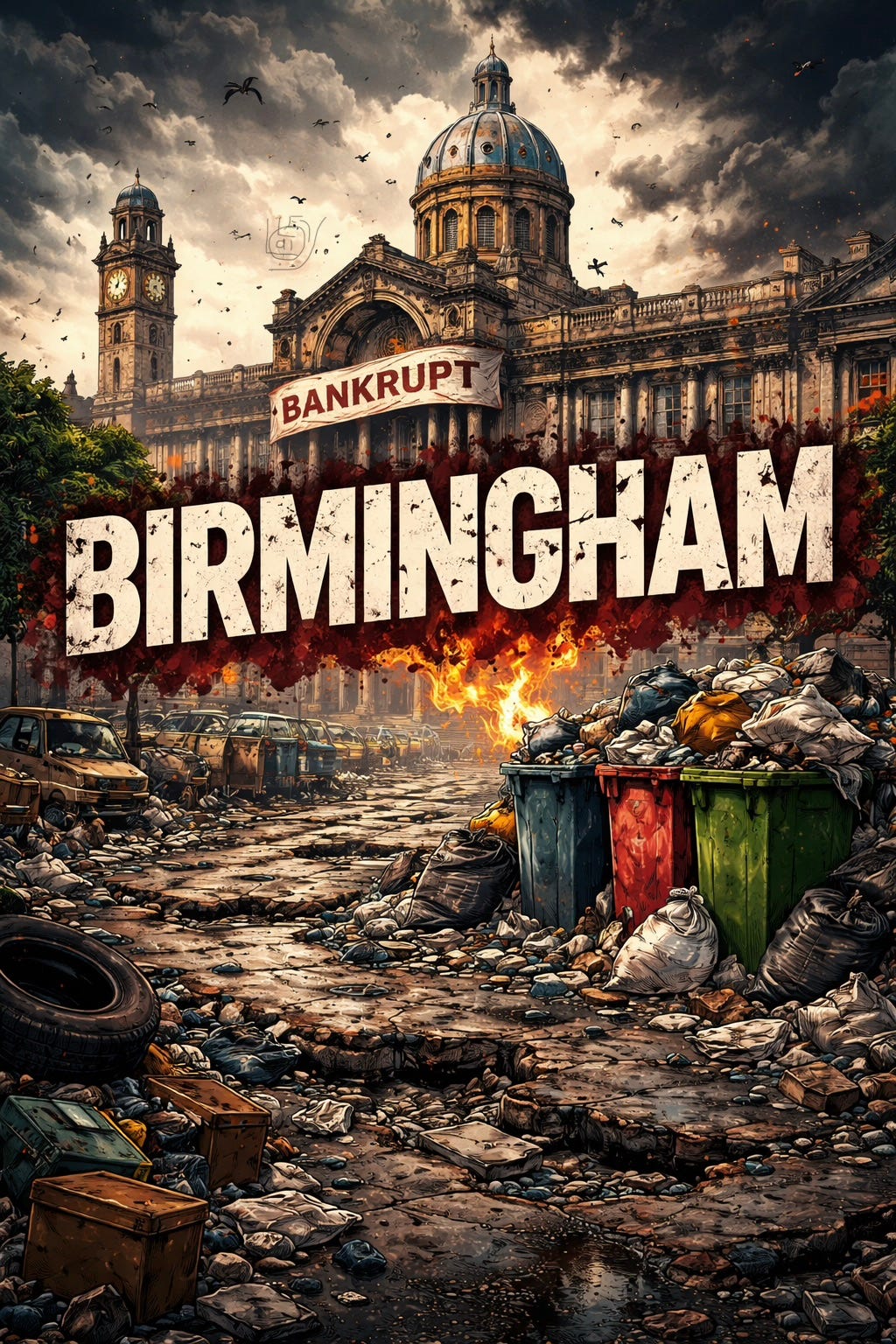
There are moments in civic life when the argument itself becomes part of the problem. This feels like one of them.
This week, Birmingham City Council published its latest budget papers, accompanied by a declaration from its Leader, Labours Councillor John Cotton, that the council is “no longer bankrupt”. Within hours, the Liberal Democrats fired back, accusing Labour of audacity, denial and cheap self-congratulation. Their leader, Councillor Roger Harmer, described the claim as “beyond shocking”, arguing that a council simply managing not to declare bankruptcy is hardly a triumph.
On one level, this is familiar territory. Political parties trading blows, press releases doing what press releases do, and truth squeezed into neat, partisan shapes. But step back for a moment, and a more uncomfortable question hangs in the air.
How did one of Britain’s great cities end up here at all?
Whether Birmingham is technically bankrupt, recently bankrupt, no longer bankrupt, or never quite bankrupt in the strictest accounting sense feels almost beside the point. The fact that this debate can even be had, let alone spun as a victory or a weapon, is a crying shame.
This is Birmingham. A city that powered the industrial revolution, that reinvented itself after war and decline, that still carries extraordinary economic, cultural and human weight. And yet here we are, reduced to an argument about whether a Section 114 notice still applies, while bins go uncollected, roads crumble under tyres, fly-tipping scars neighbourhoods, and council tax rises year after year.
The Council Leader’s claim rests on a narrow, technical truth. The immediate budget gap has been closed. The equal pay liability has been partially addressed. The emergency financial brake has been eased. On paper, the council can function.
But paper is not pavement.
Government commissioners remain embedded until at least 2028, a quiet but unmistakable signal that Birmingham is not, in any meaningful sense, back in the mainstream of local government. Major systems remain unreliable. Regeneration schemes have haemorrhaged money. Industrial relations have collapsed into a bin strike now entering its second year. Residents experience the city not through balance sheets, but through missed collections, potholes, delays, and a grinding sense of decline.
There is also something deeply troubling in the tone of the declaration itself. One cannot escape the sense that this is the best Labour’s leadership in Birmingham now feels able to offer, revelling, however unintentionally, in the detritus of the gutter and proclaiming with satisfaction that the city council is “no longer bankrupt”. Frankly, and bitterly, it sounds less like renewal than resignation. Less like leadership than survival.
Now let me be clear about this, because it matters. John Cotton is a decent man. A caring man. A thoughtful man. I am saying that plainly. He is not naïve, nor is he foolish. He must know that Labour’s chances of retaining control of the council in thirteen weeks’ time are, to put it politely, unencouraging. Indeed, while I wish him well personally, his own prospects of remaining a councillor beyond that point are limited. It is hard to avoid the conclusion that somewhere, quietly and privately, he may already have absorbed that reality.
If so, the explanation may lie less in personal failure than in structural humiliation. Cotton was not so much elected into authority as installed into crisis, shaped by a regional Labour apparatus that effectively appointed him, and constrained from the outset by government commissioners who now exercise the real power. The budget is not truly Birmingham’s. The room for manoeuvre is narrow. Decisions of consequence are shaped elsewhere, often in Westminster, leaving the Leader of the Council exposed as little more than a cork on the ocean, bobbing at the will of forces he cannot control.
That is not leadership as most people understand it. It is containment.
In that context, the declaration that Birmingham is “no longer bankrupt” begins to look less like triumph and more like an unguarded moment, a small technical victory clutched too tightly because there are so few left to claim. If that is the case, we may well see more such moments in the weeks ahead. Narrow truths elevated into headlines. Language that speaks not of ambition or renewal, but of endurance. As the end of the road draws closer, the cracks are likely to show.
And this is where the argument turns sour.
Councillor Harmer is right on one point, and it deserves to be said without the surrounding party theatre. “Having a council not declare bankruptcy is the bare minimum.” Not declaring bankruptcy is not a renaissance. It is not a civic revival. It is the minimum standard of competence.
Yet there is also something hollow in the opposition’s fury. Calling Birmingham “bankrupt” again and again may land blows on Labour, but it also keeps the city itself pinned to the floor. The phrase has become a brand, a joke in national media, a shorthand for dysfunction. Each repetition deepens the reputational damage, making recovery harder, not easier.
At a mischievous level, “Bham Bankrupt” is political theatre. At a serious level, it is an indictment of a system that allowed the country’s second city to drift into financial chaos without intervention until the moment of collapse. Years of mismanagement, yes. But also years of structural underfunding, short-term fixes, and central government indifference to the cumulative strain placed on large urban authorities.
No single leader created this crisis. No single budget will resolve it. What is truly disingenuous is not claiming improvement or criticising failure, but pretending that either side has yet articulated a vision equal to the scale of the damage done.
The real legacy of the last decade is not whether a budget line balances this year. It is the erosion of trust between the council and the people it serves. That trust will not be rebuilt by arguing over labels. It will be rebuilt when residents can once again rely on basic services, see pride restored to their streets, and feel that the city is being led with competence rather than bravado.
So no, this is not really about bankruptcy. It is about dignity.
The disgrace is not that Birmingham was exposed to financial failure. Cities, like people, stumble. The disgrace is that we now seem more comfortable arguing about whether the stumble counts than confronting how far we fell, and how much harder it will be to stand tall again.
Thank you for the thoughtful comment - it does make you wonder "are they just running around in circles" being busy doing - not much ...!!