

Birmingham Didn’t Turn Green. It Broke Apart.
A record Green surge tells one story. The numbers underneath tell a very different one.

There is a temptation, in the aftermath of any election, to reach for a simple headline. Birmingham has turned Green. It sounds neat. It sounds decisive. It suggests a city moving in one direction with clarity and purpose. It gives commentators something clean to hold onto.
But it isn’t true.
What Birmingham has actually done is something far more interesting, and far more unstable. It has fractured. The old political map has cracked open, and into those gaps has stepped the Green Party of England and Wales, faster and more effectively than anyone else. They look set to be the main group in running the council.
Nineteen councillors. Nearly 93,000 votes. The highest vote total across the city. On paper, that reads like a surge, even a takeover. But when you slow down and look at how those votes are distributed, a very different picture emerges.
Labour has not simply lost control of Birmingham City Council. It has lost its grip on the coalition that once held Birmingham together. Communities that once voted as a bloc are now splitting apart, each responding to different pressures, different priorities, and different frustrations. The Greens have picked up a large share of that fragmentation. Reform has picked up another. Independents are quietly gathering what remains.
That is the real story of this election. Not a wave. A break.
The Result That Shouldn’t Have Happened
Take Druids Heath & Monyhull. On demographics alone, this was not supposed to be comfortable ground for the Greens. In a year when Reform UK has been advancing strongly in similar communities, the expectation would have been a tight contest, perhaps even a loss.
Instead, Cllr Julien Pritchard, Leader of the Green Group, holds the seat with 64% of the vote. Yes, that is down from his previous share. Yes, Reform come through into second place. But the core fact remains unchanged. He wins, and he wins convincingly.
That is not a party story. That is a councillor story.
Because when wider political currents are moving against you, and you still produce a result like that, it is rarely about branding or national momentum. It is about the harder, slower work. Visibility. Casework. Trust built over time. Being known locally as the person who shows up and gets things done.
“Human dynamo” is not exaggeration. It is probably the most accurate way of explaining what happened there. Julian that is, is a human dynamo.
In an election defined by volatility, this was something much rarer. A result that looked earned.
What Happened Next Door Matters
And if you want to understand just how unusual that result may be, you only need to step just beyond Birmingham’s boundary.
In neighbouring Solihull Metropolitan Borough Council, particularly in areas such as Chelmsley Wood and Smith’s Wood, the pattern went in the opposite direction. There, Reform surged hard and decisively. In Chelmsley Wood, they swept all three seats. Across the northern Solihull estates, similar communities facing similar pressures, the political tide flowed firmly in their direction.
That matters because the comparison is not abstract. These are areas that share many of the same characteristics as Druids Heath. Working-class estates. Economic strain. Long-standing dissatisfaction with how services are delivered.
Yet while those areas tipped toward Reform, Druids Heath did not.
Which leads to an unavoidable conclusion. This was not simply a Green hold. It was a result shaped heavily by the presence of a very strong local councillor, someone who was able to override a broader political trend that, in similar areas, ran the other way.
A Surge, But Not All the Same Surge
Elsewhere across Birmingham, the Green advance takes on very different forms, and it is important not to treat them as one single phenomenon.
In Handsworth, the numbers jump from 95 votes to 958. In Balsall Heath West, from 121 to 934. In Ladywood, a similar pattern repeats itself. These are not slow, organic rises. They are sharp jumps, created in large part by Labour’s vote falling away and leaving space behind it.
These are real wins, and they should not be dismissed. But they are also fragile, because they are built as much on the absence of a dominant rival as they are on deep-rooted support.
Then you move into a very different set of wards altogether. Bournbrook & Selly Park at 65%. Brandwood & Kings Heath at 42%. Hall Green North at 43%. These figures suggest something more stable, a coalition of students, younger professionals, and disillusioned Labour voters finding a new political home.
This is where the Greens should feel most secure. This vote looks deeper, more values-driven, and therefore more likely to endure.
And then there is a third category, one that matters just as much but is often overlooked. Bordesley & Highgate at 25%. Tyseley & Hay Mills at 21%. Bournville & Cotteridge at 31%. Harborne, where the Greens take a seat but do not top the poll.
These are fragmented victories. Wins that come not from commanding support, but from divided opposition. In a different electoral cycle, they could easily reverse.
Put together, the picture becomes clear. This is not one Green surge. It is three very different types of gain happening at the same time.
The Wins No One Expected
There is also a quieter reality behind these results, one that rarely makes it into official statements.
Not every victory was anticipated.
There are already murmurs that in at least a couple of wards, successful Green candidates entered the race as little more than paper candidates. Names on a ballot. A presence rather than a serious expectation of victory.
And then they won.
That is not a criticism. It is a reflection of how fluid and unpredictable Birmingham’s electorate has become. But it does change the nature of what follows.
Because once elected, expectation arrives immediately, whether it was planned for or not. Constituents do not distinguish between a long-prepared councillor and someone who found themselves carried in on a wave.
If that is the case, it would be a genuine loss to the city were any to step away. Public office is not a placeholder. It is a responsibility. Those now in the chamber have been given the chance to serve both their cause and their communities.
It is an opportunity that should not be lightly set aside.
The Politics of “Collaboration”
Into this landscape comes the Green Group’s call for cooperation, led by Cllr Julien Pritchard. It is a message built around hope, inclusion, and working together across party lines to move the city forward. On the surface, it is exactly what a council with no overall control needs to hear.
But politics is rarely tested in press releases. It is tested in reality, usually in a committee room, with numbers on a sheet and votes to be counted.
So it is worth asking, gently, what collaboration actually means in practice.
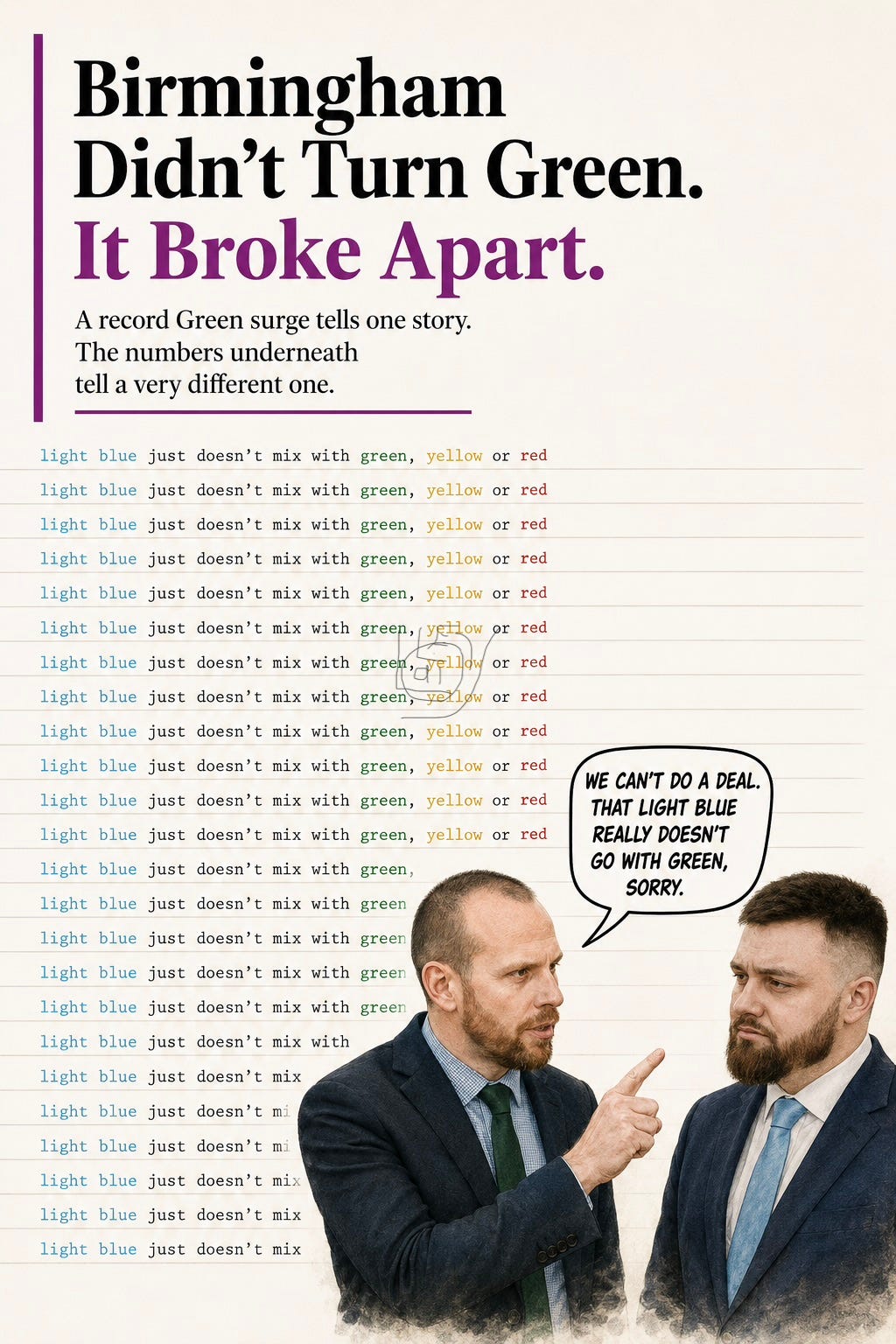
Imagine, for a moment, that Cllr Jex Parkin, leader of the local Reform UK group, were to turn up and say, perfectly reasonably, “We’ve read your priorities. Fair deal on bins. Safer streets. Cleaner air. Protecting services. We can work with that.”
You can almost hear the pause.
“Yes, all very encouraging,” comes the polite reply. “But not quite that kind of collaboration. Your see that light blue really doesn’t go with Green, sorry.”
It is, of course, a slightly absurd picture. But only slightly.
Because for all the language of openness, there is, in practice, a fairly hard political line between the Greens and Reform. That is not unusual. It is politics. But it does mean that “working with others” has limits, even if those limits are not spelled out in the opening statement.
And it is those limits, not the wording of the press release, that will shape what happens next.
Growth Brings Questions
There is also a deeper issue that sits beneath the surface of this success.
A party that grows from two councillors to nineteen in a single election does not simply expand. It changes.
The Green Party of England and Wales is no longer a small, tightly aligned group. It is becoming a broader political coalition, and with that comes diversity of outlook.
Different motivations. Different priorities. Different perspectives on social and cultural issues.
The party’s public stance is clear in its emphasis on inclusion and equality. But as the group grows rapidly, the question becomes one of consistency. How uniformly are those values held across a much larger intake of councillors?
That is not a criticism. It is a reality that every fast-growing party eventually has to confront.
And it will be tested here, in Birmingham.
The Pritchard Test
Which brings everything back to Cllr Julien Pritchard.
Re-elected as Group Leader. Indeed, likely to be the next Leader of the Council. Now leading a group that has expanded faster than almost anyone expected.
His track record suggests someone capable of holding ground through effort and local connection. But the challenge ahead is different. It is no longer about one ward. It is about shaping and holding together an entire group.
It is about turning momentum into stability. About defining what collaboration really means when decisions have to be made. About ensuring that rapid growth does not come at the expense of coherence.
From two councillors to nineteen is not just success.
It is a transition.
A City Up for Grabs
Birmingham has not turned Green.
It has broken into pieces, politically, socially, electorally.
And the Greens, for now, are the most organised force stepping into those spaces.
But they are not alone. Reform is rising. Independents are gaining ground. Labour, though weakened, is still present.
This is a competitive city again. A plural city. A city where outcomes are no longer predictable.
For voters, that may prove healthy.
For those now elected, it is both an opportunity and a test.
Best of luck to Cllr Pritchard, and to every group leader now taking their place in that chamber.
Go and build the city.
As my late Mother, born in a different age before the Great War, said about clothing “blue and green should not be seen… brown should never be worn in town”… the refusal to engage with Reform will cost the left dear… people who voted Reform will never forgive the moral superiority of the left… but it begs the question why does the left think that their values and ONLY their values are morally right? It is indeed perverse that the left today ground their morality on individual autonomy, be it trans rights, immigrant rights, abortion, euthanasia, etc. the very principle that the left historically found abhorrent. I know that Thatcher never said “ there is no such thing as society” but it is very curious that the left today extol that moral view in their ethical compass. It is not simply that they despise those on the right so much that they will not engage with them, it is that they base their morality on the right of the individual to be and do whatever she or he wants and anyone who extols social traditions, the traditional moral mores of a society, is the enemy. In the end that vision of individual autonomy and the concurrent rejection of social norms has caused many of the problem of fragmentation today. The classics professor turned politician Enoch Powell, much vilified by the left today but friend of many of the old left back in the 50s and 60s, saw this coming. He compared the decline of the Roman Empire, its fragmentation, the rejection of traditional values by the young, its reliance on foreign cheap labour to fill jobs that they young think beneath them, etc., to the decline of the British Empire. And he lamented. It has come to pass… but few on the new left do not see their values are grounded in anti-social individualism.
Think I agree on best of luck to Councillor Pritchard, all things considered!