

Birmingham Has Sacked Labour. Now It Has To Find A Government
Labour has fallen, Reform cannot govern, and Birmingham now faces the hardest question of all: who can assemble a coalition capable of actually running the city?

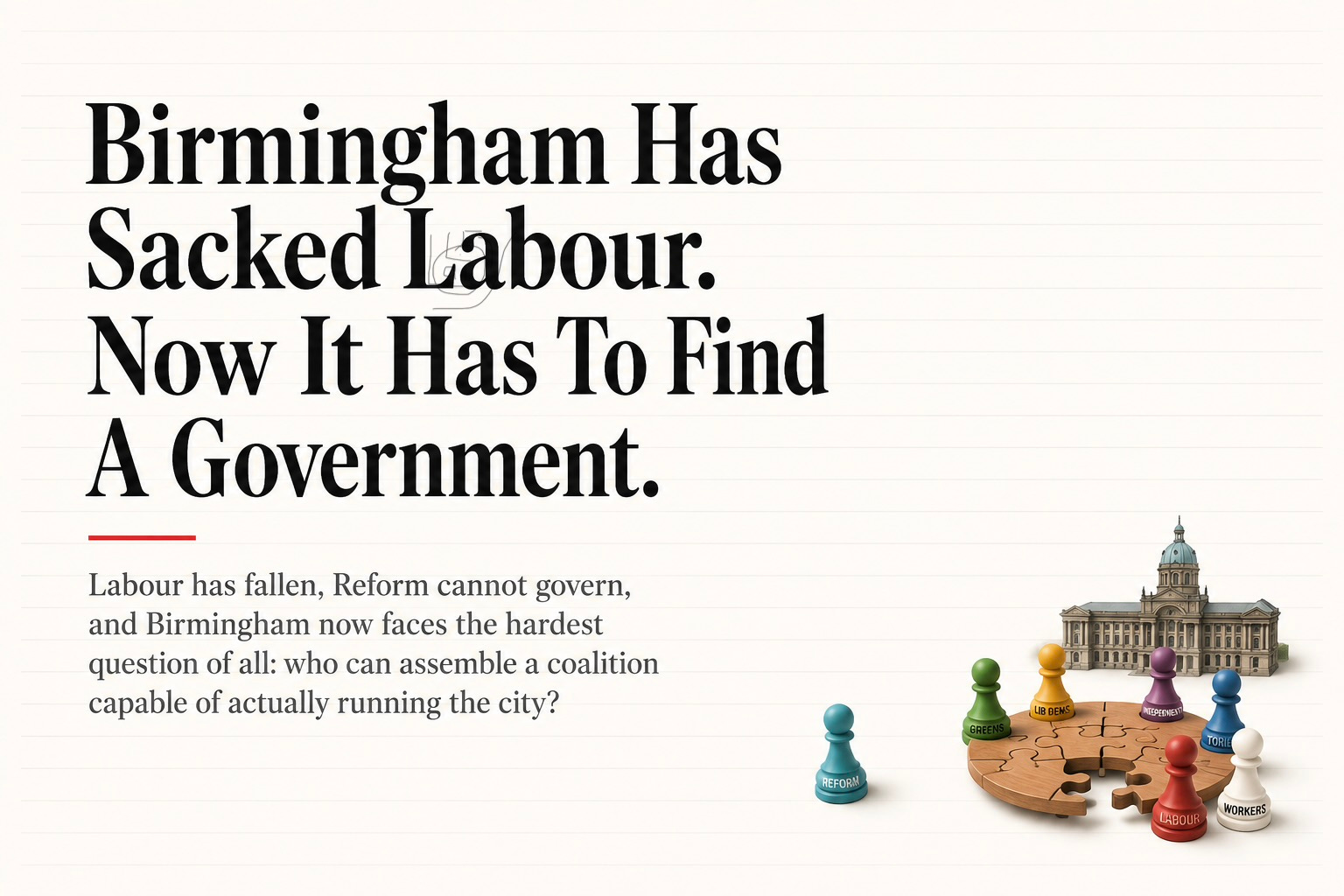
Birmingham has done the easy part. It has thrown Labour out.
The harder part begins now. Who actually runs the city?
After fourteen years of Labour control, Birmingham City Council has fallen into no overall control. Reform UK emerged as the largest group, the Greens surged, Labour collapsed into a battered rump, the Conservatives survived well enough to remain relevant, the Liberal Democrats retained influence beyond their numbers, and independents suddenly became one of the most important forces in the chamber.
This is no longer a council with a governing party and an opposition. It is now a political marketplace where everybody holds a few pieces of the puzzle but nobody possesses the complete picture. Birmingham has not elected a government. It has elected a negotiation.
The arithmetic is unforgiving. With 101 councillors, 51 are needed for outright control. Reform may have emerged as the largest group, but even they quickly accepted reality. Their Birmingham leadership has already acknowledged there is no obvious route to forming an administration because the other parties simply will not combine with them in sufficient numbers. Winning the loudest cheer in the room is not the same as controlling the room.
That leaves Birmingham facing a strange and uncertain moment. The city has clearly rejected Labour’s leadership, but it has not yet decided what replaces it.
And Labour’s collapse is impossible to overstate.
For fourteen years Labour governed Birmingham during one of the most catastrophic periods in the city’s modern history. Bankruptcy. Equal pay failures. Endless service reductions. The bin strike. Spiralling dysfunction. Residents increasingly feeling that nobody was truly in charge. Fairly or unfairly, many Brummies came to believe that elected councillors had gradually surrendered control of the city to officers, commissioners and managerial bureaucracy who then proceeded to drive Birmingham into the wall at considerable speed.
The election result reflects that anger.
Labour now finds itself reduced to a shadow of its former municipal empire. Spirit inside the group is said to be low. In truth, that would hardly be surprising. The party that once utterly dominated Birmingham politics is now merely another faction sitting around the table.
Yet Labour’s immediate focus appears not to be rebuilding Birmingham so much as rebuilding itself. Attention is already turning towards who becomes the next Labour group leader and deputy leader. Among the names circulating are Marcus Bernasconi, Majid Mahmood and Nicky Brennan, who held her seat by only three votes.
But even this internal contest raises a larger question about the modern Labour Party itself.
In recent years Birmingham Labour councillors have become increasingly accustomed to leadership arrangements heavily influenced, managed or at least guided by the wider Labour apparatus. The old days of councillors independently gathering in smoky rooms and choosing their own leaders now feel rather distant. Whether Labour councillors will freely elect their leadership immediately, or whether they effectively await signals from regional party structures before matters settle, remains unclear. That uncertainty says much about the condition of Labour municipal politics in 2026.
And nationally the context is grim for Labour too. Falling poll ratings, internal tensions, public dissatisfaction over immigration and public services, union unrest and growing working-class disillusionment are now combining into something that increasingly resembles political exhaustion. Birmingham may not be an isolated collapse. It may simply be the sharpest example of a broader national decline already underway.
The Liberal Democrats, meanwhile, have moved quickly into the role of constructive adults in the room.
Cllr Roger Harmer, Lib Dem group leader is now, alongside Cllr Bobby Alden, Tory group leader, amongst the most experienced political figures remaining inside the council chamber. That experience suddenly matters enormously in a fragmented authority where personalities, relationships and trust may prove more important than ideology.
Harmer has already ruled out a formal arrangement with Reform UK, reflecting the broader position taken by the Liberal Democrats nationally. Yet importantly, he has not adopted the increasingly fashionable politics of total exclusion either. Consistent with Liberal Democrat manifesto commitments, he has suggested Reform councillors could still properly participate in scrutiny functions and democratic oversight. In other words, disagreement without democratic quarantine.
That may sound a small point, but in modern politics it is not. Too many parties now behave as though millions of voters simply cease to exist if the “wrong” people cast the ballot. Harmer at least appears to understand that a functioning council chamber requires participation, not merely denunciation.
Politically, Cllr Roger Harmer has always projected something increasingly rare in Birmingham politics: steadiness. He is not theatrical. He does not posture endlessly for social media clips. He understands local government mechanics, procedure and administration in a way many newer councillors simply do not. In calmer times that can look dull. In a city bordering on municipal trauma, it suddenly looks rather valuable.
Cllr Bobby Alden occupies a similar position for the Conservatives. Neither man represents revolutionary politics. Both, however, understand the machinery of local government and the importance of maintaining some degree of institutional stability while the city attempts to recover from years of financial and administrative chaos.
The Greens now find themselves in a fascinating but dangerous position.
They are no longer a protest presence. They are now one of Birmingham’s central political forces. But governing Birmingham is rather different from campaigning in Birmingham. Slogans eventually meet spreadsheets. Moral certainty eventually meets refuse collection schedules, equal pay liabilities and broken roads. The Greens now move from opposition politics into the far harsher world of responsibility.
And then there are the independents.
One of the most significant stories of this election has been the rise of the Independent Candidates Alliance, driven in large part by Shakeel Afsar. Whatever one’s political position, it would be foolish to dismiss what has been achieved here. Communities that had become politically dormant, disconnected or cynical have suddenly become organised and electorally engaged.
That matters.
The ICA and associated independents now hold roughly a dozen seats, enough to become highly influential in a council with no overall control. They also worked alongside the Workers Party of Britain who won a seat in Glebe Farm and Tile Cross where now Cllr Shehryar Kayani defeated former Labour council leader John Cotton in one of the election’s most symbolic results.
Curiously, Birmingham City Council’s own website initially appeared unable even to record the result correctly. Days after the election, the council site still reportedly displayed John Cotton as councillor for Glebe Farm and Tile Cross and at one stage appeared to list him as representing the Workers Party, despite the successful candidate actually being, as stated, Cllr Shehryar Kayani.
It sounds comic. It is also depressingly revealing.
Residents increasingly view Birmingham City Council as slow, cumbersome and detached from the realities unfolding around it. If the council cannot update its own website accurately days after a major election, critics will naturally ask how confidently it can manage billion-pound finances, equal pay liabilities and core city services.
Shakeel Afsar himself appears keen to avoid the ICA becoming merely another rigid party structure. He presents it instead as a community-led movement rooted in representation rather than traditional party discipline. That distinction matters because many voters now turning towards independents have done so precisely because they no longer trust the established political machines.
Afsar has reportedly made clear that ICA-aligned independents are not looking to simply fold themselves quietly into Labour or Green control. That potentially leaves them holding considerable leverage in any future administration discussions.
There are already reports of approaches taking place behind the scenes. According to local political discussions, Green figures are said to have explored possible future cooperation with ICA independents, including suggestions of broader political opportunities beyond local government. Whether those conversations amount to anything substantial remains unclear. Politics, after all, is ambition wrapped around arithmetic.
So where does this leave Birmingham?
Probably heading towards some form of anti-Reform administration involving Greens, Liberal Democrats, parts of Labour, independents and perhaps issue-by-issue Conservative cooperation. It may not even resemble a traditional coalition. It could become a loose civic arrangement held together less by ideology than by necessity.
But the danger is obvious.
Birmingham could drift into government by committee fog. Endless meetings. Endless consultations. Endless declarations about partnership, fairness and collaboration while difficult decisions remain unmade. That would suit the officer class perfectly. Weak political leadership always strengthens bureaucracy.
And Birmingham has already suffered enough from blurred accountability.
The city does not need another performance. It does not need more slogans. It does not need carefully staged outrage on social media while the machinery underneath continues malfunctioning.
It needs competent adults willing to govern.
That means controlling the officers as well as the council chamber. It means understanding finance as well as ideology. It means making decisions that will sometimes be unpopular. And above all, it means remembering that Birmingham is not merely a political battleground. It is home to over a million people who simply want a functioning city again.
The voters have delivered their verdict on Labour.
Now the councillors must deliver theirs on whether Birmingham can still govern itself.
It's not working out so well so far. Seems folk arnt talking that much to one another. Labour I understand haven't actually got a leader in the bag as they are no longer able to vote themselves one in and equally I further understand regional and national officials have yet to make up their mind who the leader of the group can be - I suspect they will go with Nikki Brennan ...
I do not know where I should put comments…