


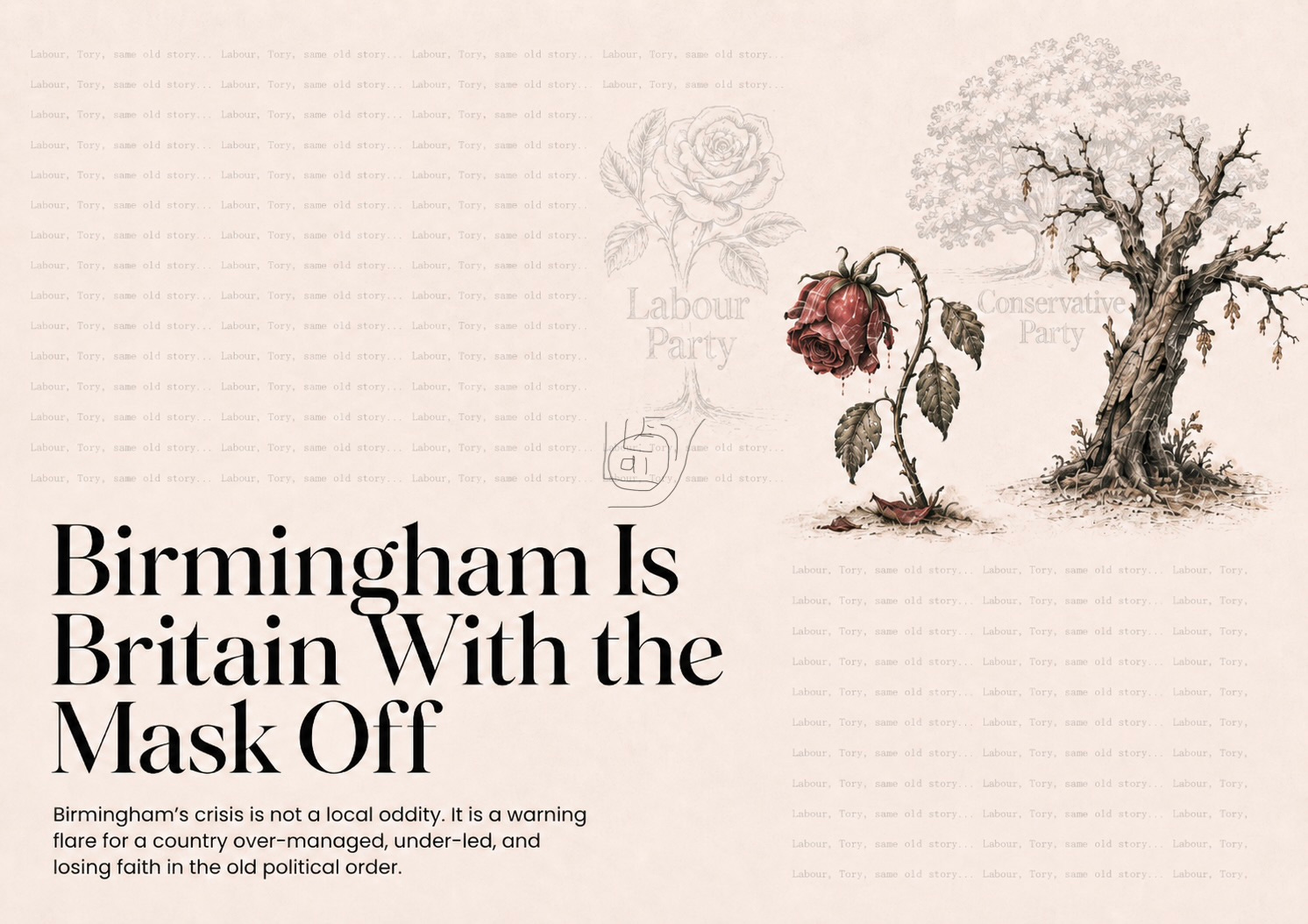
There are moments when a city stops being merely a place and becomes a warning. Birmingham has reached one of those moments. It is tempting, especially for people outside the West Midlands, to treat the city’s current condition as a local curiosity: a bankrupt council, a bin strike, a broken finance system, a shattered Labour machine, commissioners in the building, and now an election result so fragmented that even the phrase “no overall control” feels too tidy for the wreckage.
But that would be a mistake. Birmingham is not some eccentric municipal accident. It is not a freakish local failure that can be safely filed under “Brummie chaos” by people who prefer their national decline served at a comfortable distance. Birmingham is Britain with the mask off. It is the national condition in compressed form: higher costs, weaker services, blurred accountability, institutional exhaustion, public distrust, and a political class that has forgotten the difference between managing a system and leading a place.
The old Birmingham model has gone. Labour once treated the city as part of its natural estate. Not just a council it happened to control, but a civic machine it assumed would continue to recognise its authority. That assumption has now collapsed. The 2026 city council election did not merely reduce Labour. It tore apart the old operating system. Reform UK won the most seats with 23, the Greens surged to 19, Labour fell to 17, the Conservatives took 16, the Liberal Democrats 12, with the Workers Party and independents making up the rest of a chamber that now looks less like a council and more like a political weather map after a storm. Birmingham Council had been Labour-led since 2012. That world has gone.
Yet the deeper question is not simply who can stitch together an administration. That is the chamber arithmetic, and it matters. But the larger question is more disturbing: even if Birmingham finds a leader, will anyone elected actually be leading the city? Since the Section 114 crisis in 2023, Birmingham has been under government intervention, with commissioners appointed after serious concerns about finance, governance, equal pay and the Oracle system. The official government explanation in October 2023 referred directly to long-standing financial governance concerns, recently precipitated by equal pay and Oracle.
That is where Birmingham becomes more than a local story. Voters have changed the political map, but it is not yet clear that they have changed power. Commissioners may have been necessary in an emergency. There were real failures. Nobody serious should pretend otherwise. But emergency supervision cannot become a substitute constitution. A city cannot be kept indefinitely in democratic semi-suspension and still be told that local democracy is functioning normally.
This is why former council leaderJohn Clancy’s recent attack on the Ed Show on Radio WM, on the commissioners matters. Whether or not one agrees with every syllable of it. His central point cuts through the polite fog. If the real authority in Birmingham sits with unelected commissioners, answerable upwards to Whitehall rather than outwards to Birmingham, then what exactly did the voters change? The question is not simply: who leads Birmingham City Council? The question is: does anyone elected really lead Birmingham City Council?
There is also a serious question about expertise. Birmingham is not a small authority that can be fixed by importing people from tidier, smaller or less combustible places. It is the largest local authority in Europe, with more than a million people, deep poverty, complex communities, immense service pressures, equal pay liabilities, a bin dispute, an Oracle finance system still casting a long shadow, and now a shattered political settlement. You cannot copy and paste experience from somewhere neater and assume it will work here. Birmingham is not a spreadsheet with a ring road.
The public is entitled to ask what this expensive external grip has delivered. If commissioners are the grip, where is the grip? If outside expertise is the answer, why does the city still feel flat on its back? If the same broad managerial caste that circulates through regulators, water companies, boards, public bodies and senior advisory roles is supposed to rescue local democracy, then the public is entitled to ask whether it is seeing rescue or merely a more expensive vocabulary of failure.
That is not personal abuse. It is democratic scrutiny. In fact, it is the scrutiny that politics itself ought to have supplied much earlier. The tragedy of Birmingham is not that it lacked clever people. It had armies of clever people. Officers, auditors, consultants, commissioners, advisers, lawyers, finance specialists, Whitehall officials. There has been no shortage of meetings, reports, plans, strategies, notices, reviews and formal language. What Birmingham lacked was political judgement.
Someone needed to say: this is madness. The emperor is naked. Someone needed to ask whether the bankruptcy story was the full story. Someone needed to ask whether the equal pay figures were framed properly. Someone needed to ask whether Oracle was simply an IT failure, or actually a governance failure. Someone needed to ask whether residents were being asked to pay more, receive less, and sell public assets while nobody at the top was clearly accountable. Birmingham did not fail because it lacked administration. It drowned in administration. What it lacked was leadership.
That is why the city now speaks so loudly to the national condition. What is true of Birmingham is increasingly true of Britain. The country is over-managed and under-led. Everywhere, the same pattern appears: more process, less grip; more language, less delivery; more frameworks, fewer decisions; more people in charge, less visible accountability. The public pays more and receives less, then is invited to admire the seriousness of the process.
You can see it in adult social care, the great unresolved question of British domestic policy. Everyone knows the system is broken. Everyone knows it damages families, councils, the NHS and unpaid carers. Yet government after government avoids the central decision: who pays, how much, and what should people be entitled to? You can see it in SEND, where parents fight through a maze while councils drown in deficits and children wait inside a system that almost everyone agrees is failing. You can see it in HS2, where a national project was overloaded with symbolic ambition, allowed to drift, then cut back after the political and financial cost became too visible.
You can see it in RAAC (that dodgy full of air concrete) and school buildings, where maintenance became a scandal only when the physical risk could no longer be politely deferred. You can see it in the Post Office, where responsibility dissolved inside an arm’s-length institution while real people were destroyed. You can see it in planning, where Britain wants homes, clean energy, growth, grid upgrades and infrastructure, but struggles to decide what gets built, where, and who gets disappointed. You can see it in local government finance, where national pressures are pushed downwards until councils crack, and then the councils are blamed for cracking.
The pattern is not that Britain has stopped making decisions. It is worse than that. Britain has become worse at making decisions before reality forces its hand. That is managed decline. It is not the absence of government. It is government by postponement, government by review, government by consultation, government by inherited crisis and delayed invoice.
Defence and policing show the same failure from opposite directions. Defence is the external version. Britain wants the posture of a serious military power: NATO credibility, nuclear deterrence, aircraft carriers, Ukraine support, cyber capability, global reach and war-fighting readiness. But politicians avoid the brutal question: what can we actually do properly, what does it cost, and what must we stop doing? Britain wants the posture of a great power, but too often behaves like a country hoping the next crisis will wait.
Policing is the internal version. Every politician promises visible policing, safer streets and faster justice. But crime has changed. Fraud, online crime, digital evidence, organised networks and public trust all require a different model. The public asks: where are the police? The system replies: we are developing a new operating model. That gap is where confidence dies.
This is the national lesson from Birmingham. When politicians leave the field, administrators do not restore democracy. They manage decline. Not because they are bad people. Not because they are fools. But because they are not designed to imagine a different future. They stabilise, process, contain, manage risk and report upwards. That is necessary. But it is not leadership.
Politicians, at their best, are meant to do something else. They are meant to disrupt. They are meant to ask the dangerous simple question. They are meant to look at a failing system and say the emperor is naked. The British system evolved over centuries on the assumption that elected people would lead, civil servants would advise, officers would administer, and the public would hold the elected people to account. Remove the political element, or reduce it to status, caution and career management, and the rest of the machine cannot compensate. It keeps moving, but it no longer knows where it is going.
That is why Labour and the Conservatives are both in trouble. Their failures are not identical, and their histories are different, but they have increasingly come to sound like rival administrators of decline. They argue loudly, but too often inside the same exhausted frame. Fiscal rules, delivery, stability, stakeholders, difficult decisions, lessons learned, robust process. Some of that language is necessary. All of it together is deadening. The public hears two old parties competing to operate the same failing machine.
In Birmingham, the result is visible. Reform offers rupture. The Greens offer urgency. Independents offer local revolt. None should be romanticised. All may disappoint. But they do not sound like the old managerial block, and that alone now gives them force. The public may not yet know whether the new disruptors can govern, but it increasingly believes the old parties have stopped imagining.
That is the real message from Birmingham. The city is not ungovernable because democracy failed. It is ungovernable because democracy has been weakened, bypassed and hollowed out. Voters changed the council, but they cannot yet be sure they have changed power. Residents pay more, receive less, and are told the process is being handled. Commissioners may supervise. Officers may administer. Consultants may advise. But none of that is a substitute for democratic leadership.
Birmingham is not an exception. It is a warning flare. It shows what happens when politics is reduced to administration, and then administration fails. It shows what happens when a city is drowned in cleverness but starved of judgement. It shows what happens when the old parties become so cautious, so managerial and so personally ambitious that they forget the basic duty of politics: to lead.
Britain should look carefully. Birmingham is not the place where the national story stops. It may be the place where the national story is most clearly seen.
Thanks for that but you analyse a problem but without historical context. The problems local government generally face (of which Birmingham leads the way) began in the 1960s but has only become apparent in the last 30 years. Even before the Labour government was elected in 1964 Ted Heath, a European fanatic, in the dying days of the MacMillan Tory government, introduced a white paper (I have it still somewhere.. it was the first white paper I purchased aged 12!) on the reform of government in what he called Greater London. Why I refer to Heath as a Europhile, which he was, is this. He wanted us to join the EEC which became the EU but one condition for that was a reform of Local government to mirror the regionalism that exists on the continent and which the Commission requires for grants Heath saw the need to reform local government based on city states, like the German model. Greater London was one of a number of city states he envisaged at the time. The white paper went beyond Greater London to include SELNEC.. a name later suppressed… South East Lancs/ North East Cheshire (now Greater Manchester), Greater Birmingham, Avon, etc. These city states would be the hub of their regions. And of course all those things have come or are coming to pass. It has taken longer than Heath imagined. The Home government (1963/4) rejected his plans except for London but since then gradually we have had more and more reform of local government so soon, that over most of the country, Heath’s Napoleonic reforms will be realised. I say Napoleonic because that is what they are, as Heath once stated. Napoleon destroyed the historic French county and parish system replacing it with departments based on rivers or mountains. At the same time he destroyed local languages and imposed French, when two thirds of France did not speak French. The past was to be removed. Here what was local government has become is regional government. Local government has been decried as too parochial, too out of date, too unsuitable for stream line government today. Of course Heath’s “reforms” and subsequent changes were just part of a longer revision of local government, beginning with the destruction of detached parts in the 1880s, where small parts of one county were historically detached from the rest of its county… such as Halesowen, which was in Shropshire yet 12 miles way from the county itself or Dudley in Worcestershire though surrounded by Staffordshire. Streamline began in the 1880s with Gladstone but accelerated in the 1960s and 1970s…but the problem is that no one voted for these changes because no one felt empathy with the new regions. In the 1960s I realised that when living in Surrey. My local council voted against joining the GLC. Yet the Urban district was destroyed and forced into a new London Borough and as punishment the new Borough was named after a small part of the new authority Sutton. But 70 year on people still put Surrey on their addresses. Yesterday I spoke to a man in Warrington. Casually I asked him what county does he live in. He said Lancashire but Warrington has been in Cheshire since 1975… people feel affinity with their historic roots not with government reforms.
And now I turn to Birmingham, which in all national opinion polls is considered by its inhabitants the worst place to live. Here there is no sense of local pride. This has much to do with its size. I live in Perry Common, which was originally in Staffordshire then briefly in Warwickshire then became part of Birmingham. Here and I can give loads of other examples people feel absolutely no affinity with the City. That is a different world. Is it any wonder that overwhelmingly the ward voted Reform. There is a sense of neglect. That regional government throws money away at the centre ignoring the outliers. This is apparent in very simple ways eg the Birmingham City offices that control local council housing and the local parks is up for sale. Lack of money means sales and closures not at the centre but at the periphery. For every £ spent in the inner city less than a penny is spent on the outliers. Starved of cash the village centres that make up Birmingham have become as someone put it “s..t holes”. Take Erdington. Its shopping centre is run down, full of fake and charity shops, full of drunks drug addicts and beggars. Yet Erdington is a Tory ward; it is not a deprived area. Take care when going there at night. But the same can be said of Northfield and Yardley. The sense of pride in the local community has gone. People are no longer bothered if they destroy grass verges parking their cars or throwing their rubbish over park fences. Walking the dog I often see both! They are not bothered even if the rubbish is never collected. An old post man chatted to me the other day as I walked through Kingstanding. I have delivered letters here for decades. It used to be lovely. Every house had hedges and now look at it… rubbish everywhere, cars parked on pavements and rubble instead of gardens.
It is not administration or council that is the problem. It is the size of these new authorities and their incoherent nature. Why is eg Coventry attached to Birmingham. Both have their own individual civic pride or ought to have. The expansion of Birmingham in Sutton Coldfield, the creation of the West Midlands authority has destroyed true localism … pride in your patch. In short Birmingham will only improve if it is broken up. Manchester thrives but it is one third the size and population of Birmingham. It is actually at 350,000 quite small yet most UK people think of it as the Second City. Break up BIRMINGHAM and ungovernability goes away and there is a chance that civic pride will return. Where there was one make 3 or 4, each of which will still be bigger than most London boroughs.
All is not lost. There is the beginning of a fight back. The return of Rutland and the East Riding of Yorkshire, both destroyed in 1975, has happened restoring local pride. Counties like Humberside and Avon were abolished. But much needs to be done still to unpick the past EG Hillingdon in Greater London, now Reform, is planning to move back into Essex. These moves are not just nostalgia but a real feeling that local pride was destroyed by ever bigger authorities.
So to conclude… yes the Council shares some blame; yes the Council officers have blame but in the end if you have every bigger authorities with ever larger budgets doing ever increasing things run by people with no expertise in how to run a business then the system will collapse and the voter will be alienated. In the case of local government it needs to be more local, smaller budgets that are manageable with no grand vanity projects that large councils go in for with disastrous consequences… small can be beautiful but it also can be more effective…
Excellent analysis Mike. Reminded me (showing my age) of the late Professor Samuel Finer in the late 1970's on Britain being 'ungovernable' and threat to democracy of non-democratic forces stepping in. I would not include the commissioners in that threat.
Trying to locate Finer's seminal article on the theme an online search returned to my surprise an article by Hannah White, the CEO the "think tank" Institute for Government; which is close to Whitehall-Westminster: https://www.instituteforgovernment.org.uk/comment/is-uk-ungovernable
She appears to believe and cited: 'Old problems persist and new challenges have certainly emerged – particularly from the ways in which our politics has responded to the domestic and international events of the past decade, but with the right ideas and commitment from those in positions of power, these can be addressed'.
Sadly I doubt if the public, the electorate, public servants and even elected politicians are capable of meeting the challenge.