


Yesterday, I found myself watching a parliamentary hearing I had not planned to watch, and did not expect to finish
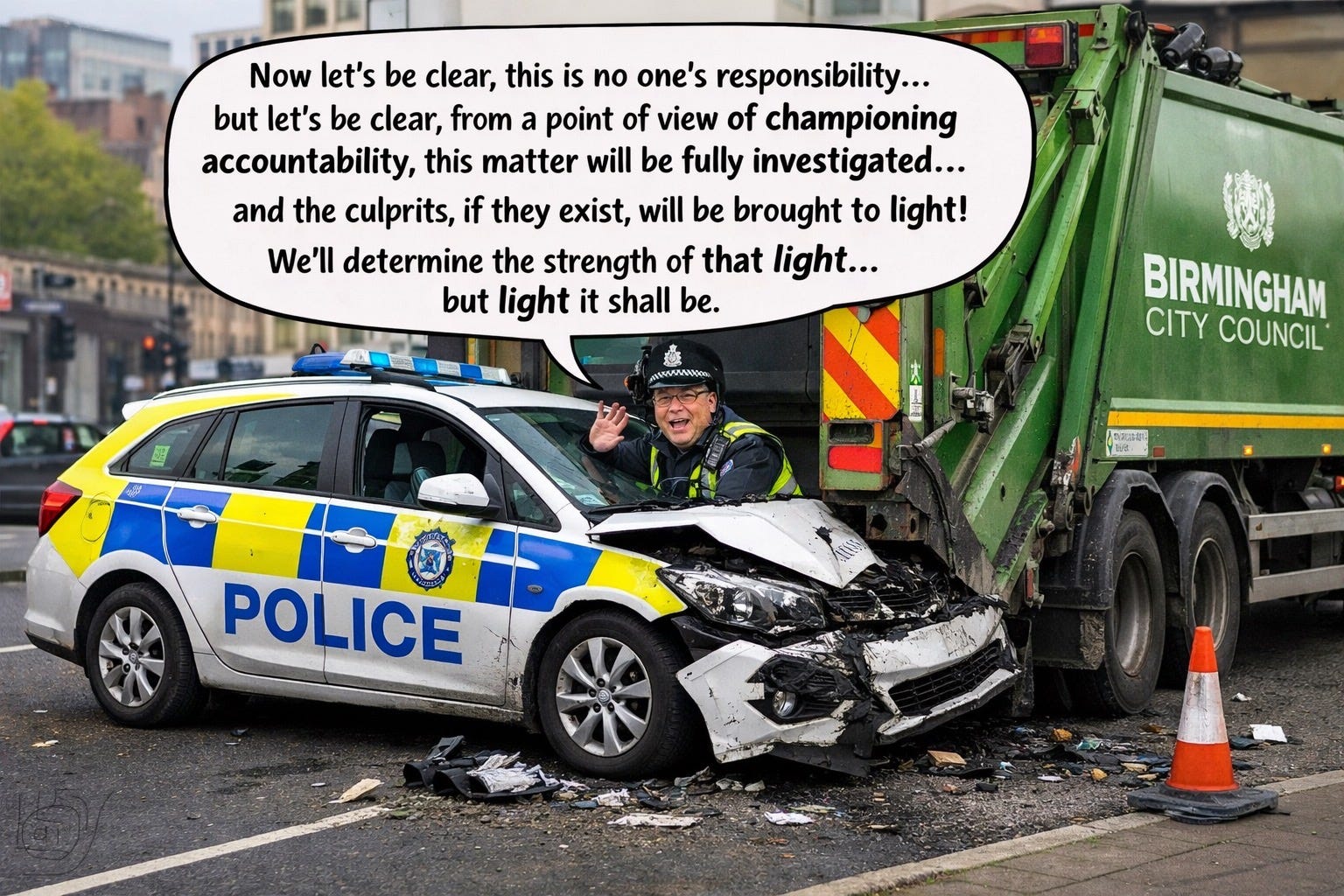
It was a session of the Home Affairs Select Committee, convened to examine how and why a European football match in Birmingham ended with away supporters barred, in practice Jewish supporters, on the grounds that their safety could not be guaranteed. What should have been a narrow discussion about policing and crowd management quickly revealed something much bigger: weak governance, selective record keeping, blurred accountability, and an increasingly uncomfortable question about whether threats of violence are now allowed to determine who gets to participate in civic life.
I stayed because it became clear, minute by minute, that this was not really about football. It was about how decisions are made in this city under pressure, how power behaves when asked to explain itself, and what happens to trust when institutions cannot clearly account for their own actions.
This is my account of that hearing, and what it tells us about Birmingham, its leadership, its police, and the systems that are supposed to protect all of us equally.
Good television, because democracy was awake
Let us get this out of the way. It was good television.
Not loud. Not theatrical. No grandstanding. Just MPs doing what they are meant to do when the stakes are real: asking the same question again, from a slightly different angle, until the answer either arrives or collapses.
There was something reassuring about that. This is how we are supposed to do things. This is how scrutiny is meant to work.
Which is why it was so unsettling to watch how often the answers dissolved into fog.
A welcoming city, confronted with an exclusion it cannot own
Birmingham tells a story about itself. A proud one. A diverse one. A welcoming one.
Much of that story is true.
And yet here we were, discussing a European football fixture that ended with away supporters barred, in effect Jewish supporters, because their safety could not be guaranteed.
That is not a minor operational decision. That is not a footnote. That is a civic failure unless it can be explained, justified, and owned with absolute clarity.
The MPs kept returning to the same question because it would not go away: what does this say to Jewish people in Birmingham, particularly students, when the message appears to be that threats work?
The answers never quite landed.
Richard Brookes, and the problem with the record
Richard Brookes appeared before the committee as a senior officer from Birmingham City Council’s City Operations function. He is responsible for supporting the Safety Advisory Group, including the preparation of its minutes.
He opened by apologising for the quality of those minutes. He was right to do so. They are poor.
But this is not about note taking. It is about accountability.
Minutes are how decisions survive scrutiny. They are how we know who said what, what was weighed, what was rejected, and why. When minutes are thin, selective, or oddly shaped, accountability drains out of the room.
MPs were not quibbling. They were asking why councillors who had publicly opposed the game appeared prominently in the record, while other material, including police intelligence, barely registered. Why outcomes were clear, but deliberation was faint. Why political commentary survived, but operational substance seemed to evaporate.
When the Chair said the minutes were not reflective, that was not a stylistic critique. It was a warning that the public record itself cannot be relied upon.
Redaction as fog, not protection
Redaction has a legitimate place. No one sensible disputes that.
But redaction cannot become a habit that conveniently removes the most contestable parts of a decision. When nobody can clearly explain what has been redacted, why, and under what framework, suspicion fills the gap.
What we saw was not disciplined redaction. It was fog. And fog protects power.
Predetermination, and the Standards question that will not go away
No one admitted the decision was fixed in advance. That is not how predetermination usually presents itself.
Instead, MPs probed whether the process was ever capable of impartiality.
Were councillors with strong, publicly stated views allowed to sit on the SAG without declaring interests? Were declarations made late? Were recusals triggered only after decisions had already hardened?
These were not abstract questions. They went directly to whether the process complied with the council’s own standards framework.
What matters here is not whether wrongdoing is ultimately found. What matters is that the concerns were serious enough for Cllr John Cotton, Leader of Birmingham City Council, to indicate that the conduct of councillors involved in the SAG may need to be examined through the Standards process.
Once that threshold is crossed, this stops being a theoretical debate. It becomes a live governance issue.
And if, as appears likely, councillors from more than one political party were involved, then any Standards process will, by definition, have to examine conduct across party lines. That may be uncomfortable. But it is unavoidable.
The optics of allegations of antisemitism being raised in a Home Affairs Select Committee, and then quietly ignored at local level, would be far worse.
Accountability ping pong, everyone advisory, no one responsible
One of the most revealing dynamics was the quiet passing of responsibility.
The SAG can only act on the information presented to it. The police provide professional advice. The council holds the safety certificate. The decision emerges somewhere between them, owned by no one.
At times it felt as though institutions were standing back to back, each pointing in the opposite direction.
This is how accountability dies. When everyone is advisory, nobody is responsible.
Cllr John Cotton stood out here. He repeatedly dragged the discussion back to first principles. Who pushed back on the Chief Constable? How hard? What alternatives were explored? What reassurance can actually be offered?
He did well. Calm. Serious. Focused.
But even he often stopped just short of forcing the hardest conclusion.
People arming themselves is not a footnote
There is one moment in this entire saga that should have stopped the room.
Intelligence indicating that people might arm themselves in response to this fixture was discussed almost casually. As if it were one factor among many. As if it were a menu choice.
This is not roast or mashed potatoes.
People arming themselves is not background noise. It is not colour. It is not a mood. It is an existential public order threat. It is the point at which the state is meant to draw a clear and unambiguous line and say: this is not acceptable, and we will deal with those making the threats, not accommodate them.
Which raises a question that has still not been properly answered.
What did the police actually do in response to that intelligence?
If credible threats were being made to arm and attack others, were those threats investigated as serious criminal offences? Were the sources identified? Were online networks, messaging platforms, and social media activity examined? Were individuals warned, disrupted, arrested, or otherwise neutralised?
Or was this intelligence treated as something too difficult, too politically sensitive, or too complex to confront directly, and therefore allowed to sit on the table as a justification for excluding the very people being threatened?
These are not rhetorical questions. They go to the heart of what policing is for.
Threats of organised violence, particularly when directed at a specific group, sit uncomfortably close to the definition of terrorism. At the very least, they demand a response focused on prevention, disruption, and enforcement, not quiet acceptance.
If threats of violence become a reason to exclude the threatened group, rather than confront the threat itself, the implications are grave. It signals that intimidation works. It teaches that the loudest and most aggressive voices shape outcomes. And it leaves everyone else wondering whether the state will stand between them and those willing to escalate.
That is not a footnote. That is the story.
If the most serious intelligence in the room was treated as background context rather than a trigger for decisive action, it becomes impossible to separate the quality of the decision from the credibility of the policing that underpinned it.
“The community”, a phrase that now demands scrutiny
Throughout the evidence, repeated reference was made to consultation with “the community”.
The problem is that no one ever properly defined who that community was.
When police assert necessity based on community consultation, but cannot clearly explain who was consulted, how views were gathered, or whose voices carried weight, the phrase begins to sound less like reassurance and more like a shield against scrutiny.
Jewish supporters were spoken about repeatedly. It was far less clear that they were spoken with.
That gap now sits at the centre of public debate, not just in Parliament, but in wider commentary. And it is not going away.
Police confidence, untethered from clarity
The performance of West Midlands Police was disappointing.
I had watched a December meeting where the Chief Constable and ACC O’Hara appeared full of confidence. Watching this hearing later, that confidence looked misplaced.
The Chief Constable repeatedly said he wanted to be clear. He repeatedly was not. Claims shifted. Context arrived late. MPs had to circle back again and again because answers never quite settled.
The police described themselves as a “learning organisation”. That is a comforting phrase. But learning usually follows recognition of error.
What we saw instead was confidence without forensic grip.
When a police force repeatedly asserts necessity while the evidential basis is increasingly questioned in public, confidence does not merely weaken, it fractures.
The option that never quite existed
The public narrative suggested a binary choice: ban away fans or risk serious disorder.
Under questioning, that narrative frayed. Reduced allocations, mitigations, and alternative approaches were not robustly explored early, or at least not recorded in a way that survives scrutiny.
A process that does not force itself to examine alternatives is not neutral. It is drifting.
When officials say “we can only act on what we are presented with”, the obvious follow up is: who insisted on being presented with more?
Meetings, work, and the myth of attendance
This is where the problem widens.
Minutes must be full, balanced, and auditable for all meetings where outcomes are determined. That includes SAG meetings. It also includes officer only meetings held outside the earshot of elected councillors, where decisions are shaped before they ever reach a formal agenda.
Attendance at a meeting is not work. Drinking coffee and nodding while someone else sets the direction is not work. Work is attending a meeting and contributing to an outcome.
Too many council officers appear to believe that being present equals labour. It does not. Outcomes are the work. Everything else is theatre.
If a meeting does not have a defined purpose and a defined outcome, it should not be happening.
What this says to Birmingham’s Jews
Strip away the jargon and the process talk, and this is what remains.
Jewish supporters were excluded because others might attack them.
If that outcome is unavoidable, it must be explained with absolute clarity and accompanied by visible, operational reassurance. Warm words about diversity do not do that work. Strategies do not do that work.
Only accountability does.
On that test, the hearing exposed a serious gap.
Why this mattered
It mattered because MPs did their job. They slowed the machine down. They demanded the paperwork. They refused to accept fog.
It was good television because it showed democracy functioning as it should.
And it should trouble everyone involved that the most reassuring presence in the room was not an official defending the decision, but the MPs testing it.
What must change
If Birmingham wants to avoid repeating this moment, several things are non negotiable.
Minutes must be full, balanced, and auditable for all outcome determining meetings.
Declarations and recusals must be recorded at the start, not discovered later.
Every high risk decision must come with a written options appraisal.
Police intelligence presented to civilian bodies must be accompanied by a clear assurance framework.
And when a minority community is excluded for safety reasons, reassurance must be operational, not rhetorical.
Because if intimidation is seen to work once, it will be tried again.
I agree that's a very fair comment and sharp observation. I imagine that the reports from the Dutch police was via a discussion between a WMs officer and Dutch equivalent. The Dutch police now say that what is claimed was said, wasn't so said. So, presumably without the Dutch police available the conversation can go no further.
Mike : A very thorough and thought provoking article. What I still find disturbing is the intelligence the Chief Constable say he received from the Dutch Police about the Tel Aviv Maccabi fans' behaviour seems at odds with statements the Dutch Police made themselves after the ban was announced. I'm surprised that the MP's haven't pursued this point further.