

Birmingham Weekly Digest: Power, Property and a System Under Strain
30,000 readers this week, and a city revealing how it really works: fractured politics, misaligned infrastructure, concentrated housing, and authority tested.

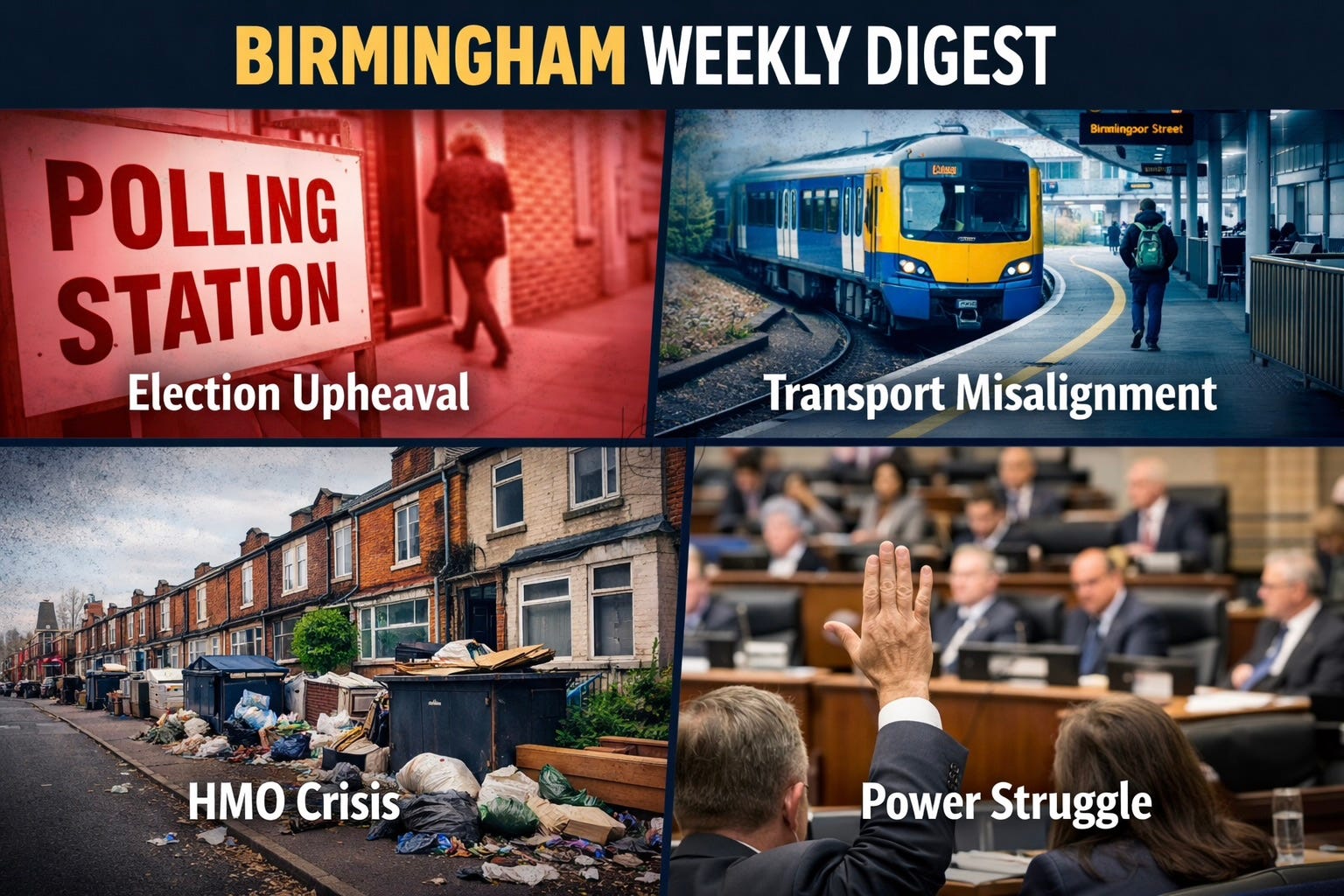
Birmingham in Motion, Systems Under Strain
Weekly Digest, Week Ending 4 April 2026
It has been a strong week for Midlands GRIT.
Across the past seven days, the work has reached more than 30,000 readers. That matters, not as a vanity number, but because it tells us something about where attention is shifting and what people are starting to look for. There is a growing appetite for clarity, for structure, and for a way of making sense of systems that no longer behave as expected.
The standout piece, by some distance, was the Birmingham election projection. A ward by ward model, built from the ground up, not headline chasing and not guesswork, but a structured attempt to understand a system that is becoming harder to read with each election cycle. If you had asked even a few months ago which subject would cut through at that level, it probably would not have been that. Who would have predicted that?
But that, in itself, is part of the story.
Because something is changing in Birmingham. People are beginning to look past the surface of politics, infrastructure, housing and governance, and ask a more direct question about how the system actually works, and who is really in control of it.
Over the past week, four strands have come into focus, elections, transport, housing and governance. Taken individually, they might appear separate. Set alongside each other, they begin to describe the same underlying shift.
Birmingham does not move in straight lines anymore. It shifts, it layers, and it reveals itself in fragments that only make sense when placed side by side.
The Election That Does Not Behave Like an Election
On 7 May, all 101 Birmingham councillors go to the polls. That only happens once every four years, and the result does not simply determine political control, it shapes how billions are spent across the city. This is not abstract politics. It is the machinery of Birmingham itself.
The working projection built over recent weeks places Reform at around 29% to 30%, with a realistic operating range between 27% and 31%. In most electoral systems, a movement of a few percentage points would be notable but manageable. In Birmingham, it is system-changing.
This is no longer a two-party city. Labour remains the largest force, but it is weakening. The Conservatives continue their decline. Reform is not simply rising, it is beginning to embed itself in areas where it was previously absent and, in some cases, breaking through.
But even that framing is too simple. Birmingham now behaves as a multi-bloc system. Labour holds a central but eroding position. Reform and the Conservatives overlap within the same electoral space. The Liberal Democrats and Greens form a structured secondary layer. Alongside them sits a persistent Independent and ICA presence that is often decisive.
That structure produces non-linear outcomes. At around 30% Reform support, the city tips into no overall control. Above that threshold, Reform may become the largest force, but still without the ability to govern alone. Power is no longer won outright. It is negotiated.
There is also a clear geographic pattern. In the south, what can be described as a Green Crescent, running from Selly Oak through Bournville, Stirchley, King’s Heath and into Moseley, continues to build steadily. Elsewhere, particularly in outer wards, Reform is applying sustained pressure.
Below 30%, Labour leads. At 30%, no one controls. Above it, Reform leads, but no one governs alone. That is the system Birmingham is now moving into, and it changes not only the election result, but everything that follows it.
Infrastructure That Exists, But Does Not Quite Work
Alongside that political shift sits a quieter but equally revealing reality in transport.
Five new railway stations are planned across the West Midlands, at Aldridge, Darlaston, Willenhall, Pelsall and Brownhills. The Camp Hill line is reopening, bringing stations to Moseley Village, Kings Heath and Pineapple Road. For communities long cut off from rail, this is welcome and overdue.
But it is not transformation. It is a beginning.
The deeper issue remains unresolved. The network still does not properly align with how people actually live and move. Across the region there are stations that exist but do not quite serve the communities around them. They sit just far enough away from where people are, or from where people need to go, to become inconvenient rather than enabling.
On a map they appear local. In practice, they often are not.
This reflects a system designed around one geography, while daily life follows another. Nowhere is that clearer than along the Stratford Road corridor, running from the edge of Birmingham city centre through Sparkbrook, Sparkhill, Hall Green and into Shirley. It is one of the busiest routes in the region, yet large sections of it have no meaningful rail access. In Sparkhill, trains pass through but do not stop.
That is not a capacity issue. It is a design issue.
The next phase of thinking should not simply be about adding more stations to existing lines. It should be about aligning infrastructure with lived reality, whether through additional stops or more ambitious options such as light rail running directly along major corridors.
But design alone is not enough. Delivery matters just as much.
Recent projects have shown how prolonged disruption can damage local economies. Independent businesses operating on tight margins cannot absorb months of reduced access and falling footfall without consequence. In effect, parts of the private sector end up subsidising public infrastructure through lost trade, a cost that is rarely acknowledged.
If the system is to retain trust, it must do more than build. It must build in a way that reflects how people live, protects local economies during delivery, and maintains what it creates over time.
A Housing System That Is Not Random
This week’s housing analysis brings together two parts of an ongoing series examining HMOs and exempt accommodation across Birmingham. What follows sets out both the underlying pattern and the visible consequences, with the final stage of the analysis to follow next week.
Most people in Birmingham know HMOs exist. What they have not seen is the pattern at scale. Working through council-held data at property level, a clear picture begins to emerge.
This is not a loose collection of small landlords. A relatively small number of organisations are operating at scale, with thousands of properties between them. One provider alone is linked to well over two thousand addresses, with others running into the high hundreds and beyond.
That level of concentration changes the nature of the system.
Alongside the publicly held data, I have also been given access, on a strictly confidential basis, to a heavily restricted document by a senior individual with direct knowledge of how this system operates. Their view is blunt. The system, as it currently operates, is bringing parts of the city down and failing the very residents it is supposed to support.
That material does not sit in isolation. It reinforces the pattern already visible in the council’s own data and raises further questions about how and why the system continues to expand in its current form.
When mapped, another pattern becomes visible. These properties are not evenly distributed across the city. They cluster. The same provider names repeat across streets and neighbourhoods, and over time those areas begin to shift.
You do not notice it immediately. Then you do.
Take Erdington. The growth of HMOs and exempt accommodation has not simply altered individual properties, it has reshaped the area itself. As housing moves towards higher turnover, stability reduces, and that change feeds directly into the local economy. Spending becomes less consistent, businesses begin to struggle, and the retail mix shifts as confidence erodes.
This is not theoretical. It is visible.
None of this is unknown. The council holds the data and has carried out more than 12,000 inspections, identifying thousands of hazards and requiring further intervention in thousands of cases.
The system is known. The pattern is documented.
And yet it continues to expand.
That is where the question shifts. It is no longer about what is happening, but about what is being done. Inspections identify problems, but enforcement changes behaviour. When one operates at scale and the other appears limited, the outcome becomes predictable.
The issue is acknowledged. The pattern remains.
The final part of this series will move from analysis to accountability, asking directly what those in positions of authority intend to do about it, and why, despite being known, inspected and documented, the system continues to expand.
A Vote That Did Not Move Power
If housing raises questions about control, governance this week has raised something more fundamental.
Authority itself.
A majority of elected councillors passed a vote of no confidence in the Leader of Birmingham City Council, Cllr John Cotton. In most systems, that would have a clear and immediate consequence. Here, it has not.
The explanation lies in process. Under the Localism Act 2011, removing a leader requires a specific mechanism set out in the council’s constitution. A vote carried in the chamber may not meet that threshold if it does not follow the prescribed form.
Legally, that distinction may hold.
Politically, it is harder to sustain.
To the public, a vote is a vote. When a clear majority decision appears to have no immediate effect, it creates a visible gap between democratic expectation and procedural reality.
That gap matters because it affects trust and shapes perception of where authority actually sits.
Within the chamber, a signal has been sent. Within the system, it has not yet been acted upon. That leaves Birmingham in an unresolved position, not without authority, but with authority that is openly questioned.
The Shape of What Comes Next
Taken individually, each of these strands tells a story. Together, they describe something larger.
A political system moving from majority control to negotiated power. An infrastructure model that builds but does not always align with lived reality. A housing system that is structured, concentrated and expanding. A governance framework where process can delay or reshape clear democratic signals.
None of this amounts to immediate failure. But it does point to transition.
Birmingham is no longer operating as a simple system with predictable inputs and outputs. It is becoming more complex, more layered, and more dependent on how its different parts interact.
That creates risk, but it also creates clarity.
Because when systems become harder to read, their underlying structures begin to show. Those structures are now visible.
The election will not resolve that. It will expose it further.
Because in Birmingham, the result is no longer the end of the story. It is the point at which the real story begins.