

Birmingham’s Budget Promises: Mind the Potholes
Awkward question: "Are these promises new?"

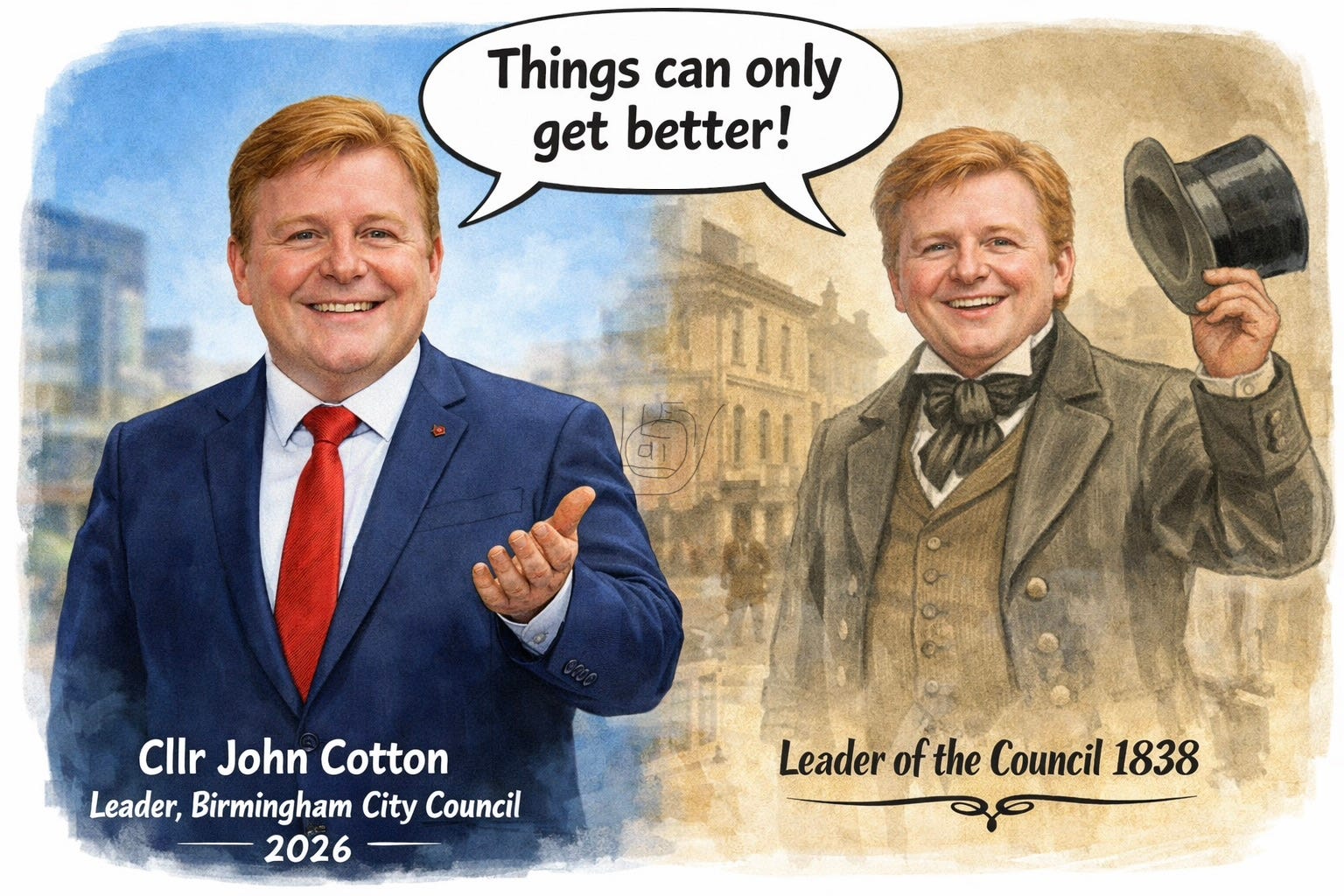
There are two great certainties in Birmingham life. The first is that the council will eventually promise to fix the potholes. The second is that this promise will arrive shortly after the potholes themselves.
This week Councillor John Cotton, Labour Leader of Birmingham City Council, appeared on social media following the passage of the city’s latest budget with a message of optimism.
Birmingham, he said, has turned a corner. The financial turbulence of recent years is settling. Investment will return to frontline services. Streets will be cleaner. Roads will improve. Neighbourhoods will benefit.
After the upheaval the council has endured, few would begrudge a civic leader the right to offer a little encouragement. The equal pay crisis and financial collapse placed Birmingham in a position no major city should ever find itself in. Stabilising the council’s finances has not been easy.
Yet once the optimism settles, a rather awkward question begins to surface.
Are these promises new?
Or are they simply the latest instalment in Birmingham’s long-running municipal series titled: This Time We Really Mean It.
Consider potholes.
The municipal structures that evolved into Birmingham City Council have been responsible for maintaining the city’s roads since the nineteenth century. By 1838 the duty of maintaining highways and streets was already embedded in civic administration.
Which raises a modest question.
Why, in 2026, are citizens still hearing enthusiastic pledges that the council will finally get to grips with potholes as though the concept of road maintenance has just been discovered?
This is not an unsolved engineering mystery. Cities across the world maintain their road networks perfectly competently.
Japan experiences earthquakes, typhoons and rainfall that would make a Birmingham drizzle look positively polite. Yet its roads remain remarkably smooth.
Even theme parks manage the trick. Visitors to Disneyland rarely report disappearing axle first into a crater outside the queue for Space Mountain.
Which suggests the problem is not the weather.
It is the system.
And housing offers an equally revealing example.
Some years ago, when Cllr John Lines, now John Lines, served as Cabinet Member for Housing, Birmingham attempted something refreshingly straightforward. It tried to improve housing standards in a serious and systematic way.
The Municipal Housing Trust programme encouraged better quality housing development across the city. It pushed standards upward and attempted to change the direction of travel in neighbourhood renewal.
It also had a team of officers who were unusually determined to make sure the policy actually happened.
They marched around insisting that the programme be implemented. Developers were challenged. Standards were enforced. Projects moved forward.
They were not universally adored within the council bureaucracy. Officers who insist on getting things done rarely are.
But they were effective.
Housing standards improved and the dial began to move.
Then the political winds changed.
When Cllr John Lines left the housing portfolio, the team that had driven the programme gradually disappeared. Officers moved on or were moved aside. The momentum slowed. What had been an active programme began quietly to run down.
Eventually the Municipal Housing Trust itself was scrapped under the leadership of Cllr John Cotton.
Whether that decision reflected financial pressures, shifting priorities or the realities of governing a council emerging from crisis is open to interpretation. But the result is clear enough.
The one programme that had attempted to raise housing standards with real determination simply faded away.
Meanwhile the city’s housing debate has taken on a rather curious character.
Council leaders regularly express concern about the spread of Houses in Multiple Occupation. Residents complain about them. Planning meetings debate them endlessly.
Yet the practical reality across large parts of Birmingham is that HMOs continue to expand.
It is an unusual model of housing policy.
The council condemns HMOs in speeches while approving them in planning applications, and systematically fails to enforce against their often poor illegal standards.
The consequences are predictable. Poor housing standards rarely remain neatly contained. They spread outward. Local centres weaken. Neighbourhood stability erodes. Standards drift downward over time.
Which brings us back to the promises.
When Cllr John Cotton speaks about cleaner streets, improved neighbourhoods and better housing outcomes, there is little reason to doubt the sincerity of the ambition. Most political leaders genuinely want their cities to succeed.
But Birmingham’s electorate has heard variations of this language many times before.
Each crisis is followed by renewal. Each renewal produces speeches. Each speech promises that this time things will be different.
Sometimes they are.
More often the same structural problems quietly return.
The truth is that Birmingham does not need better speeches about potholes.
It needs fewer potholes.
It does not need endless debates about housing standards.
It needs policies that actually raise them.
And if the council truly wishes to convince citizens that the city has turned a corner, the proof will not come from social media videos or budget statements.
It will come from the quiet details.
Roads that remain repaired.
Neighbourhoods that stay clean after the press release fades.
Housing that strengthens communities rather than diluting them.
Because in the end Birmingham’s residents are not asking for miracles.
They are simply hoping their city does not become the first place in Britain where the potholes and the HMOs end up competing for the same patch of road.
Thank you Liz, turned out well 🤗
Love the picture!