
Birmingham’s Enduring Son
Why Tony Iommi’s MBE matters far beyond heavy metal

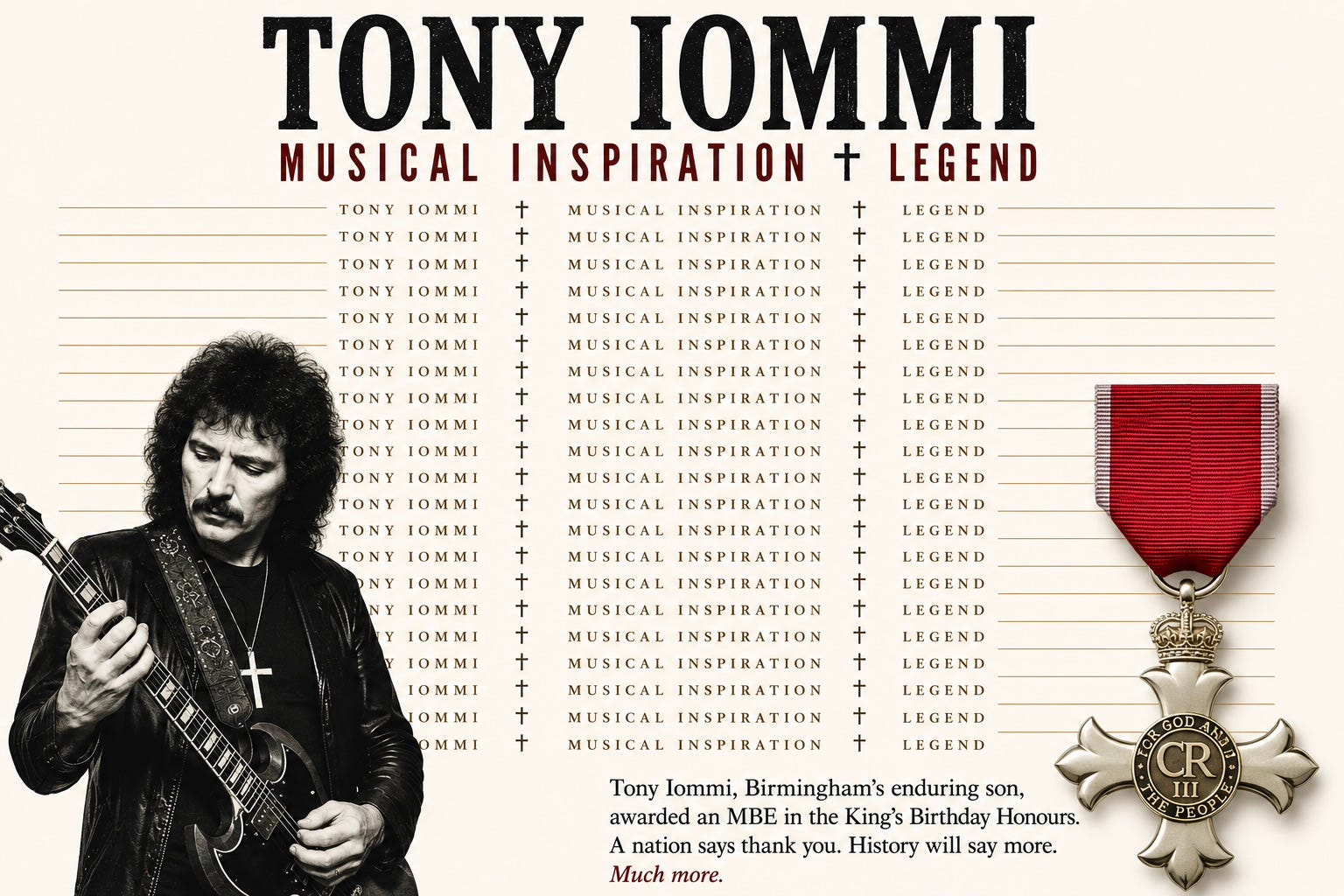
There are honours, there are medals, there are awards, and then there are those rare moments when a nation quietly acknowledges that one of its own has changed the world. Tony Iommi has now been awarded an MBE in the King’s Birthday Honours List, and for Birmingham this is not just a pleasing footnote in the honours pages. It is a moment of proper civic pride. Knowing Tony and his delightful wife Maria, I know they could not be more pleased and excited. Tony is used to recognition, of course. He has received many awards for his achievements. Yet I suspect this will be regarded by him as a personal best, not because it is louder than the others, but because it comes from the nation itself.
And rightly so. Birmingham has produced many remarkable people, politicians, industrialists, scientists, writers, actors, entrepreneurs and musicians. Yet if someone asked me which Brummie is most likely to be remembered five hundred years from now, I would answer without hesitation: Tony Iommi. I say that also with full respect and affection for His Majesty King Charles III, a monarch I admire, but I suspect history may eventually make Tony Iommi’s name echo louder than the very King who honoured him. That is not a discourtesy to the Crown. It is simply how cultural memory works. Monarchs reign within their time. Great artists, when they truly alter the architecture of human expression, can travel far beyond it.
Tony’s fame, I believe, is still in the early stages of its historical life. That may seem odd to say about a man who helped found Black Sabbath, sold millions of records, influenced generations and has already been celebrated across the world. But there is ordinary fame and there is permanent fame. Ordinary fame belongs to the age that creates it. Permanent fame is different. It keeps renewing itself because the thing created remains useful, powerful and alive. That is why Tony’s reputation will not merely endure for decades, as it already has. I believe it will endure for centuries.
The reason is not simply that Tony was a great guitarist, though he plainly was and is. It is not simply that Black Sabbath became one of the most influential bands in the world. It is not even that he helped create heavy metal, although that would be quite enough for most careers. The deeper reason is that Tony changed what music could be built from. Before Tony Iommi, the guitar riff was often decoration. It might be a hook, an entrance, a flourish, a signature phrase. But usually the song itself was still carried by melody, harmony and movement. Tony changed that. In his hands the riff became structural. It became load-bearing. The song no longer simply used the riff. The song was built around it. That is the central argument of the book outline I have been developing on Tony: that his influence is structural rather than merely stylistic, because styles date, while structures endure.
And before we talk about how he adapted, we must pause on the injury itself. Tony suffered a dreadful industrial accident, losing the tips of two fingers on his fretting hand. For any young man that would have been traumatic. For a guitarist it must have felt almost like a sentence. In Tony’s age, injuries of that kind were not rare enough. Men and women worked close to machines that could take fingers, hands, confidence and futures in a moment. Mrs Olley’s mom, Mrs Donovan, had her thumb crushed. I once drilled through my own index finger, through the bone. Crikey. Yet that was industrial life in our industrial town. People took it in their stride because they had to. But Tony’s injury was different in one crucial respect. For a guitarist, losing the tips of two fingers on the fretting hand was not just painful. It threatened the very thing he was trying to become. The dangerous working world got him. Then, gloriously, he refused to let it have the last word. He did not really listen to the experts. He made new fingertips, changed strings, changed tuning, changed method and, in doing so, changed music.
That too is Birmingham. Not in the sentimental postcard version of the city, but in the real one. The Birmingham of work, pressure, improvisation and grit. The city that makes, fixes, adapts and carries on. Tony’s music does not sound as though it floated down from some soft artistic cloud. It sounds forged. It sounds engineered. It sounds as though weight, rhythm, repetition and consequence have all been hammered into shape. That is why it could not have come from nowhere. It came from here.
Listen to Black Sabbath, War Pigs, Iron Man, Paranoid or Children of the Grave. The riff is not a polite introduction before the “real” song begins. The riff is the ground on which the entire structure stands. The vocal, bass, drums and lyrics do not float separately above it. They live inside it. That is why the music still feels modern, dangerous and alive long after the fashions around it have passed. It was never just a style. Styles date. Structures survive.
This is where Tony belongs in the company of the very rare musical disruptors. Beethoven changed what repetition, pressure and development could do within symphonic music. James Brown reorganised popular music around rhythm, command and physical activation. Tony Iommi changed the role of the riff. These figures do not need to sound alike to belong in the same historical category. They share something more important. They reassigned responsibility inside music. They altered what a musical idea was allowed to carry.
His influence did not stop with heavy metal. That is merely the most obvious inheritance. Hard rock took from him. Doom metal almost lives inside his shadow. Thrash, speed metal, stoner rock, sludge, grunge, industrial, punk, post-punk, alternative rock, noise rock, gothic rock and even parts of modern electronic and hip-hop production have absorbed something from that idea of repetition, weight, pressure and unresolved tension. Some of that influence is direct. Some of it is second-hand, travelling through bands who learned from bands who learned from Sabbath. But that is how deep influence works. It does not always arrive wearing its own name badge.
If one were bold enough to put a number on it, and I stress this is a judgement rather than a statistic, I would say that perhaps a quarter to a third of guitar-based music since 1975 carries some trace of Tony Iommi’s structural invention. Not every heavy riff is Tony. Not every dark chord belongs to Sabbath. But the idea that a riff can be the building, not the decoration, runs through an astonishing amount of modern music. Once heard, that idea could not be unheard. Once built, that architecture could not be unbuilt.
There is also a discipline in Tony’s work which is often misunderstood. People talk about heavy music as if it is merely loud, rebellious or chaotic. Tony’s best work is almost the opposite. It is controlled. It contains chaos rather than surrendering to it. The heaviness is not random noise. It is structure under pressure. The riff repeats not because nothing else can be thought of, but because repetition becomes force. It refuses easy release. It holds the listener in place. It builds weight by staying where it is.
For Birmingham, this MBE should therefore be received with real pride. We are not simply celebrating a famous local lad who did well. We are celebrating a Brummie who changed the world’s musical grammar. That is a far greater thing. Cities sometimes misunderstand their own greatness. They chase passing headlines while failing to recognise the people whose work will still matter when today’s headlines are dust. Tony Iommi is one of those people.
So yes, congratulations to Tony. Congratulations to Maria too, because great lives are rarely lived alone, and those closest to the great figures often carry more of the journey than the public ever sees. This is a lovely moment for them both, and Birmingham should share in it warmly. The MBE is richly deserved. The honour is welcome. The recognition is overdue and yet beautifully timed. But the greater award will come from history itself. Long after today’s celebrities are forgotten, long after chart positions have lost their meaning, long after many modern reputations have faded into archive dust, Tony Iommi’s riffs will still stand. They will stand because they were built to carry weight.
That is the measure of the man. Not merely a guitarist. Not merely a rock star. Not merely the founder of a genre. Tony Iommi is an architect of sound, Birmingham’s enduring son, and one of the few musicians Britain has produced whose name may echo for centuries.