

Birmingham’s Invisible Government
Birmingham has a new leadership, but the old question remains: who really holds power at the Council House?

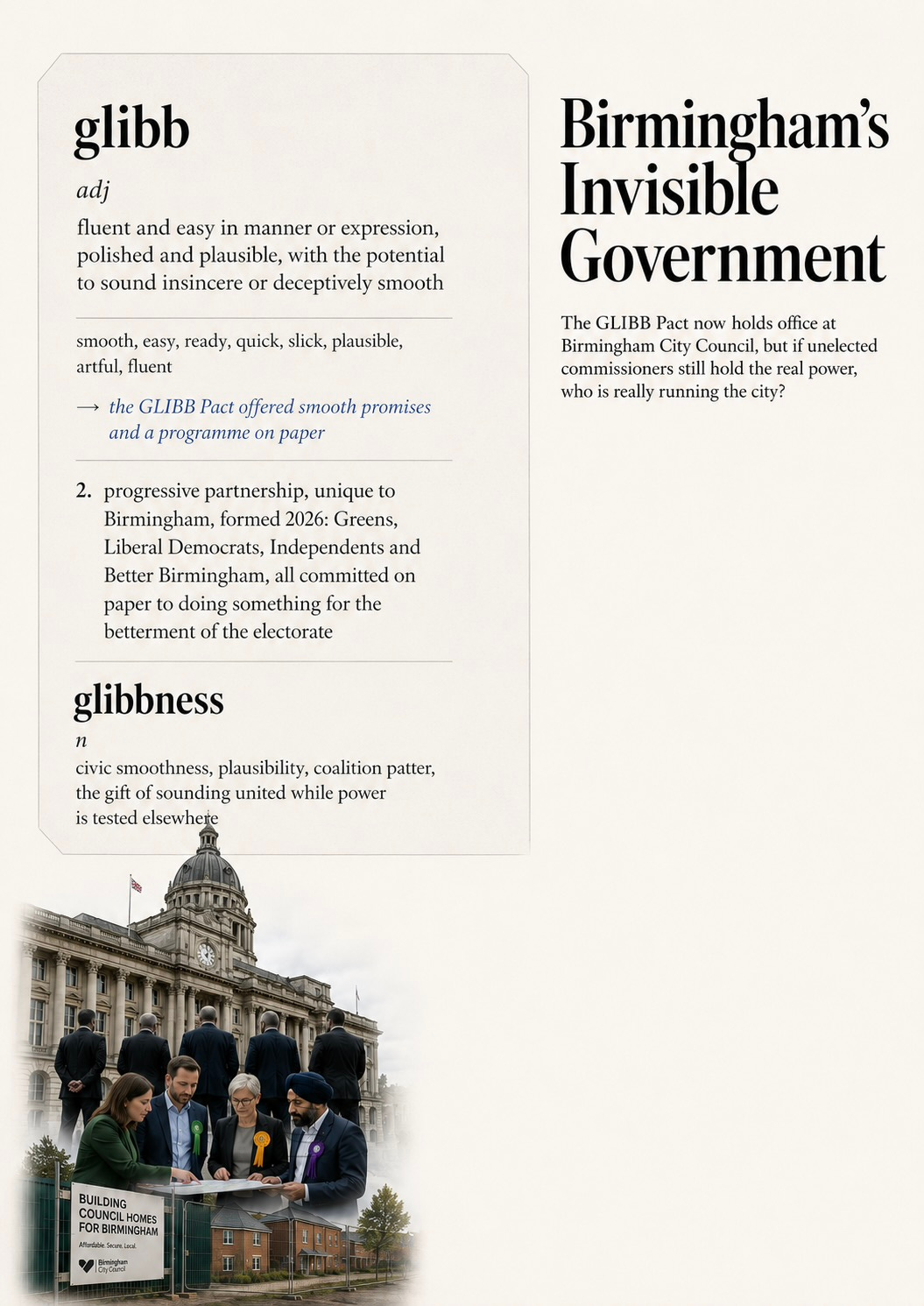
There is a simple democratic test for Birmingham now. Can any resident name a commissioner? Can any resident contact a commissioner? Can any resident question a commissioner? Can any resident vote a commissioner out of office? If the answer is no, or even “not without a torch and a cousin in Whitehall”, then Birmingham does not merely have a financial crisis, a bin crisis, a housing crisis or a political crisis. It has a democracy crisis wearing a sensible suit.
That is why former council leader John Clancy’s intervention on Sarah Julian’s excellent early morning BBC Radio WM show matters. Not because John is having a pop at Tony McArdle. That is the easy version. Old politics. Old wounds. Old Labour. Old rows. In John’s case, an old brain operating like a civic filing system with an espresso machine attached.
Birmingham has just had an election. Labour was heavily rejected. The city now has a Liberal Democrat leader, Roger Harmer, a Green deputy leader, Julian Pritchard, and a loose arrangement of Lib Dems, Greens, Better Birmingham and independents. For convenience, and because Birmingham politics is already ridiculous enough, I shall call it the GLIBB Pact: Greens, Liberal Democrats, Independents and Better Birmingham.
The GLIBB Pact now has the visible authority of office: cabinet, speeches, smiling officers and even applause, which in Birmingham civic life is usually reserved for retirements, funerals and the rare moment someone finds the correct agenda. What it may not yet have is power. That was Clancy’s point. Birmingham residents voted one way, but unelected Labour-appointed commissioners remain, still shaping the city. That goes to the heart of local democracy.
Nobody serious pretends Birmingham City Council has been a model of civic excellence. “Oracle”, “equal pay”, “bin strike”, “bankruptcy” and “temporary accommodation” do not exactly form a municipal hymn. But intervention must not become occupation. Commissioners are not councillors. They do not knock doors in Bartley Green, Erdington, Alum Rock or Northfield. They do not stand in draughty halls seeking votes. They do not get chased about missed bins, damp flats, flytipping, potholes or why council tax keeps rising while parts of the city look lightly abandoned.
They are appointed from above, report upwards and exercise influence sideways. The ordinary citizen is left peering through the municipal fog asking: who are these people and where is complaints? At the annual meeting, after Harmer had been elected leader, I congratulated a senior councillor. I then offered advice, because I am nothing if not shy and retiring. I said: now do something. So I suggested a modest start. Build some council houses.
Not a taskforce. Not a seminar. Not a glossy strategy with a child on the cover and a foreword nobody reads. Actual council houses. Bricks. Mortar. Front doors. Homes where families are not moved around like unwanted furniture. This is rather more important than waging holy war on the motorist or holding another civic conversation about flags.
The Liberal Democrats said in their manifesto that the council must urgently speed up social housing, prioritising it over so-called affordable housing, often affordable only to people with the income of a minor royal. Another part of the GLIBB Pact put it plainly: social housing, not luxury flats. Council-owned land should be used for social rent homes. That was the Greens. Either way, the commitment is there. Social housing. Not warm words. Not “affordable” homes with a gym and a rent that requires a hedge fund.
When I raised this, the reply came back that permission would be needed. Permission? That made my ears stand up like a municipal meerkat. Permission from whom? If the answer is the commissioners, Birmingham’s new political leadership has a problem. If elected representatives cannot push social housing without unelected commissioners leaning over the balcony of power like imperial prefects, what exactly did Birmingham vote for?
At this point I suggested no confidence in the commissioners. Naturally, this was the moment I noticed the Lead Commissioner sitting rather close by in the public gallery. You may care to insert a “whoops” here. I did not feel the need. I do not withdraw the point. I would sharpen it.
Three years on, what has this intervention delivered that residents can feel? You could argue it has got worse. The bins remain a public humiliation. Housing remains desperate. Temporary accommodation remains a civic wound. The city remains unsure where real authority lies. And they have cost us millions of our pounds to boot. Why?
If commissioners exercise public power, they must be publicly reachable. If they shape decisions, they must explain themselves. If they set the boundaries for elected councillors, residents should know who drew them. At the weekend, I submitted a Freedom of Information request asking Birmingham City Council for the business email address, postal address and contact arrangements for the commissioners. I also asked how public correspondence to commissioners is received, forwarded, acknowledged or answered.
I did this because the commissioners appear to hide away, with no clear public contact details on the council website. Let us see what comes back. To be clear, I am not asking for private home addresses or personal details. I am asking for public contact arrangements attached to public functions exercised over a public authority, paid for by the public. That should not require a treasure map, a séance or a retired permanent secretary.
There is something almost Victorian about the arrangement. The commissioners appear, issue letters, attend meetings, shape decisions, pronounce on improvement and retreat into the official fog. Their names are published. Their reports are published. Their fees may be listed, but the true costs are another matter. That is another Freedom of Information request I am waiting on. Accessibility is not the same as existence. A lighthouse is visible. That does not mean you can ask it why your bins have not been collected.
Democracy only means something if the people who win office can govern, and those who govern can be held to account. The commissioners may say they are necessary. They may even be right. But necessity is not a blank cheque. A city cannot be told to vote, then told the real decisions are elsewhere. A new administration cannot be told to lead, then need permission to move. Residents cannot be told to trust a system they cannot see, question or remove.
So here is the test for the GLIBB Pact. Do not manage decline politely. Do not inherit Labour’s mess, wear a nicer tie and call it renewal. Do not spend the next year saying nothing can be done because permission is required from people most residents could not pick out in a bus queue. Put the question openly. Who runs Birmingham?
If it is the elected council, then govern. If it is the commissioners, let them come out from the shadows, publish their contact arrangements, answer residents directly and explain why they still need to hold the reins after voters threw the old riders off the horse. And if nobody can name them, contact them, question them or vote them out, then Birmingham should say so plainly.
That is not democracy. That is remote control government. After everything this city has been through, Birmingham deserves better than being run by people whose greatest political skill appears to be staying just out of reach. At that point, our elected representatives should jolly well put a vote of no confidence in them before we, the great unwashed, and I am sorry, I know it is early days, but life goes on apace, put one in the GLIBB Pact.
Getting something to the Commissioners is as I have experienced virtually impossible. The bureaucracy has a way of stalling and stalling. As to Freedom of Information requests I made one in April and I am waiting, despite a promise to provide it after the election. Democracy is a precious commodity but once lost it is hard to restore. But do not blame the Commissioners. They are the executioners. They are not the guilty party… the last administration is to blame, both the politicians and the council officials who allowed it, who permitted it, to happen. The first group are no longer there… the second group remain in place still. Yes politicians make the decisions that caused the bankruptcy but they take advice and that advice was either taken or ignored. Either way officials share blame. From my limited knowledge a lot of what went on before the election reveals a laxity in governance, which is at the heart of the problem. Unfortunately there is no commissioner to oversee governance.
Now to the Liberal Green coalition… those with a keen eye on the past will remember the first Labour government in 1924. At that time Labour had 58 MPs in a Commons of over 650. It lasted nine months. It lasted because the dominant party, the Tories, were divided. Obviously the result on May 7 resulted in no dominant party but the refusal of the other parties to engage with the largest elected party is similar to the refusal of free traders in the Tory party to engage with the protectionist majority. So what we have is the Liberals, who lost vote share throughout Birmingham and a seat in 2026, leading the council. This is of course an affront to democracy as it was in 1924. The Liberals though have form when it comes to losing and then wanting power. In 2010 they entered government with the Tories yet today criticise the austerity of which they were a part. Abroad, in past coalitions eg. In Germany, Liberals desire power without responsibility. That is the nature of junior partners in coalitions. What is perplexing is the big winner in 2026, besides Reform, were the Greens. Surely they should have taken the Council Leadership as the senior partners?
As to social housing… forget it. A Council that is broke in a country that is broke cannot afford to build properties that lose it money. Borrowing to build might be, in some peoples’ minds, desirable but when no one wants to lend you money or the interest too high it is not viable. As for an approach to the Secretary of State…mmm…two years through this government and less than 25% of the 1.5 million new houses promised. Indeed most of the completed new build were planned under the last administration. And where are these social houses to be built? Where is there an abundance of council land? I would like to know… Sutton Park? I wonder!
Perhaps a letter to Steve Reed, Secretary of State @ Housing, Communities and Local Government to supplement your FOI request? After all I expect his department appointed the commissioners and someone in the maze receives their reports. Might a Labour MP for a Birmingham constituency also ask a question?