


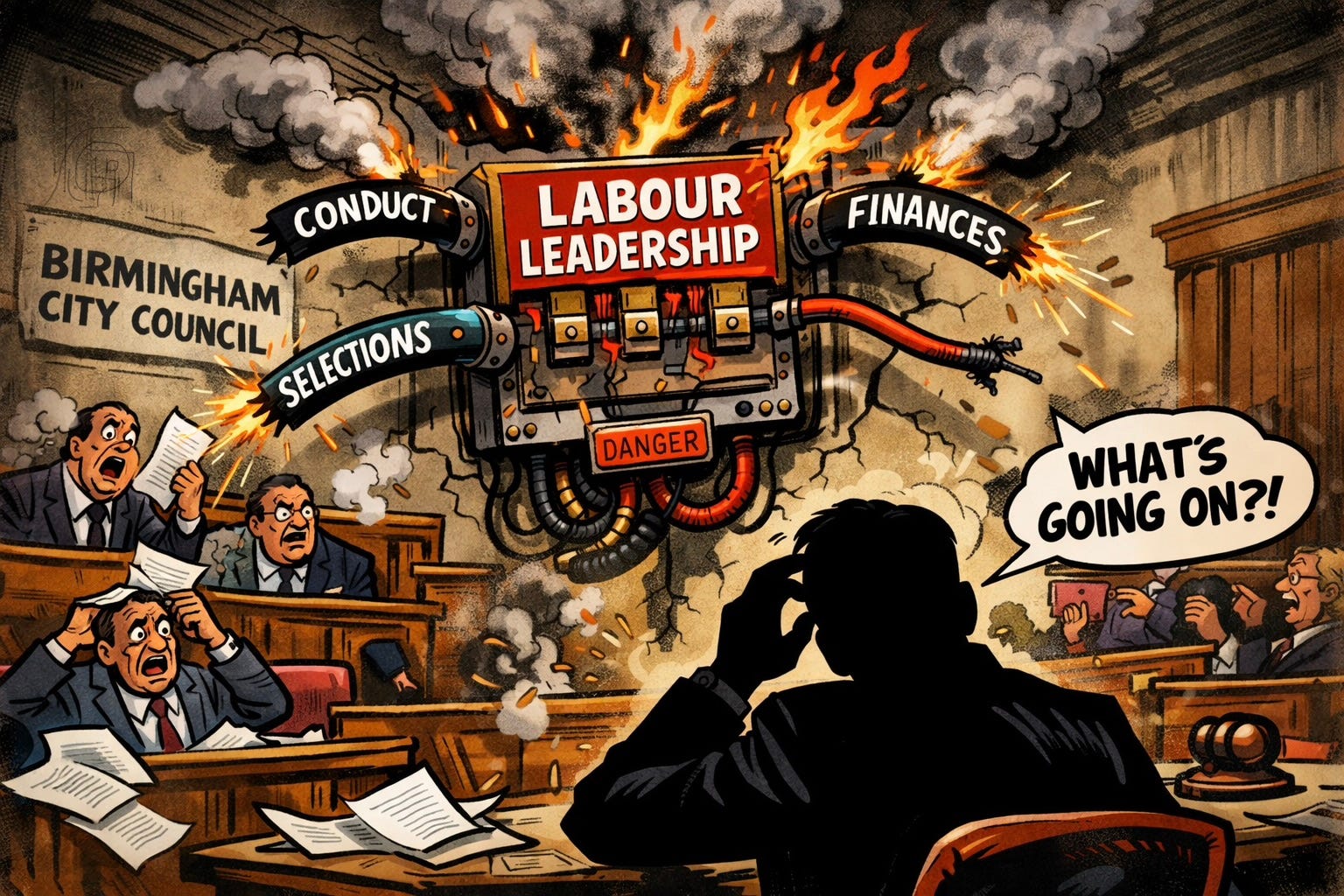
A smell.. !! Not smoke. Not flames. But that low electrical hum you hear before the lights flicker.
In the space of a fortnight, the ruling Labour group at Birmingham City Council has found itself navigating three separate pressures. None individually fatal. Together, politically uncomfortable.
This is not scandal chasing.
It is pattern recognition.
And patterns matter.
1. Allegations and a Cabinet Step-Down
Councillor Jamie Tennant has stepped down from his cabinet role following renewed attention on allegations of sexualised and age-related comments made during a mayoral recount two years ago.
The allegations are detailed and serious. They describe repeated inappropriate remarks, public humiliation and aggressive language. Councillor Tennant has previously indicated that it was never his intention to cause distress and has denied harassment.
An official Code of Conduct assessment was completed on 17 September 2024. The Deputy Monitoring Officer concluded that the Council’s Members’ Code was not engaged because Tennant was present at the count in his capacity as a counting agent, not acting in his formal role as a councillor .
That is a technical but significant distinction.
The complaint was not dismissed as imaginary. It was found to fall outside the Council’s standards jurisdiction because of the capacity in which he was acting .
However, because of the seriousness of the allegations, the matter was referred to the Labour Party’s Chief Whip .
Now, two years later, the issue has resurfaced publicly. Tennant has stepped back from cabinet responsibilities but remains a councillor.
That is pressure point number one.
Leadership and Judgment
The Leader of Birmingham City Council and of the Labour Party group, Councillor John Cotton, appointed Tennant to a cabinet portfolio covering social justice, community and equalities.
The Code of Conduct assessment is dated September 2024 and records referral to the party’s Chief Whip . In any organised political group, the Chief Whip and the Leader sit at the centre of discipline and cabinet formation.
It would therefore be surprising if a complaint of this nature, formally referred into party channels, was not known at leadership level.
If the Leader was aware and judged the matter resolved or insufficient to affect cabinet suitability, that becomes a question of political judgment.
If the Leader was not aware, that raises a different question about internal communication within the ruling group.
Either way, the public is entitled to expect that allegations touching on dignity and equality are weighed carefully before allocating a cabinet brief, particularly one concerned with social justice.
Standards law may turn on technical capacity.
Leadership turns on perception and judgment.
2. The Late Scramble
Elections are only weeks away.
By this stage in the cycle, any disciplined political organisation would normally have its candidates selected, briefed and active. Literature printed. Data mapped. Volunteers mobilised.
Selections are not usually reopened at the eleventh hour.
Yet information seen by Midlands GRIT from a reliable source shows that Labour has reopened applications in a number of Birmingham wards, describing this as the “final” opportunity before a fast-approaching deadline.
These are not marginal experiments. In more settled times, several would have been regarded internally as highly favourable.
But what does favourable mean in Birmingham now?
After effective bankruptcy. After service reductions. After months of corrosive headlines. After national political volatility.
The vocabulary of safe seats feels increasingly dated.
When applications are reopened only weeks before polling day, two explanations present themselves.
Either the original field was not strong enough.
Or there was no meaningful field at all.
Neither interpretation suggests a governing group entirely at ease.
Political strength is not just measured in seat totals. It is measured in confidence, depth and the willingness of members to step forward.
Late recruitment tells its own story.
3. Internal Finance Questions
The third strand comes from a recent report in the Daily Telegraph raising concerns about the internal finances of the Birmingham Labour group, suggesting mismanagement within party structures.
It is important to be precise. These are reported concerns, not formal findings of wrongdoing.
But optics matter.
A ruling group presiding over a city that has experienced effective bankruptcy now facing questions, in the national press, about its own internal financial arrangements is politically uncomfortable.
Internal political group finances sit in a grey zone.
Council budgets are subject to statutory officers and external audit. Party group funds are different. They are political structures embedded within public institutions. They draw contributions from elected members. Oversight mechanisms are largely internal.
When I sat in the Labour Group some twenty years ago, there was a group treasurer. Contributions were modest. Even then, annual reports were not easily circulated. It was informal and largely unquestioned.
Today, councillor contributions are significantly higher. The sums involved are not trivial.
Which raises a straightforward governance question.
What transparency exists over internal political group finances? What reporting standards apply? What scrutiny mechanisms are in place?
These are prudent questions in any organisation, particularly one exercising control in a financially fragile city.
The Arithmetic of Power
Labour remains the largest single group on the Council.
But it does not hold an unassailable majority in the mathematical sense. If every non Labour councillor voted together against it, Labour would lose that division.
That matters.
Because political authority in Birmingham now rests not only on numbers, but on cohesion and perception.
A group that looks confident can carry the chamber.
A group that looks divided or distracted can quickly find itself on the defensive.
None of the three strands outlined here, taken alone, would destabilise the largest group in the Council.
Together, they create cumulative pressure.
Allegations resurfacing.
Leadership judgment under quiet scrutiny.
Candidate recruitment reopened weeks before polling day.
National press raising internal finance concerns.
The pattern is not necessarily scandal.
It is strain.
Strain inside the group.
Strain in public confidence.
Strain in the projection of steady leadership at a moment when Birmingham can least afford uncertainty.
Authority depends on cohesion, credibility and control of narrative.
Right now, the wiring is warm.
Whether it cools or overheats will depend on how firmly the leadership grips the fuse box in the weeks ahead.