

Birmingham’s Longest Early Evening
A hung council, an Andy Burnham vote, two suspensions and a new leader. Just another evening at Birmingham City Council.

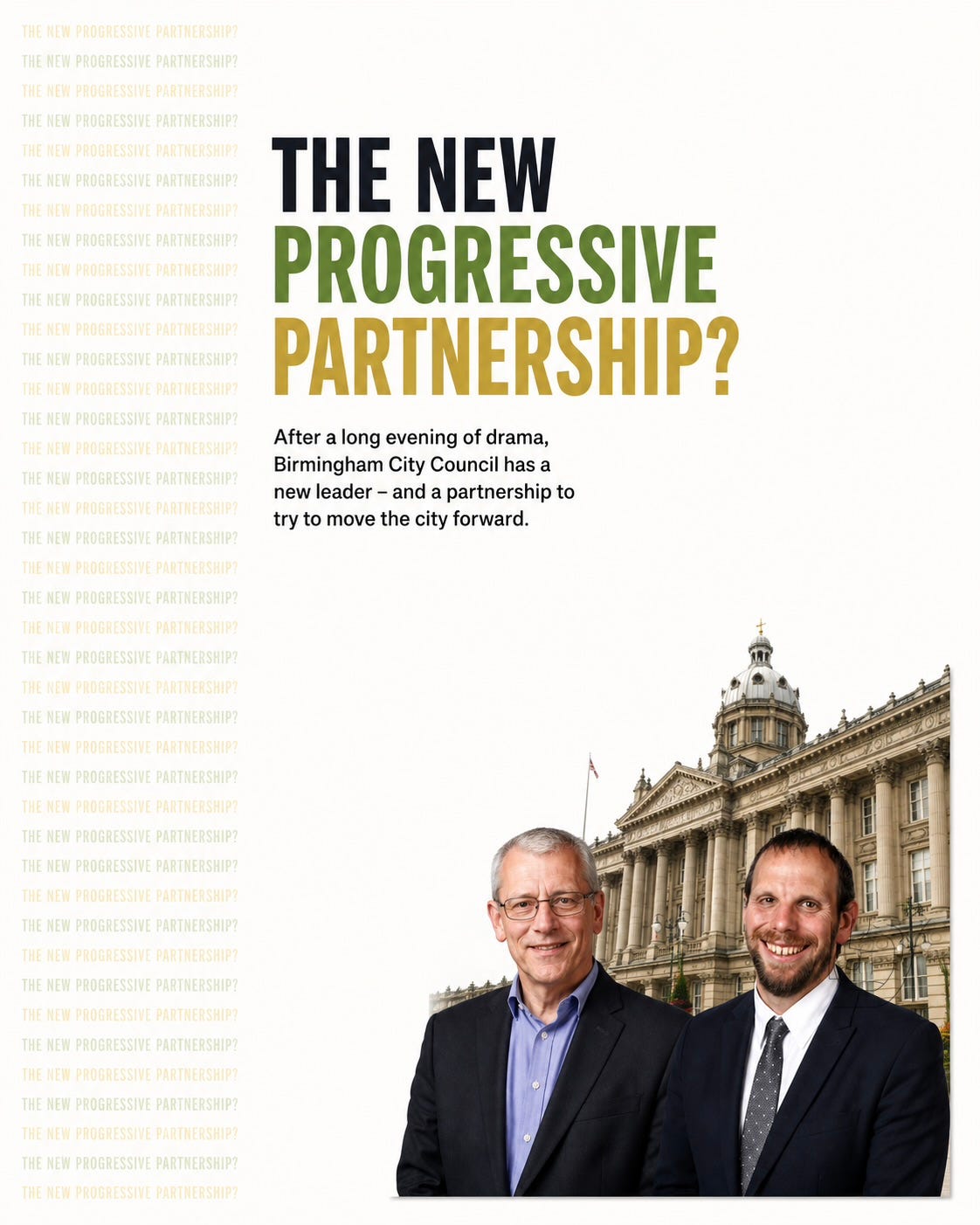
The annual meeting of Birmingham City Council began on a sombre note at 18.07, with a minute’s silence for Henry Nowak, the 18-year-old Southampton student whose murder has shocked the country.
Only after that moment of reflection did Birmingham return to its more familiar civic pastime: attempting to work out who was actually going to run Britain’s largest local authority.
The Lord Mayor arrived fashionably late, nominations were made and then, almost immediately, proceedings were suspended for twenty minutes while councillors disappeared into corners, huddles and whispered conversations. It was less House of Commons and more school disco, with everyone trying to work out who was talking to whom.
When councillors re-emerged, Roger Harmer looked relaxed and cheerful. Robert Alden looked rather more serious. Labour members gathered in an informal meeting on the chamber floor before breaking up with smiles on their faces. Several quietly indicated they intended to abstain.
The city solicitor eventually took charge. Each candidate would get five minutes before councillors were called individually to vote.
Cllr Roger Harmer, Liberal Democrat, went first. Reading from prompts, he spoke of working together, getting Birmingham back on track and focusing on the things residents actually care about. Clean streets. Potholes. Antisocial behaviour. Fixing the bin strike through fair and reasonable negotiations. Less rhetoric, more action. It was a disciplined and thoughtful speech that landed well around the chamber. I clapped.
Cllr Robert Alden, Conservative, followed. Echoing a phrase often used by his late father John, a decent man and former councillor himself, he described Birmingham’s council chamber as the greatest democratic forum outside Westminster. He attacked years of failure, called for action rather than excuses and focused heavily on the bin strike, poor housing, HMOs, green spaces, Oracle and antisocial behaviour. His most interesting proposal was to devolve more funding to ward councillors so local representatives could actually solve local problems. In a city as vast as Birmingham, it was a point that found some sympathy. I clapped.
Then came Reform UK’s Cllr Jex Parkin. Delivering a confident and rather good maiden speech, he argued that Birmingham needed change rather than political posturing. Reform, as the largest opposition party, should be given the opportunity to tackle decline and restore confidence in local services. Whether members agreed or not, it was an assured performance from a newcomer.
Then came the vote. The city solicitor read out each councillor’s name and they shouted back who they were voting for.
The Greens, Liberal Democrats and independents largely lined up behind Harmer. Conservatives backed Alden. Labour mostly abstained. Most Reform councillors voted for Parkin.
One Labour wag, Cllr Majid Mahmood, shouted out his vote for Andy Burnham.
This created a slight constitutional difficulty, principally because the Mayor of Greater Manchester is not currently a Birmingham councillor and had shown no obvious intention of becoming one. I am not sure whether Labour could find a councillor willing to stand down for him.
The vote was therefore treated as an abstention.
The final result was Harmer 40, Alden 19 and Parkin 18.
And with that, Roger Harmer became the first Liberal Democrat leader in Birmingham City Council’s history.
The chamber then adjourned.
Again.
During the break I congratulated the new leader and may, entirely accidentally, have offered an unfiltered observation regarding one of the Labour Government-appointed commissioners. Unfortunately for me, the commissioner in question, the lead commissioner indeed, was sitting directly above in the public gallery.
Readers may insert their own “whoops” at this point.
Eventually the bell rang for councillors to return. Remarkably, a round of applause broke out around the chamber. The Lord Mayor reappeared accompanied by smiling officers carrying fresh paperwork. In Birmingham local government that is usually a sign that either a breakthrough has been achieved or somebody has finally located the correct agenda.
Harmer then announced a cabinet. it was at this point he announced Cllr Julian Pritchard as the councils new Deputy Leader. Sealing a large part of the new compact. The cabinet was also announced. That drew members from across the city’s three principal political groups, the Lib Dem’s, Greens, Better Birmingham along with other independents, an acknowledgement perhaps that in a hung council nobody gets everything they want and everybody has to live with somebody they would rather not.
For now at least, Birmingham has a leader and a leadership.
After months of bin strikes, political deadlock, anonymous briefings, public rows and enough manoeuvring to keep a chess club occupied until Christmas, that alone felt like an achievement.
Whether the new arrangement lasts is another question entirely.
This is Birmingham, after all.