


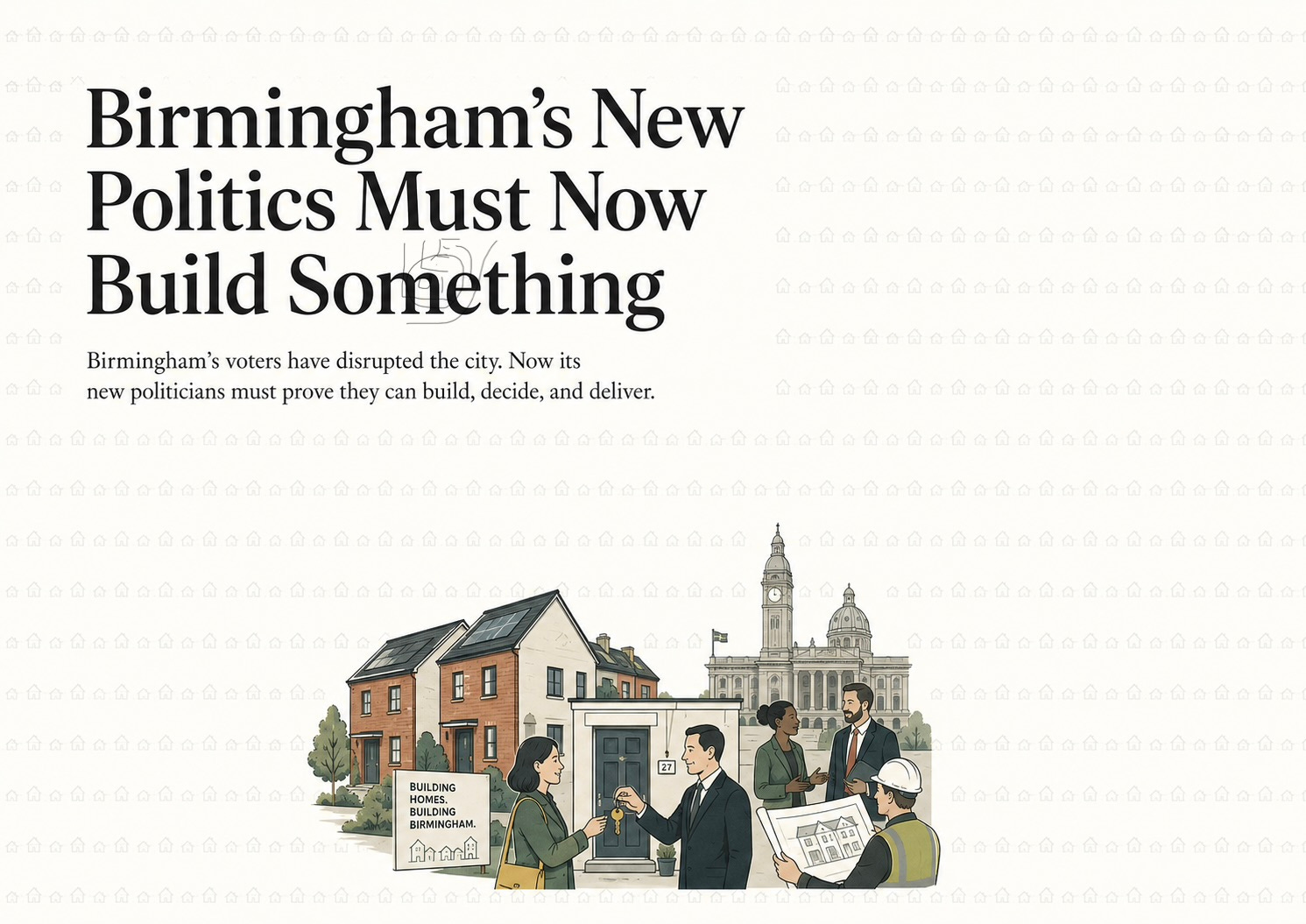
Birmingham’s New Politics Must Now Build Something
There is a particular pleasure in being asked onto a podcast by Adrian Goldberg. Adrian has the rare gift of making Birmingham sound like it matters because, of course, it does. Not as a provincial curiosity. Not as a civic patient lying on a trolley while London consultants in expensive spectacles make sorrowful noises. Birmingham matters because what is happening here now speaks directly to the condition of Britain.
That was the spirit of the Byline Times podcast conversation in which I joined Adrian and newly elected Green councillor Corinne Fowler to discuss whether Birmingham has become ungovernable, what Labour’s collapse in the city tells us about the party nationally, and whether the political rupture now visible here is part of something much larger. The podcast is available on YouTube, and it deserves attention because the Birmingham question is no longer merely a Birmingham question. The city is Britain with the mask slipping and the official PowerPoint still insisting everything is going well.
The city has changed. Labour, once the natural governing force of Birmingham, has been reduced to one player in a broken chamber. Reform has arrived. The Greens have surged. Independents matter. Conservatives and Liberal Democrats remain in the argument. Commissioners still loom over the city’s recovery. Officers still administer. Whitehall still watches. The voters have spoken, but the great question remains: has power actually moved, or have we merely changed the people standing near the steering wheel while someone else keeps the keys in a drawer marked “statutory intervention”?
My argument on the podcast was simple. Birmingham is not ungovernable because Birmingham people are impossible, though I accept we can be lively when provoked and occasionally even when not. It has become ungovernable because the old political model collapsed. The city is over-managed and under-led. It has not lacked clever people. It has had officers, auditors, consultants, commissioners, lawyers, advisers and Whitehall attention. Birmingham has been ankle-deep in cleverness. What it has lacked is political judgement.
The failure was not simply that councillors made bad decisions, though plenty were made. The deeper failure is that too many stopped making political decisions at all. They stopped setting direction. They stopped asking the awkward question. They stopped saying no to the machine. Into that vacuum stepped officers, advisers, commissioners and process. But administrators cannot supply democratic imagination. They can keep a damaged system moving, but they cannot tell it where to go. When elected politicians stop being political, the machinery of government does not become wise. It becomes cautious, defensive and managerial. It manages decline.
That is also the national story. Labour and the Conservatives have both become too comfortable as rival administrators of decline. They speak the same anxious language of process, restraint, delivery, review, stakeholder engagement and difficult decisions. They argue loudly, but too often inside the same exhausted frame. Voters can hear it. They may not read every council paper, but they know when politics has stopped imagining. They know when they are being asked to applaud a “robust process” while the bin bag outside has achieved sentience and is considering standing for election.
This is why Reform and the Greens matter, whether one likes them or not. They are completely different forces. Reform offers rupture. The Greens offer urgency. Both are risky. Both may disappoint. Neither should be wrapped in bunting and mistaken for a ready-made answer to municipal collapse. But both have one immense advantage: they do not sound like the old managerial block. The public may not yet know whether these newer forces can govern, but it increasingly believes the old ones have stopped leading.
That is where Corinne Fowler’s presence on the podcast mattered. It would be easy, and wrong, to say that Birmingham now has “new councillors” and therefore lacks experience. Being new to the council chamber is not the same as being new to life, judgement, scholarship, public argument or civic duty. Corinne is not some empty vessel with a Green rosette and a slogan. She is Professor of Colonialism and Heritage at the University of Leicester, author of Green Unpleasant Land and Our Island Stories, and the director of the Colonial Countryside project. That is not small experience. That is intellectual heft and a willingness to enter contested ground without immediately asking where the nearest safe consultation document is kept.
And this applies across the chamber. Take Joe Peacock, one of the new Green councillors in Billesley. Joe quite fairly pointed out that some of my own election predictions were a touch off the mark. I had predicted one Green and one Reform councillor there, having originally wondered whether Reform might take both seats. It was only the intervention of a very dear friend of mine, a person all true Brummies know and respect, who told me how hard the Greens were working the patch, that persuaded me to shift to one Green and one Reform. Even then, I was wrong. Billesley returned two Greens, including Joe. So there we are. Democracy has spoken, and on this occasion democracy had read the ward better than I had. Annoying, obviously, but one must remain magnificent in defeat.
Good for Joe. If he and his colleagues worked Billesley hard enough to win both seats, they have earned the right to be taken seriously. Being new to the chamber does not mean being lightweight. It may simply mean they have not yet been fully marinated in municipal defeatism. Birmingham City Council has been known to take fresh civic optimism and reduce it to something grey, damp and suitable for filing. But for now, the new councillors arrive with energy, local knowledge and the dangerous advantage of not yet believing every sentence that begins: “Unfortunately, Councillor, due to the complexity of the current framework…”
So yes, Joe Peacock in Billesley, Corinne Fowler in Bournbrook and Selly Park, Eddie and Jex from Reform, Taj as an independent, and all the other new or returning councillors now bearing the mantle for their wards and for Birmingham as a whole: this is the challenge. The public has not merely given you seats. It has given you trust. Not blind trust, not eternal trust, and certainly not the sort of trust that comes with a civic sofa and a commemorative biscuit tin. It is conditional trust. It says: the old lot stopped deciding, so now you decide.
That is the vacuum you have been elected into. Fill it properly. Do not become the fresh faces of the same old paralysis. Do not spend the first months proving Birmingham can produce a new generation of people able to sound concerned in three committee-approved paragraphs. The voters have had enough aspiration to insulate the Library of Birmingham. They voted for disruption because the old order failed to act. Now disruption has to become decision.
And if the new council wants a first test, make it a proper one. Not flags. Not another symbolic row in which everyone discovers they are morally braver than everyone else while the city waits for a repaired service, a swept street or a decent home. Flags matter to people, and so do identity, memory and belonging, but Birmingham has more urgent things to do than spend its first burst of democratic energy wrestling over cloth on poles. Start with homes. Proper council homes. Walls, roofs, doors, keys. The sort of politics that does not need a lengthy explanatory motion because a family can sleep inside it.
The irony, sharp enough to slice a ceremonial sandwich, is that the modern mechanism for Birmingham municipal housebuilding was not some grand Labour act of working-class resurrection. Birmingham Municipal Housing Trust was set up in January 2009 to lead the council’s new-build housing programme. It was part of the council, not an arm’s-length body. By 2018, Birmingham had built thousands of homes through it. So where were Labour, the self-advertised heroes of the working class, while the mechanism sat there waiting to be used with full municipal fury?
That is the charge. Labour did not merely fail to build enough. It failed to treat council housing as a central political mission. It allowed the machinery of municipal housebuilding to become technocratic, cautious and partial, when it should have been the beating heart of Birmingham’s recovery. Shame on Labour for that. Not shame in the candlelit vigil sense. Shame in the practical sense. You had the language of social justice, you had the history, you had the moral inheritance, and you had a mechanism. Then Birmingham still ended up with a housing crisis, families trapped, tenants waiting, estates under pressure, and the city reduced to talking about “options” as if homes were a philosophical puzzle rather than walls, roofs, doors and keys.
So to the new councillors: show us you are worthy of the moment. If the problem was that the last political class stopped making decisions, the answer cannot be that the new political class learns to avoid them more politely. Tell the administrators, officers and senior people whom this city pays to support the democratic will: build. Not someday. Not after a spiritual retreat with the risk register. Build.
Use contractors by all means. Builders build. That is not the problem. But let the council be the civic builder. Let the council own the mission, control the rents, hold the asset, house the tenants, and answer to the public. Not some arrangement where a large private company extracts the profit, a consultancy extracts the adjectives, and the council gets invited to pose in a hard hat beside a building nobody on an ordinary income can afford. Birmingham needs municipal social housing, not another brochure full of people laughing near shrubbery.
And because managed decline hates few things more than a calendar, let us give the new council a date. By 1 January 2027, Birmingham should be able to show real progress on municipal social housing: land identified, a route approved, work underway, and, if humanly possible, the first keys handed to Birmingham tenants. Not a vision board. Not a strategy refresh. Not a glossy PDF featuring a diverse group of smiling people pointing at a sapling. Keys. Doors. Homes. Families moving in.
By New Year’s Day 2027, Birmingham should not be hearing another speech about aspiration. It should be hearing a front door close behind a tenant who has just been housed. That is the sound of politics becoming real. A key in a lock. A kettle going on. A child choosing a bedroom. A council rediscovering that the point of power is not to describe need, but to meet it.
And if the answer comes back, “Sorry, Councillor, but…” then treat that as the beginning of the argument, not the end. That phrase has done a great deal of damage to British public life. It is the mating call of managed decline. Sometimes it is legally necessary. Sometimes it is financially true. But far too often it is simply the sound of a system trying to persuade elected people to sit down and behave themselves. The public did not kick holes in the old political map so the new councillors could be trained to nod at excuses.
As for the commissioners, the same challenge applies. They have already cost Birmingham a very large sum in fees and expenses. If after all that money the answer to a political priority like council housing is still a long face, a stern letter and another lecture on constraints, then the city is entitled to ask what exactly it has bought. Grip? Guidance? Or just very expensive permission to keep declining?
So let the new council say plainly: municipal social housing is a political priority. We are going to identify land. We are going to use the tools available. We are going to bring forward a scheme. We are going to put tenants into council homes. We are going to do this with legal care, financial discipline and public urgency. But we are not going to allow the word “complex” to become a padlock on the future.
The new politics is now on trial. The Greens cannot remain permanently innocent. Reform cannot remain permanently outside. Independents cannot simply denounce the machine without helping decide what should replace it. Labour cannot hide behind history. Conservatives cannot pretend the national record is someone else’s luggage left on the platform. Commissioners cannot claim endless authority without visible democratic restoration. Officers cannot keep offering fluent process while the city waits for judgement.
Next week I will be writing a series of pieces expanding the argument that came out of the podcast: Birmingham as Britain with the mask off, politicians leaving the field, commissioners and democratic hollowing-out, Labour and the Conservatives as rival administrators of decline, and Reform and the Greens as the new politics of rupture.
But the point that links them all is simple. Birmingham cannot be saved by administration alone. Nor can Britain. Officers can administer. Commissioners can supervise. Civil servants can advise. Consultants can report. Lawyers can warn. Auditors can qualify. Working groups can meet until the sandwiches curl at the edges. But only politics can lead.
Birmingham’s voters have disrupted the city. Now the city’s politicians must make disruption useful. The old parties were punished because they stopped deciding. The new politics will only earn its keep if it starts.
Build something. House someone. Fix something. Decide something.
And by 1 January 2027, hand someone the keys.
That is where renewal begins.
I am a foreigner from the South. I came to Brum over 20 years ago and have live in the south and west and north of the city since then. I have walked in those years every part of the city. My conclusion is that it is not and never has been while I have been here a cohesive place. It has always been divided and those divisions were hidden by the dominance of a one party state, Labour. When a child I live a while in a similar one party state called Spain under Franco’s Fascist dictatorship. In many respects when I came to Birmingham things were familiar. The lies of the one party rulers were self evident. Every now and then the propaganda would spew forth how this and that was planned and how building for this or that would start next year. Take for example the Typhoo wharf… nearly tens ago the then Council Leader Ian Ward appeared on TV and in the local newspaper, which has been the propaganda machine for Labour, stating that a deal has been signed to develop the wharf and picture of what it would look like were shown but it never happened. And now there a new plan. Take for example also Perry Barr former athletes village, which was never used by athletes because it was not finished in time, and is now filled with migrants when locals live in squalid HMOs… HMOs that grow in number day by day. Unlike the middle class liberal Moseley types I have visited some of these because I have friends who lived in them. They are a disgrace to a civilised society. But back to Spain for a second. I had friends in Franco’s Spain, where every was in the propaganda as in Birmingham, lovely. But I visited my teenage friends with chickens in the kitchen and no electricity because they could not afford the connection to the grid. Another interesting link between Spain then and Birmingham was that those who represented in the Cortes in Spain the poor working class areas rarely lived there. The same was true in Labour Birmingham. It was hard to find the facts because most councillors unusually, unlike most areas, kept their address a secret. But gradually I discovered the truth through other means. A parish priest is required to live in his parish but not so with councillors ; more’s the pity. I asked a council official to change the rule allowing anonymity so that the first part of the post code say B44 could be known but that was months ago and I have yet to have a concrete answer. Of course in Franco’s Spain the fascist representative would not reflect the socialist leanings of his electors (yes there were elections but with only party candidates). In Birmingham the reason for living in another part of city or outside it was more insidious. It was that they did not wish to live among the “poor and unwashed”, their electors.
Birmingham is ungovernable. You spoke of another podcast with a person who does not live here, an academic on colonialism… well well there are certainly colonies here. In fact the City is divided into distinct colonies. You speak of your podcast and people in the Moseley area as if they know Oscott or Kingstanding or even Frankley or Longbridge. It is no good having a podcast discussing the future of BIof