

Birmingham’s Polling Day: When the Parties Broke and the City Was Left to Decide
Birmingham votes today amid party splits, public anger and political drift. The ballot paper has become a battlefield.

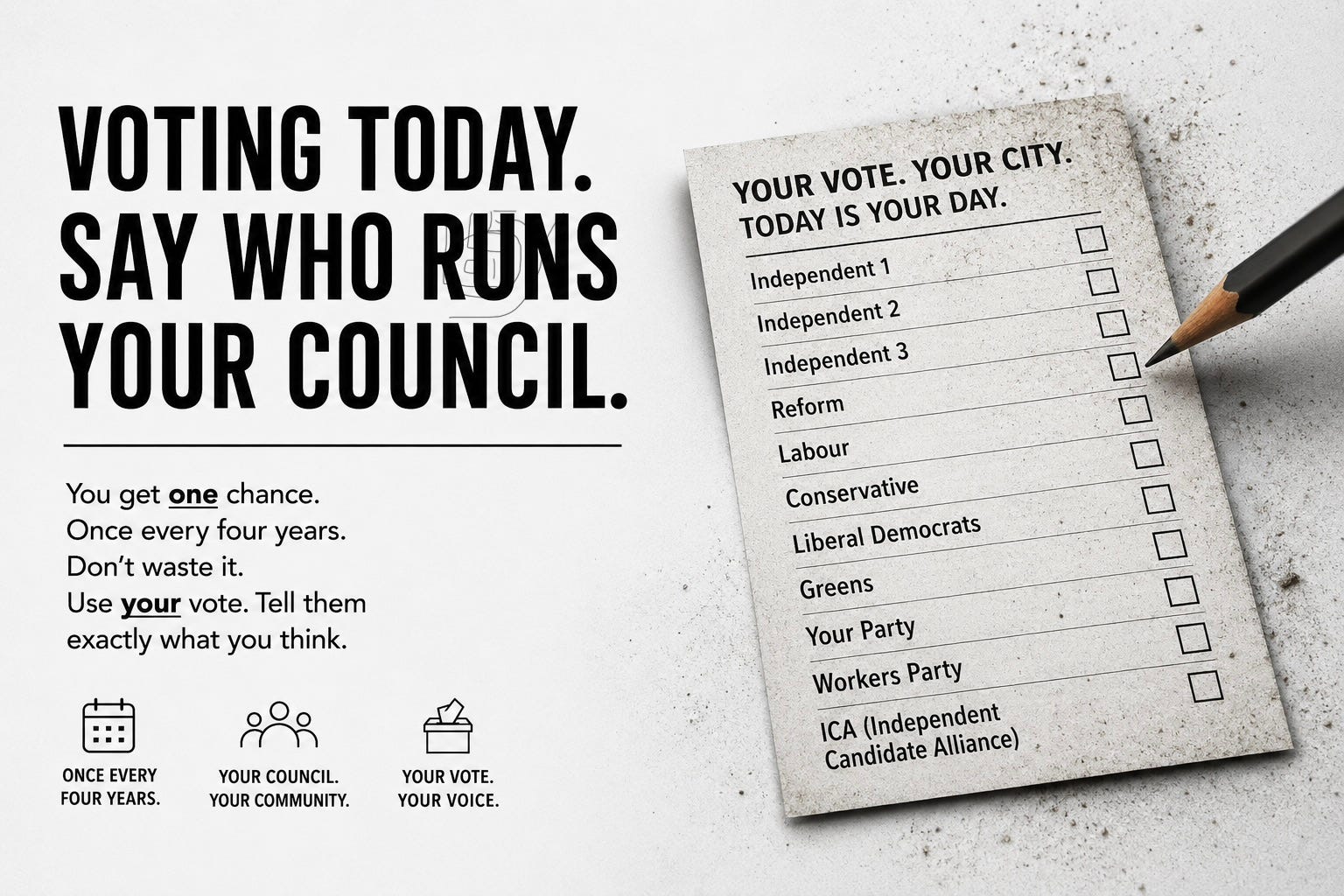
Polling day has arrived in Birmingham, and it does not feel like a normal election. It feels like a moment of exposure. The kind where everything that has been papered over, spun, deferred, or quietly managed finally steps into the light. This is not simply a contest for council seats. It is a test of whether the political machinery that has governed this city for decades still holds together, or whether it has already begun to come apart.
The numbers alone tell you something has shifted. Labour, once dominant, is staring at the possibility of losing half its seats. Reform is rising fast, the Conservatives are circling, the Greens are advancing in pockets, and independents are everywhere. Not as curiosities, but as contenders. More than six hundred candidates are chasing just over a hundred seats. That is not stability. That is a system under strain.
But the quiet story of this election is not just that Labour may lose seats. It is that Labour has, in places, expelled parts of itself onto the ballot paper. Voters are not just choosing between parties. They are choosing between versions of the same political family, now standing against each other in full public view. Former Labour councillors, people with years of local work behind them, now stand as independents or under looser banners, knocking on the same doors, speaking to the same residents, but without the party that once defined them.
That does not happen in a healthy political organisation. It happens when control tightens, trust weakens, and the bond between the centre and the street begins to break. In Birmingham, that break has been visible for some time. Bankruptcy, equal pay liabilities, rising council tax, failing services, bin strikes that have become a symbol of something deeper. All of it has eroded confidence. And when deselection came for some, they did not quietly disappear. They stepped outside the party and stood again, this time on their own terms.
Labour’s problem now is not just competence. It is credibility. A party that presided over decline now asks to be trusted with recovery, while at the same time replacing known local figures with candidates many voters have never heard of. That might be called renewal inside a party meeting. Out on the street, it looks more like confusion.
Yet before Labour’s opponents get too comfortable watching that confusion unfold, they might pause. Because this election is not a morality play with one villain. It is a civic autopsy with multiple contributors.
The Conservatives offer critique, and much of it lands, but critique is not the same as conviction. Voters hear what is wrong. They are less certain about what comes next. Reform arrives with energy and momentum, and in a city this frustrated that counts for something, but momentum is not the same as structure. Building a slate of candidates quickly, rejecting others with long records of work, and riding a wave of anger can win votes. Running a city the size of Birmingham requires something more durable than that.
The Greens continue their quieter advance, often disciplined, often locally focused, picking up support where others falter. But they remain too thinly spread to carry the weight of a council this complex. And then there are the independents. Some serious, some reactive, some rooted in genuine local grievance, others shaped by global events finding their way into local politics. In areas such as Alum Rock, tensions have already spilled into the open, with allegations, counter-allegations, and police presence reminding everyone that elections are not always tidy affairs.
Even some of the more explosive claims being circulated require care. Accusations around candidates, including references to convictions overseas, need to be treated with context as well as seriousness. A conviction secured in a country like Yemen, with all the political realities that implies, is not the same as one tested through the British courts. That does not make it irrelevant. It does mean it should not be reduced to a campaign slogan without scrutiny.
All of this leaves the voter in an unusual position. The ballot paper is no longer a simple choice between parties. It is a patchwork of names, some familiar, some not, some wearing new labels, some shedding old ones. In some wards, the contest is effectively Labour versus former Labour, with other parties hoping to come through the middle. In others, it is a straight fight between anger and exhaustion.
What Birmingham faces, then, is not a choice between strong options. It is a choice between incomplete ones. Parties are shedding candidates. Candidates are shedding parties. And voters are left trying to decide what still carries weight, a party label, a familiar name, or simply the least unsatisfactory option on the page.
If this feels chaotic, it is because it is. Labour is paying the price for control without delivery. The Conservatives for criticism without credibility. Reform for momentum without structure. The independents for passion without a plan. And through it all, the city itself continues, residents dealing with the daily reality of services that do not work as they should, bills that rise, and a council that has yet to convince them it knows how to turn things around.
There will be winners from this. There always are. Some candidates will slip through the fractures created by their own parties. Some unknown names will become councillors overnight. There is even the real possibility that the next leader of the council is not, at this moment, even a sitting councillor. That alone tells you how far from normal this election has drifted.
But there is something else here, something that should not be lost in the noise and the manoeuvring. This is the one moment, the only moment most people get, to register a view that cannot be ignored. Local elections do not come around often. In fact, they come around far too rarely. Once every four years for something this important is, in itself, a quiet democratic failure.
Which is why, whatever the frustrations, whatever the cynicism, whatever the sense that none of the options quite measure up, this is not the moment to step back. It is the moment to step forward.
Because if the parties have made a mess of it, and many would argue they have, then the only answer left is the one thing they cannot control.
The vote.
Cast it. Use it. And tell them exactly what you think.
Well my guess is that they will reshape the bin service and that may mean contractors coming in and current bin workers booted out. But my preference would be proper management of the service. I certainly can't believe you feel no garden waste collection or no recycling is a better way to run the service although I do suspect that out recycling is a bit of smoke and mirrors as to where it actually ends up. As for the feathers well for some your probably right but I feel certain it's not for all
Thanks again Richard - I think you are touching on something many people quietly recognise, even if they are often reluctant to discuss it openly.
Naturally those who lead such discussions always say "we would love to discuss it" but then slink away.
Birmingham is no longer a politically or culturally uniform city. Was it ever ? Different areas increasingly have very different social identities, priorities and voting behaviours, and that clearly affects how the city is governed and how politics is conducted. In some wards, politics is becoming far more community-based and identity-driven than the old broad Labour-versus-Conservative model that dominated for decades.
That does not automatically mean communities cannot live together successfully, but it does mean the traditional idea of Birmingham speaking with one coherent political voice is becoming harder to sustain. The old civic glue has weakened considerably.
I also think there is a wider frustration building among many residents who feel that perfectly legitimate concerns about cohesion, integration and representation are too often dismissed outright rather than discussed honestly. That tends to deepen polarisation rather than reduce it.
Where I would slightly differ from you is that I would be cautious about viewing the city purely through a racial or religious lens. Economic decline, weak governance, housing pressures, educational disparities and the collapse of trust in mainstream parties are all feeding into the same atmosphere as well. Essentially it not about race it's about social class.
Your broader governance point, however, is a serious one. Birmingham is now enormous, highly diverse and politically fragmented. There is a respectable argument that a more devolved borough-based structure might produce better accountability and more responsive local decision-making than the current over-centralised model.
At the very least, this election is likely to expose just how different various parts of the city now are politically, culturally and socially, and pretending those differences do not exist is probably no longer sustainable. We will know Friday evening ...