
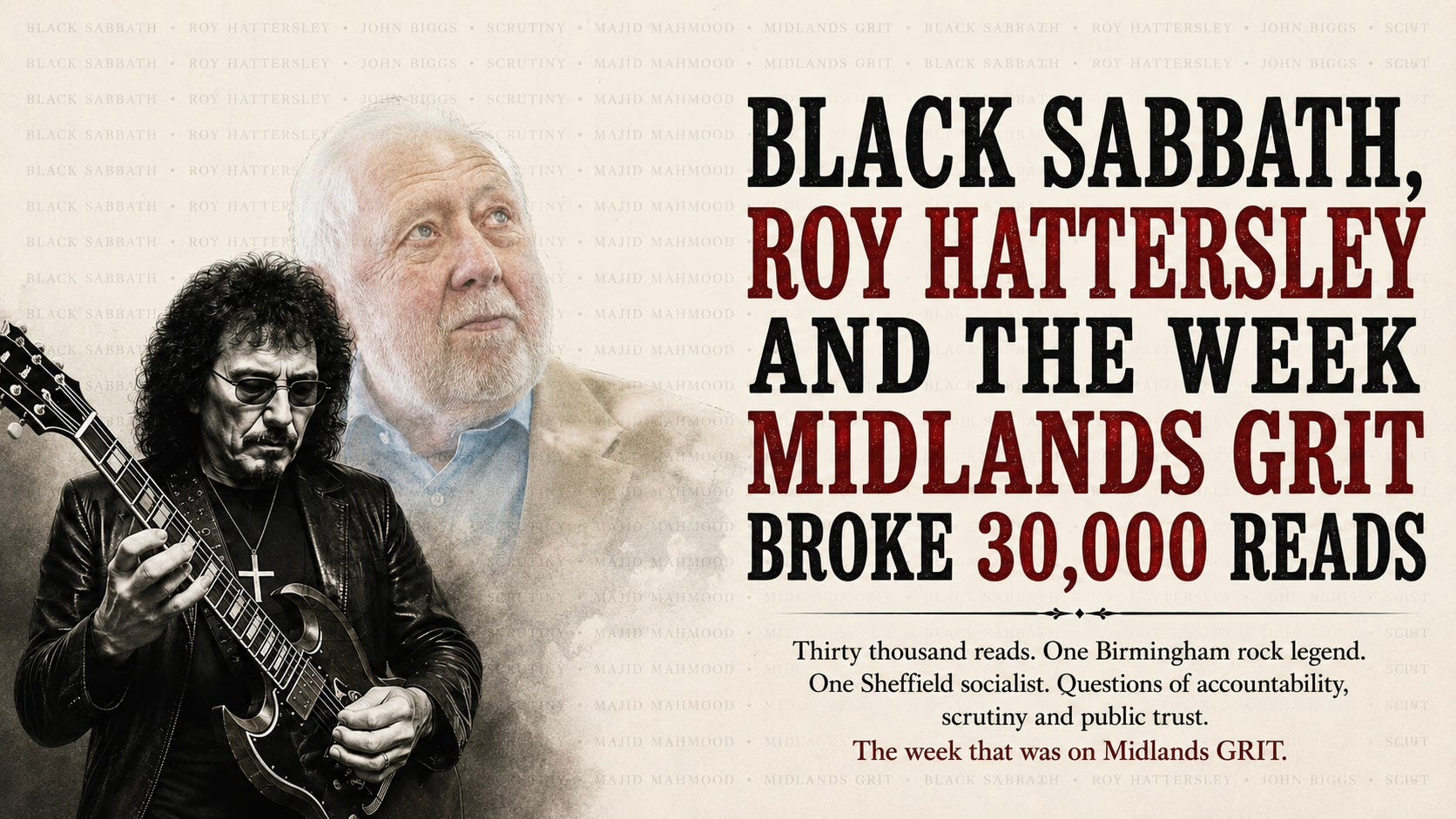
Black Sabbath, Roy Hattersley and the Week Midlands GRIT Broke 30,000 Reads
Thirty thousand reads, Tony Iommi Birmingham rock legend, a Sheffield socialist, scrutiny battles, democratic arguments and questions about who really shapes the future of Britain’s second city.

There are weeks when you feel you are pushing a wheelbarrow uphill, and then there are weeks when readers decide to come with you. This week Midlands GRIT passed 30,000 reads across all platforms. For a publication of this size, that feels like a proper milestone. Most weeks I hope to hit 25,000. Sometimes we just about scrape past 20,000. To break through 30,000 feels rather like achieving a personal best after months of training. Thank you. More importantly, thank you for keeping me honest. The readers of Midlands GRIT are a discerning bunch. If I rush something, cut a corner or throw together a swift one because the clock is beating me, you usually notice. That is not a complaint. Quite the opposite. It means standards matter. Hard work still matters. Research still matters. Good writing still matters. Perhaps that is an old-fashioned truth, but some truths survive because they are true.
The runaway success of the week belonged, quite rightly, to Tony Iommi MBE. That was hardly surprising. When Birmingham produces global cultural giants, Tony sits near the very top of the list. Black Sabbath did not merely become a successful band. They helped create an entirely new musical language, and Tony’s guitar playing became its foundation. Before Sabbath, the riff was often decoration. Tony turned it into the thing that held the whole song together. What struck readers was not simply the honour itself, but the story behind it. A young Birmingham factory worker suffers a devastating industrial accident. The tips of two fingers are lost. A dream should end. Instead he adapts, invents, perseveres and changes music forever.
There is something profoundly Birmingham about that journey. This city has always respected resilience. We understand people who get knocked down, stand up and carry on. Those of us from industrial Birmingham know something of that world. Machines could be unforgiving. Mrs Olley’s mom had her thumb crushed. I once drilled through my own index finger and into the bone. Crikey. Yet that was life in our industrial city. People carried on because they had to. Tony carried on too, but in doing so he gave the world something astonishing. The MBE is richly deserved. And if my article generated so much interest, perhaps it reflects a simple reality. When one of Birmingham’s genuine global stars receives recognition, people pay attention. Tony also has new musical work on the horizon, so Midlands GRIT will be keeping a watching brief and reporting properly as and when.
Tuesday brought a very different conversation. Nigel Farage’s essay on standards and merit collided with comments from former senior Birmingham Labour councillor Majid Mahmood and Sheikh Zahir Mehmood. At the centre of the debate was a simple but uncomfortable question. How important is English language competence for elected representatives? My answer remains the same. No state test. No qualification barriers. No bureaucrat deciding who can stand for election. But voters are entitled to ask questions about competence. Councillors must read reports, challenge officers, understand budgets, engage with residents and participate fully in public meetings. Democratic rights come with democratic responsibilities.
That issue generated strong reactions because it sits at the intersection of democracy, identity and practical governance. I left school at fifteen with no qualifications, so I have no interest in building a clipboard democracy where officials decide who is clever enough, fluent enough or polished enough to appear on a ballot paper. But democratic freedom does not remove democratic responsibility. If English is the working language of the council, voters are entitled to ask whether candidates can do the job. Parties should raise standards. Voters should ask harder questions. Communities should stop accepting symbolic representation when effective representation is needed. Democracy belongs to the voters, but competence still matters.
Wednesday focused on a man most Birmingham residents probably could not identify in the street, yet Birmingham taxpayers help fund his work. John Biggs serves as a political adviser within the commissioner structure overseeing Birmingham City Council’s recovery. The article was not really about John Biggs himself. It was about visibility. Public office carries public accountability. Public money carries public interest. Birmingham residents know who their councillors are. They know who their MPs are. They can usually identify senior council figures. But many struggle to understand who influences the commissioner regime, what advice is being offered and how those decisions shape the future of the city.
The invitation remains open. A coffee. A conversation. No ambush. No theatrics. Simply a discussion about how Birmingham rebuilds trust after one of the most significant local government failures in modern British history. I am told John is not a bad bloke if you get to know him. Good. Let us get to know him. If Birmingham is paying for the advice, Birmingham deserves to hear it. And if he is claiming expenses, I shall expect him to buy the coffee.
Thursday turned to scrutiny, which everybody loves until scrutiny starts asking questions. At Birmingham City Council, Labour and Reform have criticised Conservatives holding all scrutiny chair positions. At the West Midlands Combined Authority, Conservatives have criticised Labour and Reform for reducing scrutiny arrangements. Different politicians. Different buildings. Remarkably similar complaints. The humour writes itself. Yet beneath the irony sits a serious principle. Scrutiny exists for the public, not for whichever political group happens to be in charge this week.
Good scrutiny should make life uncomfortable. It should ask awkward questions. It should open drawers that some people would prefer remained closed. Birmingham’s history shows why this matters. The city spent substantial sums supporting scrutiny structures over many years, yet still found itself facing financial collapse, a Section 114 notice and government intervention. That does not mean every scrutiny chair failed. Some worked hard. Some undoubtedly spotted problems. But taxpayers are entitled to ask whether the system delivered the challenge and oversight they paid for. The new scrutiny leadership now has an opportunity. I wish them well. Do a proper job, please. The public deserves nothing less.
Friday closed with a tribute to Roy Hattersley. Roy never pretended to be a Brummie. He remained proudly Sheffield, proudly Yorkshire, proudly Sheffield Wednesday and proudly Labour. Somehow that made Birmingham trust him more, not less. Following conversations with former Birmingham Perry Barr MP Khalid Mahmood, a picture emerged of a politician who understood something many modern politicians appear to have forgotten. Relationships matter. Trust matters. Communities matter. Roy represented Birmingham Sparkbrook for more than three decades while navigating Labour’s internal battles, the Militant years and the SDP split. Yet people remembered him not because he won every argument. They remembered him because he remained authentic.
Roy’s Birmingham strength rested on relationships. Khalid’s father, Sabir Mirza, helped keep Roy connected to Sparkbrook at a time when newly arrived families needed help with forms, interviews and the daily business of getting by in a new country. That built trust, and trust is the currency of politics. Roy also understood Birmingham City Council. He worked with Councillor Dick Knowles, later Sir Richard Knowles, but was perfectly capable of sharp criticism when services failed. The difference was that criticism led to engagement. He wanted things fixed. In a political age increasingly dominated by branding, focus groups and carefully managed messaging, authenticity remains a surprisingly powerful asset.
Looking back, perhaps there is a common thread running through the entire week. Tony Iommi. Roy Hattersley. John Biggs. Scrutiny. Majid Mahmood. Different subjects. Different politics. Different worlds. Yet each piece ultimately asked the same question. Who earns public trust, and how? Trust earned through authenticity. Trust earned through accountability. Trust earned through competence. Trust earned through perseverance. Thirty thousand reads suggests those questions still matter. Thank you for reading. Thank you for sharing. Thank you for arguing with me when you think I have got it wrong. And thank you for making Midlands GRIT part of your week. The next digest is already being written.