

Blind passengers, Belgian football, Brummie metal and burning cupboards
Five very different stories reveal the same uncomfortable truth: when institutions become absorbed in process, ordinary people are too easily overlooked.

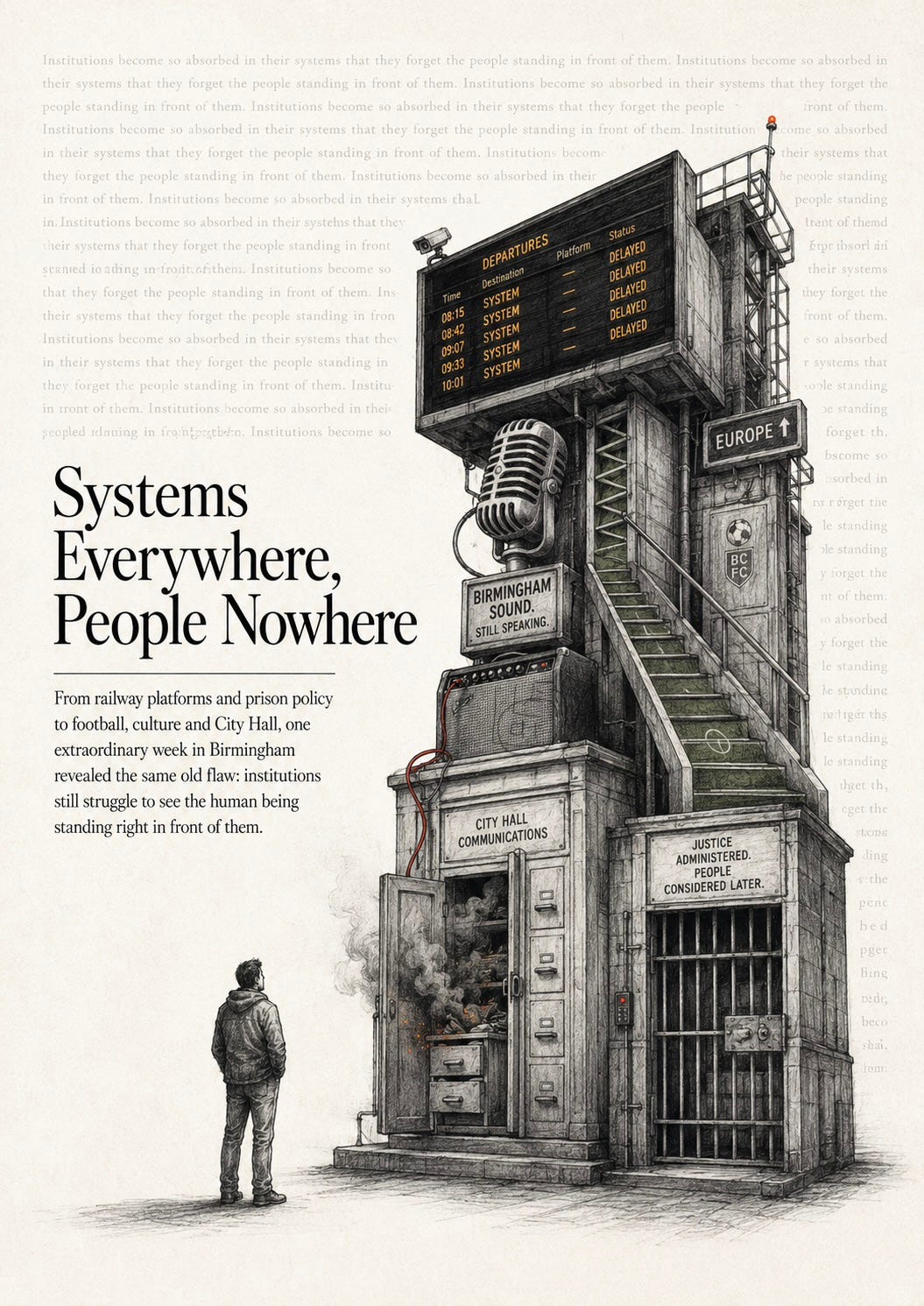
There are weeks when writing a column feels like trudging through wet cement while carrying a filing cabinet, and there are other weeks when the stories arrive waving their arms, shouting for attention and bringing their own jokes. This was emphatically one of the latter. We have travelled from blindness and railway stations to rock television, Belgian football, Birmingham City Council’s press office and the national prison crisis. What astonished me most was the response to the football piece. I deliberately tried to write about football for people who do not spend their lives studying League Two formations, arguing over wing-backs or declaring that a 19-year-old reserve goalkeeper “needs a loan spell.” Football writing can become a private language spoken by devotees in replica shirts, whereas I wanted to write about changing careers, institutions and loyalties, using Mat Sadler’s move from Walsall to Lommel SK in Belgium as the doorway. And, blow me down, people read it. Lots of them.
Sadler’s move looks like one thing and may prove to be something quite different. To some, leaving an English manager’s job to become an assistant coach in Belgium resembles going backwards, or at least taking a suspiciously long route to somewhere nobody had previously suggested visiting. Yet Lommel is part of City Football Group, the worldwide organisation built around Manchester City. Sadler has not merely changed clubs; he has entered an international system in which coaches, analysts, players, recruitment teams and ideas move between countries. That is modern football. We still sit in our familiar seats, complain about the referee and insist the opposition goalkeeper is wasting time from the fourth minute. Behind us, however, football is becoming a global graduate training scheme with shin pads. Mrs Olley and I watched Aston Villa beat Walsall 5-0 this week. We went with Villa and Birmingham City-supporting friends and had a perfect evening. No Blues colours were worn because diplomacy had to be protected. By the end, some of us might have accepted camouflage. Clubs may belong to global networks, but football still belongs to families, friendships, arguments and journeys home discussing a match everyone has already seen.
The other great surprise was the response to Rockefellas TV’s European studio launch in Birmingham’s Jewellery Quarter. Thousands upon thousands of people read that piece, which suggests either that Birmingham remains fascinated by its musical legacy or that the promise of a free T-shirt possesses powers beyond conventional journalism. Californian entrepreneur Alex Garcia invested here because Black Sabbath, Judas Priest, Led Zeppelin, ELO, Duran Duran and The Moody Blues travelled 5,000 miles and lodged themselves in his imagination. Rockefellas TV is a streaming operation rather than an old-fashioned television channel, and its Birmingham studio will host Brad’s Basement, presented by singer Brad Henshaw. His first guest is Jim Simpson, the man who managed Black Sabbath when they were still called Earth. I have met people who begin conversations with, “When I first managed Black Sabbath…” and others who begin with, “According to paragraph 4.7 of the cultural strategy.” I know which table I would choose, even if the second one had biscuits.
Birmingham has never lacked culture. It has sometimes lacked the confidence to recognise culture unless it arrives with a lanyard, a funding stream and somebody using “stakeholder” as a verb. Heavy metal was not invented in a committee room, nor did it emerge from a consultation exercise conducted between 10am and noon on a wet Tuesday. It came from working-class Birmingham: factories, clubs, pubs, terraced streets and young men making an almighty noise. Sometimes it takes somebody from 5,000 miles away to point at our treasures and remind us what they are worth. There will be more on that next week, particularly for the metal fans. My lips are sealed, which is not a condition from which I usually suffer. At the launch somebody asked whether the Rockefellas shirts were for sale. Alex interrupted to say they were giving them away. I was too busy talking and missed out. For the avoidance of doubt, should anybody from Rockefellas be reading, I remain a 2XL.
We began the week with a quieter and perhaps more important story. A blind reader told me about the assumptions people make because she does not “look blind.” Few phrases are intended as kindly and yet land quite so badly. Years ago, while guiding a friend with sight loss, I announced that there was a step immediately ahead. “Up or down?” he asked. One question demolished my confidence. I had supplied information that was perfectly clear to me and almost useless to him. My reader described being left on a train after the other passengers had departed. She eventually contacted a cleaner, while recovering the ticket cost reportedly took six months and the involvement of the Rail Ombudsman. Britain can propel hundreds of tonnes of steel around the country at speed, but refunding one blind passenger apparently required negotiations resembling the Congress of Vienna.
Her larger point was simple. Why is accessibility so often designed around asking for help rather than reducing the need to ask? At Sight Village, organised by Birmingham’s Queen Alexandra College, she suggested placing live departure information at head height, in high contrast, with audio and reliable updates. People living with barriers frequently suggest obvious solutions after institutions have spent years commissioning complicated ones. Not everyone with sight loss is completely blind. Many people have enough remaining vision to navigate independently, but using it constantly is exhausting. Every journey becomes an exercise in concentration, uncertainty and repeated requests for assistance. Accessibility should not begin with, “Please ask for help.” It should begin with, “We have already thought about you.” That is not special treatment. It is the same freedom the rest of us barely notice because we have never had to fight for it.
Thursday brought us back to Birmingham City Council, where my Freedom of Information request revealed that 3,257 media enquiries were logged between January 2024 and June 2026. The Council says it does not hold figures showing how many received a substantive answer, how many received a holding reply, how many received no reply, or how long answers took. It also says it holds no written service standard, media handling procedure or performance report covering those matters. This is a communications department. Measuring whether it communicates might be regarded as central to the enterprise, rather as counting books matters in a library or checking for water matters at a swimming pool. The press office has six full-time staff. Eleri Roberts is the responsible Strategic Director and Councillor Roger Harmer carries political responsibility as Council Leader. Harmer has inherited bins, commissioners, financial difficulties and assorted unexploded administrative devices. He can now add a press office that records questions but apparently cannot readily say what happened to them. Every cupboard he opens seems to contain another cupboard, usually on fire.
To be fair, there may be an innocent explanation. The information may exist elsewhere, or the reporting tools may be buried somewhere inside Vuelio beneath a button nobody has pressed since 2019. That is why a follow-up FOI has already gone in asking about data fields, reporting functions, audit trails and performance information. This is not about catching individual officers out. A communications department exists to explain the work of everybody else, and it should therefore be capable of explaining its own performance. If the system contains the information, splendid. If it does not, then fixing that ought to be among the easier challenges confronting Birmingham’s new administration. Nobody is demanding a moon landing. We are merely asking whether questions were answered.
Finally, prisons. Andy Burnham paused plans for earlier prisoner release following concern that those responsible for killing PC Andrew Harper might benefit. Pausing, listening and reconsidering is not weakness. In modern politics it is almost an endangered form of adult behaviour. The deeper issue, however, is honesty about sentencing. A judge says fifteen years. Television reports fifteen years. Victims hear fifteen years. The public believes fifteen years. Yet the period actually spent in custody may be very different because of release rules, licence periods and legislation understood by roughly twelve people, nine of whom are barristers. HMP Birmingham processed around 5,000 prisoners in a year, released more than 220 people each month and was close to capacity when inspectors visited. Inspectors also found prisoners who had been released after their lawful release date. We have built a system capable of releasing some people earlier than the public expects while keeping others longer than the law permits. That is not joined-up government so much as government assembled from several different jigsaws.
If a sentence means seven years inside and the remainder on licence, say so. If it means fifteen years in prison, say that. Justice should not require a footnote, a calculator and a postgraduate qualification. If honest sentencing requires more prison places, more experienced officers, stronger probation services and proper investment in rehabilitation, then let us have that argument openly. Justice has always cost money. The cost of failing to invest is eventually paid by victims, communities and public confidence. So there we are: blindness, broadcasting, Belgian football, Birmingham bureaucracy and British prisons. Five stories with little in common except one theme. Institutions become so absorbed in their systems that they forget the people standing in front of them. The blind passenger wants to travel independently. The football coach wants a route forward. The investor wants Birmingham to value what it created. The journalist wants an answer. The public wants a sentence to mean what it appears to mean. None of that is unreasonable. Indeed, much of it is painfully obvious. But then the painfully obvious is often where the best stories are hiding.