

Bobby Alden and the Erdington Test, Can Local Credibility Outrun National Decline
A café in Erdington, a well-known councillor, and a city in flux. Bobby Alden’s future may say more about Birmingham than his party.

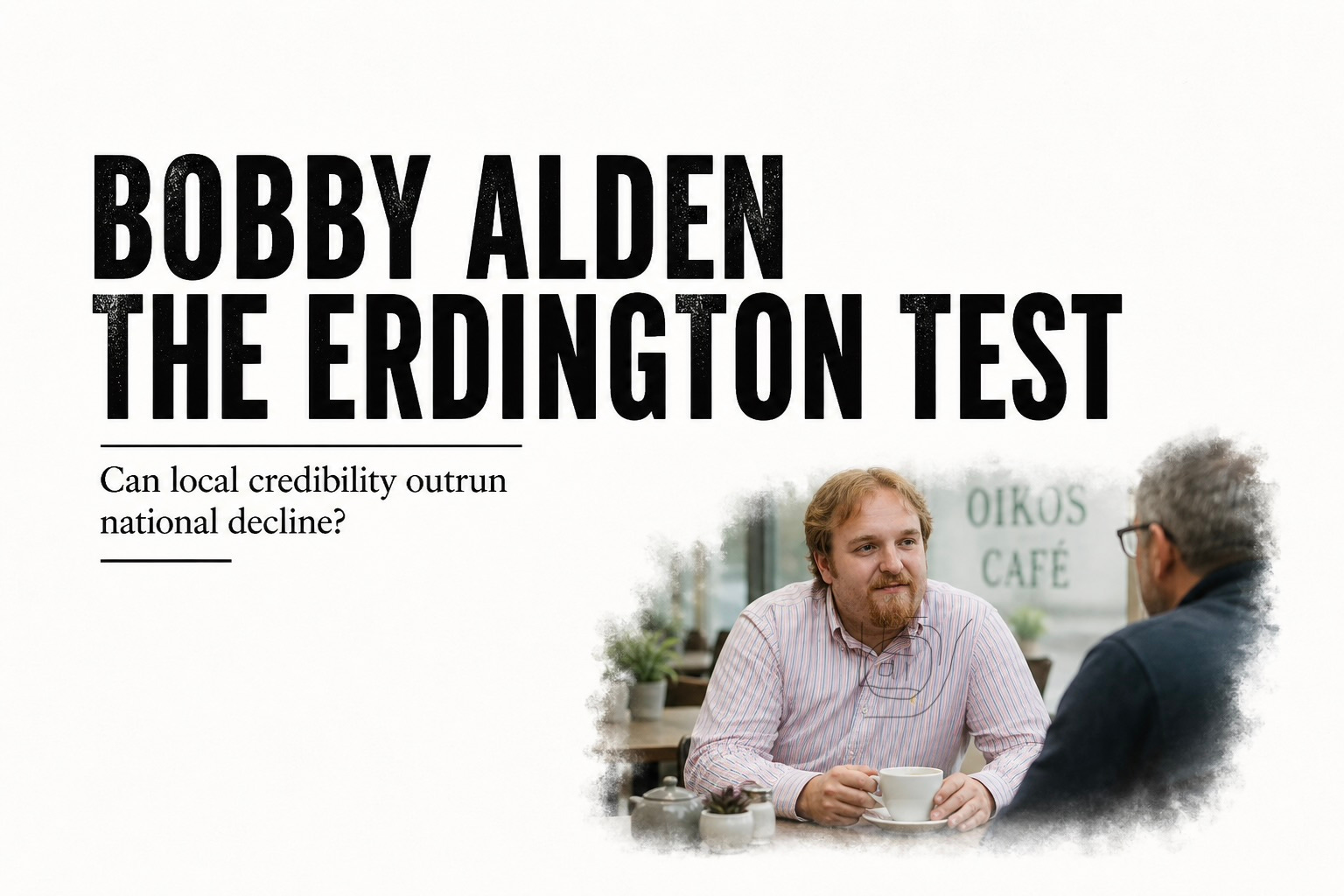
I met up with Cllr Bobby Alden, the Conservative group leader in Birmingham City Council, at Oikos Café, a little gem on Erdington High Street, in his ward, the sort of place you might walk past without noticing, but once inside, you realise it sits right at the heart of the community. It did not take long to understand Bobby’s place within that same ecosystem. We were constantly interrupted, not awkwardly, not apologetically, but naturally. People came over to wish him well, to raise issues, to exchange a few words. It was steady, unforced, and telling. Bobby is not just recognised locally, he is embedded. He is clearly a well-known and well-liked figure in Erdington, and that kind of recognition is earned, not manufactured.
That carries weight, because electorally, things are not especially comfortable for his party at the moment. The Conservatives are polling just above Labour but under 20% on many polls. The national picture is “difficult” for the Conservatives, and Birmingham is no exception. Yet Erdington is not a place that simply follows national trends. It has a habit, over the years, of recognising hard-working local councillors, and Bobby fits that description entirely. Which brings us to the central question hanging over him as leader of the Conservative group in Birmingham. Can he win his own seat? It is a question that does not just apply to him. Labour leader John Cotton faces a real, almost impossible challenge, with Reform pushing hard. Green leader Julien Pritchard also sits on potentially shifting ground. Even Liberal Democrat leader Roger Harmer, while more secure, is not entirely insulated. Local politics across Birmingham feels unusually fluid, almost unsettled.
For Bobby, the range of outcomes is stark. This time next week he could be nursing defeat, having lost his seat. Equally, he could find himself leading the council. Somewhere between those two sits what I would describe as the most likely scenario, deputy leader of the council. And that opens up another layer of political reality. Deputy to whom? Quite possibly to a Reform figure that most voters have barely heard of, with Rajbir Singh widely regarded as their leading presence, a man with a Labour past as leader of Sandwell Council. It is a remarkable prospect, but one that cannot be dismissed. That said, there is still a great deal of electoral water to pass under the bridge before any of this settles.
Bobby first came to my attention not just through his own work, but through his family. Birmingham has its own political lineage, quiet but influential, and the Aldens are very much part of that tradition. I know his mother, Deirdre Alden, a councillor in Edgbaston who has built a solid and respected presence over many years. But it was his father, the late John Alden, who stands out most in my memory. I served and worked with John when I was a councillor. John was part of a generation of civic politicians who saw Birmingham as something to build, not something to sell. He served the city for decades, from 1983 through to 2018, held senior roles including Deputy Leader of the Conservative Group between 1996 and 2000, and for a period led the group himself in 1997. He was also Lord Mayor in 2003 and 2004, and characteristically set himself the task of shaking every Brummie’s hand. He got to around half a million, which tells you everything you need to know about his approach to public life. He was driven, sometimes fiery, but always grounded in a belief that the city mattered.
Bobby is very much cut from that cloth. He combines a hyper-local focus with a sharp, analytical mind. Anyone who has watched him in the council chamber will know he is more than capable of dismantling the Labour leadership when required. There is an intellectual edge there that is hard to ignore. But what tempers that is something equally important. He is, in person, a genuinely pleasant and approachable man. You could see it in the café. Those interruptions were not brushed aside, they were welcomed. Conversations were had, not managed. That kind of engagement cannot be faked over time.
It does feel slightly unusual, I admit, as an unreconstructed socialist, to be writing in these terms about a Conservative politician. But you have to speak as you find. And Bobby Alden is a decent bloke, a hard worker, and intellectually capable. That combination is not as common in Birmingham politics as it should be. It probably was not in my day either.
In Erdington, he is strengthened by his colleague Gareth Moore, a proper local figure in his own right. Gareth brings energy, visibility, and a grounded understanding of the area. Together they operate as a team, and that matters. It creates a local force that can withstand wider political pressures. I put it to Bobby directly. Does all the effort, the constant availability, the leaflets, the casework, the sheer presence, does it really matter? His answer was simple. If it does not matter to people, they will not vote for us, and that would be a shame, because we do it for them. It is a straightforward philosophy, but one rooted in something real.
From where I sit, that approach may well give Bobby and Gareth enough momentum to stay ahead, despite the broader drag on Conservative support nationally. Local credibility still counts in places like Erdington. But beyond that lies the bigger question. What happens to Birmingham itself? It would be unwise to dismiss the possibility that Bobby could emerge as a key figure in the city’s leadership, whether as deputy or even, in certain circumstances, as leader.
Whatever your views on Reform, on Nigel Farage, or the wider noise of national politics, the reality is that Reform are likely to perform strongly in outer areas. Not in the inner city necessarily, but in places like Castle Vale, my old seat, a variety of outer city seats like Yardley and many others. Labour has lost ground in the past, and it may do so again. And one factor that could help the Conservatives hold on in Birmingham is the approach Bobby has insisted upon in recent years, relentless local activism. The local Conservative Party, in areas where they had been quiet for too long, has begun to re-engage, delivering, communicating, and showing up again. That shift may yet save more seats than the national picture would suggest.
If that happens, and if Reform emerges without overall control, then Bobby Alden as deputy leader becomes a very real outcome. Should that come to pass, it will be fascinating to see how he adapts from a focused local councillor and opposition leader into a position of city-wide authority. It would, frankly, be difficult to do worse than the current Labour administration. Too often in Birmingham today, power appears to rest with senior officers rather than elected members. That balance will have to change if the city is to recover, if services are to function properly, and if there is to be any meaningful sense of direction. Officers tend to operate on short, two-year horizons, often shaped by personal career considerations. That is no good for this, or any, area.
One thing Bobby reminded me of, something I had known but allowed to fade, is that Birmingham once had higher average wages than London. It sounds almost implausible now, but in the 1960s, with a strong manufacturing base, the West Midlands delivered real prosperity. Good wages, solid living standards, and confidence. That memory still sits within the city, even if it feels distant.
Which brings us to the wider point. Birmingham does not have to accept decline as inevitable. It does not have to settle for being a bankrupt centre of managed despondency. There is still the possibility of renewal, of rebuilding, of something better. Bobby Alden might play a role in that. He is capable of the job.
Because in the end, if the city can be rebuilt, if it can regain its confidence and its purpose, then perhaps it matters less who does it.
And more that someone finally does.
Thanks Adrian,
Politics is fascinating, but it has a habit of stripping out the humanity in us.
I’m sorry I can’t recall his name, but the man who stood as the communist candidate against Andy Street, I actually worked with him back in the 1970s at the BSA. He was known as “the Commie”, and most people kept their distance. In fact, as an apprentice, I was told to do the same.
But I had reason to work with him, only briefly, and found something quite different. He was engaging, humorous, and genuinely good company. The factory had him completely wrong.
Years later, Andy Street said much the same.
It’s a reminder, perhaps, that the crowd is not always right, and that labels rarely tell you the whole story.
Excellent insight as always Mike - great to get away from the tribalism of so much politics, especially in the local arena