

Bond, Phillip Bond, and Warwickshire Police’s No Further Action Habit
Threats, a defaced memorial bench and years of reports. Warwickshire Police says insufficient evidence. Its own record makes that answer worth investigating.

Bond. Phillip Bond. He is not a secret agent, although his command of dates, documents and process might make the average desk officer wish he would disappear behind a revolving bookcase. Mr Bond is a retired officer who served with the Metropolitan Police and West Midlands Police. He now teaches investigative and quasi judicial bodies how to investigate properly. I have met Mr and Mrs Bond. They struck me as decent, pleasant, middle England people, not performers auditioning for the role of professional victim. Phillip is precise. Sometimes you have to stop him and ask which document belongs to which event. He stops, resets and explains. That may make him demanding. It does not make him dismissible.
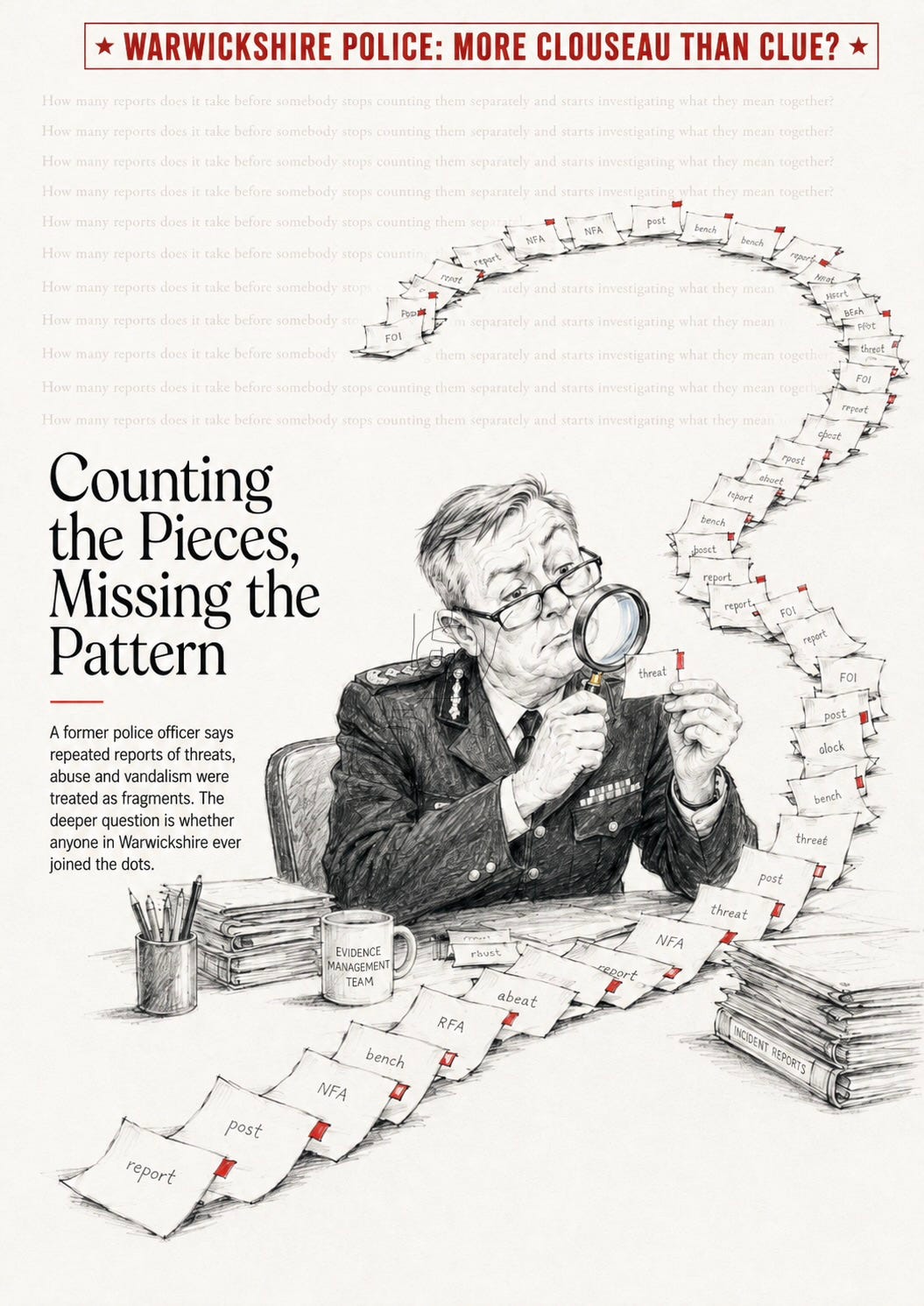
Mr Bond alleges that he and Mrs Bond have endured a sustained campaign involving threats, hostile social media material, suggestions that he is insane, general nastiness and the defacing of a memorial bench. He says one principal individual, known to Warwickshire Police, sits at the centre of it, with a small group around that person. I have seen numerous reports and pieces of material, although I do not propose to empty the Bonds’ filing cabinets into this article or conduct a criminal trial by Substack. The immediate question is simpler. Did Warwickshire Police ever place the whole body of material before one experienced investigator and ask whether these apparently separate incidents formed a continuing course of conduct?
In February, Warwickshire Police told me that two harassment reports involving Mr and Mrs Bond were under investigation. By June, the force said both had been filed as not for action because of “insufficient evidence provided”. Those words deserve attention. Insufficient evidence found after a thorough investigation is one thing. Insufficient evidence provided by a complainant is another. The police are not a parcel collection service waiting for a perfectly wrapped prosecution to arrive at reception. Their job includes finding evidence and linking incidents. Perhaps all that happened. Warwickshire Police has not said. I asked whether the wider pattern had been reviewed as a possible course of conduct. It did not answer.
This is not Warwickshire Police’s first rodeo on the no further action roundabout. Earlier this year it emerged that the force had missed the prosecution deadline in 16 drink driving cases over three years. In one Nuneaton case a van driver crashed into parked vehicles, pushing two into nearby properties. Blood results reportedly showed alcohol above the legal limit and drugs in the driver’s system, but the email containing them was missed and the deadline was not chased. The force’s complaint process found numerous failings, and no further action letters had been sent without explaining why. When journalists asked about the other cases, the communications department said the questions were best suited to Freedom of Information. I recognise the route. It has polite signposts and appears to lead in a circle.
Warwickshire Police’s press office sent me down precisely that lane. It answered the easy part, declined the awkward process questions and told me they belonged under Freedom of Information. I duly submitted a request. The FOI unit then said it could neither confirm nor deny holding the information because I had identified the Bonds. Legally, that exemption may be available. Administratively, it is magnificent choreography. One department points towards a door. Another explains why it cannot be opened. Nobody is rude. Nobody answers the question.
We used to call it being kicked into the long grass. Nowadays people too often appear not to be there to help you but to deal with you, moving you to the next inbox and department until you tire. I cannot prove that was Warwickshire Police’s intention. But a responsible police press office must understand the route it recommends. Sending a journalist towards an exemption can look less like assistance and more like getting him out of the room. I am going to assume such a low down technique is not standard operating practice. Warwickshire Police may care to reassure me.
HMICFRS is the national inspectorate which examines and grades police forces. It looked at 50 Warwickshire incidents reported as antisocial behaviour and concluded that 32 crimes should have been recorded, but only 21 were. It found poor handovers, missing evidence, crimes waiting weeks for allocation, missed investigative opportunities and unjustified delays. Inspectors also judged 85 of 100 investigations effective, so this is not an argument that every Warwickshire officer is hopeless. It is evidence that missing patterns and allowing difficult files to drift are real risks.
Then there are the complaints. Warwickshire’s Police and Crime Commissioner reported that 34 complaint reviews were completed during 2024/25 and 47 per cent were upheld because either the handling or outcome had not been reasonable and proportionate. Forty seven per cent. Nearly half. Most complainants do not enter the process as experts. They misunderstand forms and use ordinary language where the system expects the approved incantation. Warwickshire Police knows every gate, nuance and phrase. It enters with home advantage, the rule book and possession of the ball. Yet nearly half of the reviewed decisions were still found wanting.
And then there is the Warwickshire Hunt business. Warwickshire Police issued the hunt with a community protection notice. Eight months later it was replaced by what Matt Western MP described in Parliament as a secret protocol. He said he was refused a copy, wrote repeatedly to the chief constable and Police and Crime Commissioner and was blanked. He later alleged a cover up involving the hunt, the force and the Commissioner. The Commissioner denied it, and an independent review found no evidence that his Countryside Alliance membership influenced operational decisions.
That finding belongs here. So does the plain English appearance. A hunt, connected people, a private protocol replacing formal enforcement, an MP unable to obtain answers and the county’s great and good appearing to receive courtesies the great unwashed would not expect. Whatever the legal conclusion, the optics stank. The review itself identified shortcomings in oversight and communication and called for greater transparency. Not proof of corruption, but evidence that a matter requiring openness was handled in a way which bred suspicion.
David Gardner is Acting Chief Constable. It would be unfair to pin every historic failure on him because most began before he took the chair. Nor should we suggest he is campaigning for the permanent job. Emma Bond MBE is the preferred candidate. But Gardner is the operational head today, and acting chiefs do not receive acting responsibilities. Warwickshire is among the smallest forces in England and Wales. Small ought to mean agile. It should not mean a complicated complainant is passed among officers until everyone has touched the file and nobody owns it.
GRIT is not letting this go. I will ask Mr and Mrs Bond to make Subject Access Requests for their records and closure rationales. I will submit another Freedom of Information request, force wide and stripped of personal identifiers, asking how Warwickshire Police records, links, supervises and closes repeated harassment and online abuse reports. If the answers justify a formal complaint, I know how to make one. I hope that will not be necessary. The preferable outcome is one suitably senior and experienced investigator reviewing the Bond material as a whole and reaching a reasoned conclusion.
That conclusion might be that no criminal case can properly be brought. Mr Bond may not like it. I might not like it. But a proper investigation can withstand an experienced former police officer examining it. A half job cannot. Warwickshire residents do not pay for a police force to outlast complainants by attrition. They pay it to distinguish irritation from risk, paperwork from evidence and a string of incidents from a pattern. How many reports does it take before somebody stops counting them separately and starts investigating what they mean together?
Fascinating piece Mike.