


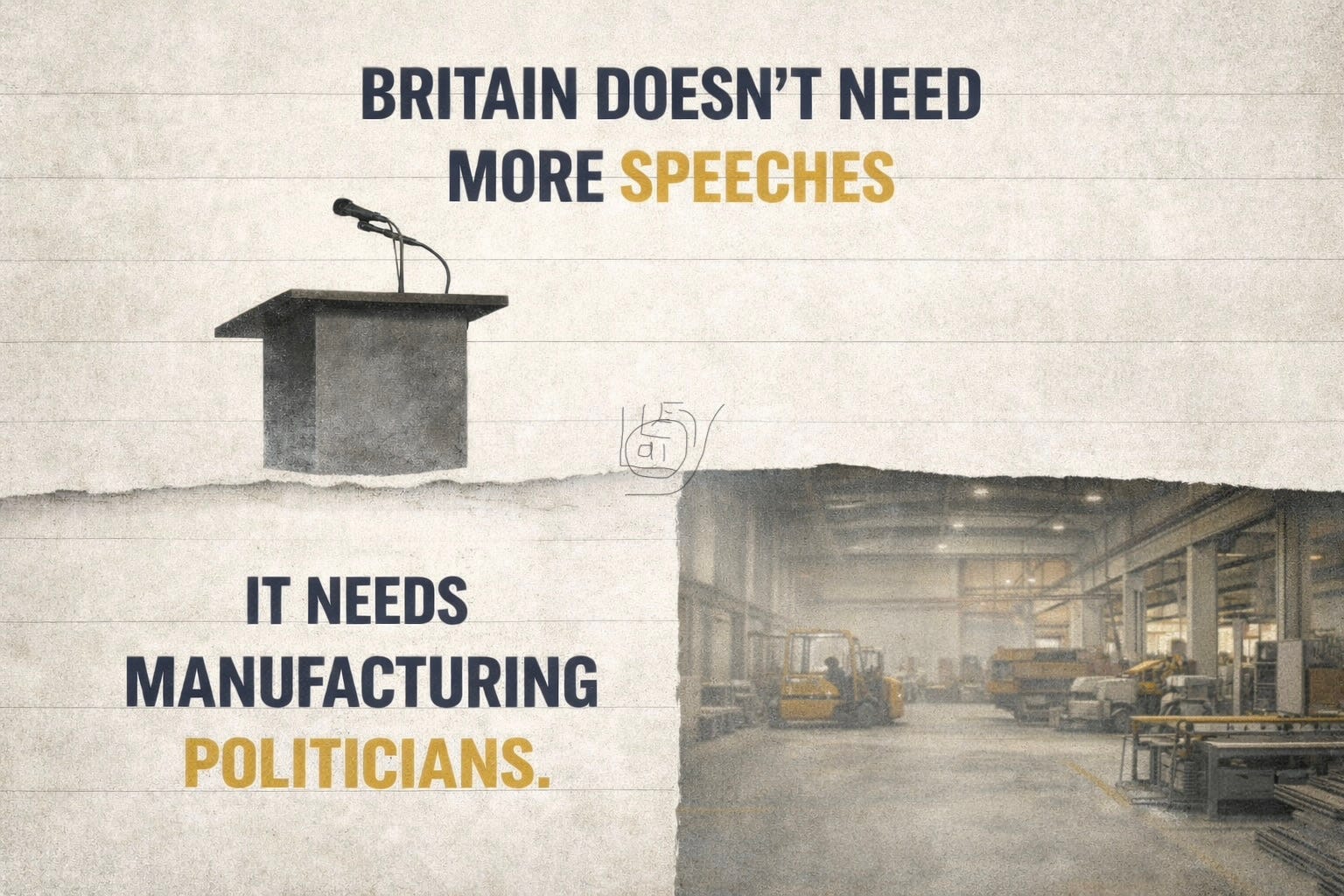
Where Are Britain’s Manufacturing Politicians?
Rachel Reeves had a choice, and it was not a complicated one. Reeves is the Chancellor of the Exchequer, the person who controls taxation and spending across government. If something affects the cost of doing business in Britain, it runs through her desk. She looked at business rates, a tax on commercial property, and chose to leave the system broadly as it is, a blunt formula where bigger buildings pay more, regardless of how productive they are. That decision matters because manufacturers need space. Big space. Factory floors, machinery, loading areas. You cannot build cars or precision components from a laptop in a serviced office. By increasing the burden on higher-value properties, including those above £500,000, she has effectively increased the cost of making things in Britain.
She could have done something different. She could have recognised that industrial property is not the same as a shop or an office. She could have reduced the multiplier for factories, linked rates to output or employment, or targeted relief at regions like the West Midlands where manufacturing still underpins the economy. She did not. The system remains blunt, and the result is predictable. The places that still make things, Birmingham, Coventry, Wolverhampton, the Black Country, carry more of the load.
This is where it stops being abstract. The West Midlands is not a museum piece. It is still one of the few parts of the country where manufacturing genuinely drives jobs, exports and economic activity. When policy misses here, it lands directly on factory floors. Decisions are being made now. Do we expand or hold back? Do we invest here or abroad? Do we hire or automate faster? What looks like a technical tax tweak in Westminster becomes a real-world constraint in the Midlands.
Ask a simple question inside any factory across the region. Who in British politics is actually fighting for you? Not visiting, not smiling, not issuing statements, actually fighting. You will get a pause, then a shrug. Because there is no politician who can point to a clear, measurable shift that makes it easier to manufacture here than somewhere else.
Take the current cast. Jonathan Reynolds is the Secretary of State for Business and Trade, the cabinet minister responsible for industry and business conditions. He is articulate, present, and always across the brief. But where is the decisive intervention that reduced costs, secured investment or anchored a supply chain in the West Midlands? It is not there. Not yet. Rachel Reeves, as Chancellor, is setting a tax structure that weighs more heavily on production than many other parts of the economy. The West Midlands pays for that.
Andy Street, until recently Mayor of the West Midlands Combined Authority, understood manufacturing better than most. He pushed the gigafactory, backed advanced industry and spoke the language of supply chains. But instinct is not enough. Because behind every political statement sits a machine. Officers, procurement rules, frameworks, processes. That machine does not care where something is made. It cares about cost, compliance and convenience.
So you get the absurd reality. British-branded products wrapped in a Union Jack, made somewhere else. Councils talking about local growth while buying from overseas. A system where failing to support British manufacturing carries no consequence at all. No impact on promotion, no professional risk, no accountability.
Richard Parker, the current Mayor of the West Midlands, now holds those same regional levers. Investment strategy, funding influence, economic direction. But he inherits the same machine. And early signs suggest the same habits. Even something as simple as replacing bikes tells a story. Not sourced locally, not tied to regional manufacturing, just another purchase in a system that does not prioritise British production. It sounds small. It is not. Systems are built from habits, and habits repeated often enough become policy.
Then there is Nigel Farage, leader of Reform UK, a party positioning itself as a challenger to the main political establishment. They talk a stronger language of British production, and in one visible way they attempt to live it. Their football shirts and campaign merchandise are made in Britain. Compare that with Labour and the Conservatives, quite content to sell “British” politics on goods manufactured in China or elsewhere. Labour MPs turning up in Stoke-on-Trent, a city built on making things, while their own party merchandise is imported. It is a small detail, but it exposes a bigger point. If you cannot even get your own merchandise made in Britain, what does that say about your seriousness when it comes to rebuilding British manufacturing?
The problem is not a lack of rhetoric. It is a lack of structure. Telling people to “buy British” is easy. Building a system where British supply is the default is harder. That means changing incentives, not issuing slogans. If procurement officers knew that consistently bypassing British suppliers would be tracked, questioned and ultimately affect their careers, behaviour would change quickly. At the moment, nothing happens.
So what would actually move Britain, and the West Midlands in particular, towards a pro-manufacturing economy? Start with business rates. Treat industrial property differently. Lower the burden on factory space and recognise production as strategic. Fix procurement so that public contracts favour British supply chains where possible, measure it and publish it so it becomes real. Cut industrial energy costs because if it is cheaper to power a factory abroad, investment will follow.
Then deal with skills, and this is where it becomes uncomfortable. Tie skills funding directly to industry, not institutions. Put money into manufacturing, not into the hands of further education establishments delivering generic courses. Link apprenticeships to real factories, real employers, real output. Colleges and training providers will scream and winge, of course they will, because it shifts power and money away from them. But if the goal is to rebuild manufacturing capacity, that is exactly what needs to happen.
Finally, reward investment in plant and machinery. Make it easier and more attractive to build and expand production here than anywhere else.
None of this is radical. It is basic. But it requires a decision Britain has avoided for too long. Choosing production.
Until that choice is made, clearly and structurally, nothing changes. Factories will continue to carry higher costs. Procurement will continue to drift overseas. Politicians will continue to visit shop floors, nod thoughtfully, and leave everything exactly as it was.
If Britain is serious about rebuilding its manufacturing base, the answer is not another speech. It is a system where making things here is not an act of resilience. It is simply the easiest and most logical choice.
You're saying what people my age (77) already know, ditching apprenticeships was a bloody stupid idea.