


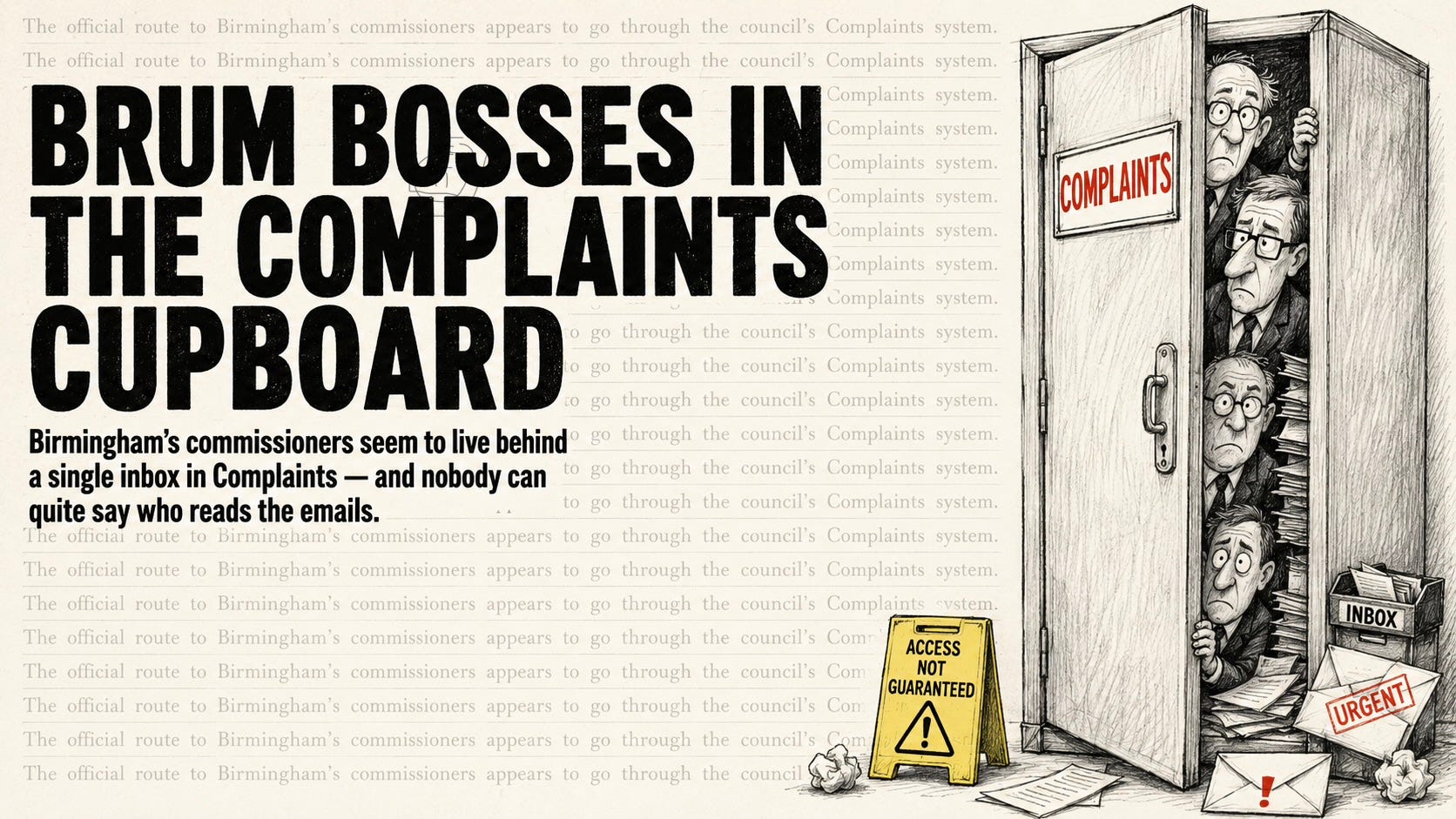
Birmingham democracy is a strange old thing. Councillors get elected. Officers advise, get paid, enjoy generous pensions, and may later retire into the private sector they once dealt with as council officers. Commissioners oversee, with generous day rates and the sort of expenses unlikely to involve a Megabus and a packed lunch. Consultants invoice, also at very generous rates. Then low-paid bin workers can be sacked without the councillors being properly told until the damage is done. Councillors eventually do what they are told… sorry…, what they are “advised” to do.
Now we have the perfect symbol of the whole mess. If you want to contact Birmingham’s commissioners, the official route appears to go through the council’s Complaints system. Not complaints as in people are angry. Complaints as in the department.
I asked Birmingham City Council under Freedom of Information for the official business email address, postal address and published contact arrangements for the Lead Commissioner and the other commissioners. I also asked for any policy, protocol, guidance, procedure, briefing note or internal instruction explaining how the public may communicate with them, and how correspondence addressed to them is received, triaged, forwarded, acknowledged or answered.
This was not me asking for secret material. I did not ask for private phone numbers, home addresses, shoe sizes, preferred biscuits, favourite football teams or whether any commissioner has ever tried to explain the Birmingham ring road to a visitor without crying. I asked the basic democratic question: if citizens want to contact the people appointed to help oversee their city, how do they do it, and what happens to the message once they send it?
The answer was a small municipal masterpiece. The commissioners can be contacted at Commissioners@birmingham.gov.uk. They can also be contacted by post through “Commissioners, Birmingham City Council, Complaints, PO Box 16616, Birmingham, B2 2HN.” The council’s response also points to the council’s Complaints route. So the people appointed to help oversee Birmingham City Council appear to be contactable through the part of Birmingham City Council used by people complaining about Birmingham City Council.
Perhaps that makes sense somewhere. Perhaps the commissioners are a complaint. Perhaps the council is complaining about itself. Perhaps Whitehall has invented self-service democracy, where the public reports the problem, the problem acknowledges receipt, and the solution is working from home.
The second part of the FOI reply is even better. The council says it holds no protocol, policy, guidance, procedure, briefing note or internal instruction setting out how members of the public may communicate with the Lead Commissioner or other commissioners. It also says it holds no recorded process explaining how correspondence addressed to commissioners is received, triaged, forwarded, acknowledged or responded to.
There it is. One email address. Several commissioners. A political adviser. A complaints route. No recorded process. Public accountability with all the structural clarity of a carrier bag in a canal.
Now, some people may say this is just administration. They may say there is nothing odd about a generic inbox. They may say somebody opens it, forwards it, logs it, checks it, stamps it, strokes it gently and makes sure the right people see the right thing. Excellent. In that case, there should be no problem explaining who that somebody is, what authority they have, whether all commissioners receive the emails, whether anything is filtered, and whether correspondence from citizens, journalists or elected representatives ever reaches the people it is addressed to.
This is not a demand for state secrets. It is not MI5. It is not the nuclear codes. It is an inbox.
So, on behalf of the citizens of Birmingham (not that they asked, but why not…), I wrote to the commissioners. I asked why correspondence to the commissioners is housed within the council’s Complaints arrangements. Is it treated as a complaint to Birmingham City Council, a complaint about Birmingham City Council, a complaint about the commissioners, or correspondence to an intervention team that happens to enter through the complaints door of the authority under intervention?
That is not mischief. That is basic navigation. If you put the lifeboat office inside the ship’s complaints department, passengers are entitled to ask who is holding the oars.
I also asked who actually receives and reads emails sent to Commissioners@birmingham.gov.uk. Will an email be forwarded to the Lead Commissioner, every commissioner and John Biggs, in his role as political adviser? Will each of them personally read it? If not, who reads it first? A council officer? A complaints officer? A democratic services officer? A government official? An external adviser? A man called Keith with a spreadsheet and a haunted look?
Then I asked for an interview. Nothing grand. No red carpet. No branded lanyard. No “stakeholder engagement moment” with warm water in glass jugs. Just a conversation with the people helping to oversee the city.
The questions are obvious. What has the commissioner operation cost? What have external consultants cost? How much of the work has produced actual cashable savings rather than reports, boards, workstreams and recommendations for more workstreams? Have the commissioners personally examined the effect of West Midlands Pension Fund employer contributions and valuation assumptions on Birmingham City Council’s financial position? What is the difference between Birmingham as a city and Birmingham as a balance sheet?
That last question matters. Birmingham is not a spreadsheet with traffic lights. It is not a recovery plan with people attached. It is a city of neighbourhoods, arguments, loyalties, histories, football shirts, bus routes, markets, mosques, churches, pubs, factories, takeaways, allotments, estates, parks and families who know exactly when public services have gone wrong because they are the ones living with the result. A commissioner who only understands Birmingham through officer briefings understands Birmingham in the way a tourist understands the sea by looking at a puddle.
So I added some local-knowledge questions. How many wards outside the city centre has each commissioner personally visited? When did each last attend a public meeting in Birmingham not arranged for them by officers? Could each name three Birmingham neighbourhoods and one current issue affecting each? And, because public service should never be afraid of the deeper constitutional questions, how many times have Aston Villa won the FA Cup? Will Birmingham City ever win it? And is that currently more or less likely than Birmingham City Council returning to normal democratic control with public confidence restored?
Then there is Mr Biggs. He is not technically a commissioner. He is a political adviser. That is useful, because Birmingham is short of money, confidence and functioning public accountability, but apparently not short of political advice. So I asked whether, as political adviser, he predicted the collapse of Labour control in Birmingham. I asked whether he could advise when he expects the next General Election, how many seats Reform UK will win, and who a politically informed observer should regard as favourite to become Prime Minister afterwards. Not betting tips, obviously. Just a test of whether publicly funded political advice works before events happen, or only afterwards when everyone is pretending they saw it coming.
And then, because public bodies are very good at answering the question they wish had been asked rather than the one actually sent, I included an aide-mémoire. A simple matrix. Thirty questions, numbered, with space for answers. Entirely helpful. Entirely reasonable. Also, of course, a small administrative mousetrap. If a reply arrives saying “thank you for your enquiry, transparency is very important to us”, I will be able to point politely to questions 3, 7, 12, 18, 26 and whichever others have disappeared into the civic fog.
The deadline for reply is Monday 13 July 2026. That gives them time to find the inbox, locate the complaints cupboard, check whether the commissioners exist in email form, consult the political adviser, and decide whether Aston Villa’s FA Cup record is within the scope of the intervention.
If they respond clearly, excellent. Birmingham will know more than it knew before. We will know who reads the inbox, who handles the correspondence, whether commissioners personally see what is sent to them, and whether the people helping to oversee the city are willing to answer questions from outside the official comfort blanket.
If they do not respond, the story writes itself. Birmingham’s commissioners are contactable through a single generic email address routed through the council’s Complaints arrangements, while the council says it holds no recorded process explaining who handles commissioner correspondence, who sees it, who filters it, who answers it, or whether the commissioners themselves ever read it.
That is not accountability. That is hide and seek with day rates.
I feel we shouldn't hold our breath..........