


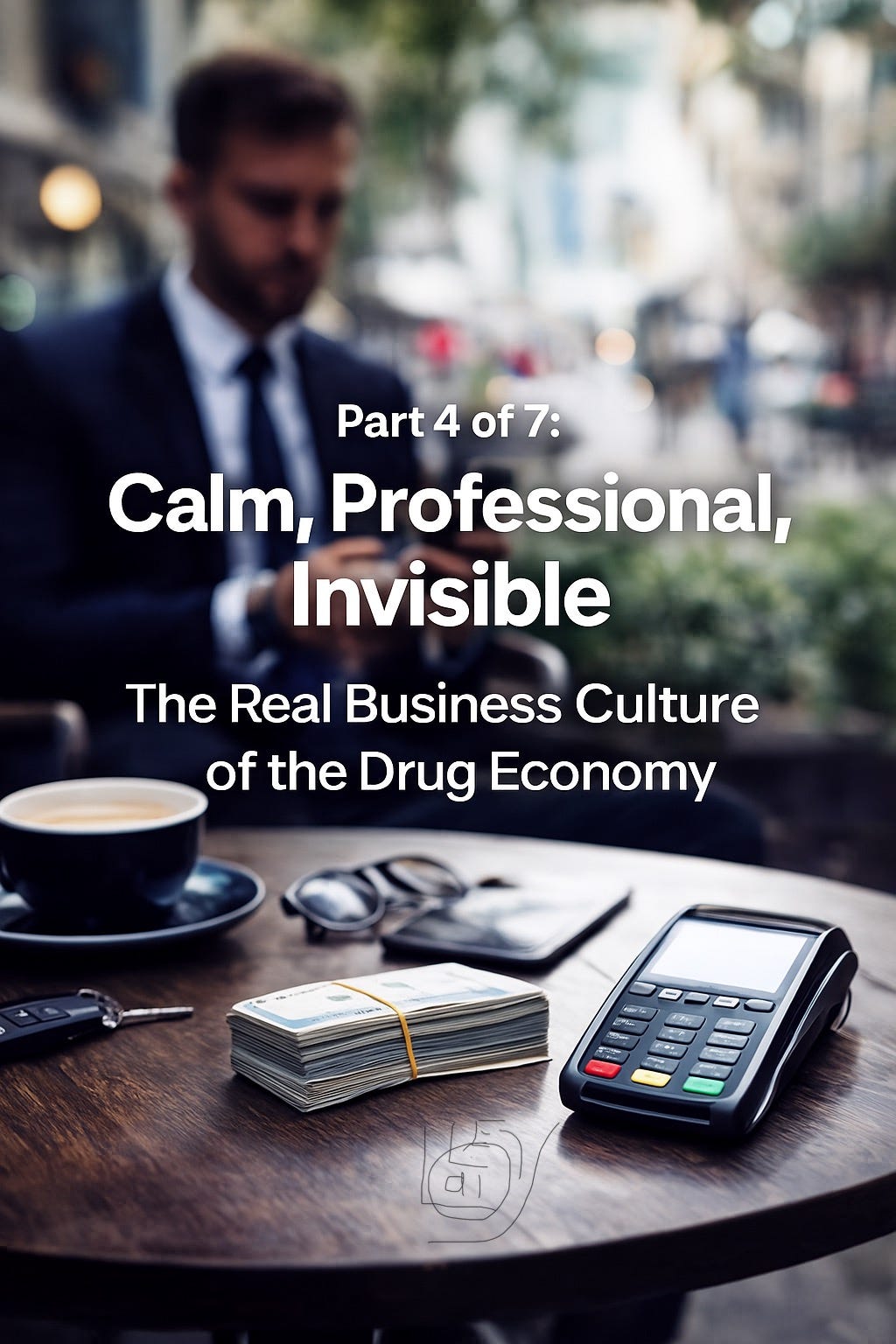
Part 4 of 7: The Real Business Culture of the Drug Economy
In Part 3, Taxed and Sanitised, we followed criminal money into the Treasury. We traced the quiet fiscal toll gates that attach themselves to laundered turnover. We saw how VAT, corporation tax, property levies and payroll contributions flow into the public finances long after ministers have condemned the very trade that generated them.
Part 4 moves from money to method. If Part 3 explained how the state profits from the drugs economy, Part 4 explains how the drugs economy sustains itself. This is the part of the series where the myth finally breaks. The drug world that newspapers imagine bears little resemblance to the drug world that actually exists. The real industry is not loud. It is not chaotic. It is not a rolling theatre of violence. It is structured and patient and careful. Those who survive inside it do so because they understand stability as the first rule of survival.
Part 4 reveals the internal logic that keeps the drugs economy standing long after the speeches, raids and political condemnations have faded.
Calm, Professional, Invisible: The Real Business Culture of the Drug Economy
We comfort ourselves with tidy fictions about criminals. The popular one, endlessly reinforced by cinema and the more excited corners of journalism, is that the drug economy is driven by constant threat. A world where a miscounted note earns a beating and a delayed payment earns a bullet.
If the drug economy really behaved like that, it would not last a month.
No business survives on chaos. No workforce performs under permanent fear. No supply chain thrives when every dispute becomes a spectacle. The truth, visible to anyone who has spent time studying durable criminal operations, is very different. The most successful actors in the illegal drugs market succeed through discipline and caution. They value routine. They value predictability. They value calm.
The strongest operators resemble small business owners more than the characters invented to frighten teenagers. Their logic is managerial, not cinematic.
Why Violence Is a Failure Mode
Violence is not a business strategy. It is a liability. Every violent incident creates witnesses, generates reports, attracts police attention and unsettles staff. In a trade where the first rule is to avoid scrutiny, violence is the loudest and most self defeating choice available.
Professional operators understand this instinctively. They use violence rarely, sparingly and usually as a last resort. When it appears, it is targeted and forensic. They know that a single reckless act can collapse years of stability

This is why the most publicised incidents of drug related violence often involve amateurs. Beginners panic. Professionals avoid noise. If a mature organisation becomes violent, it is telling you that something inside it has failed.
Human Resources in the Shadows
Finding competent staff is difficult in any industry. The drugs economy is no different. When you find someone reliable you do not terrorise them. You protect them. A good runner, a dependable courier, a discreet intermediary is an asset. They understand the rules. They understand the customers. They understand the importance of routine.
The popular notion that someone is executed over a five pound shortfall is nonsense. That is the behaviour of deluded hotheads, not sustainable enterprises. Real organisations think like managers. They need staff loyalty. They need retention. They need performance. Fear creates unpredictability and turnover. Stability requires confidence.
The drugs economy has its own unwritten HR code and it exists for the same reason it exists in legitimate business: reliability keeps the operation alive.
The Modern Market: Not Street Corners but Quiet Networks
The street corner dealer survives mostly as a cultural relic. The modern drug market operates through digital networks. Arrangements are made by message. Meetings occur in neutral, unremarkable locations. A fashionable café. A supermarket car park. A shopping parade where nobody looks twice at a stranger using their phone.
The invisibility is deliberate. The goal is to blend into everyday life. Transactions are not carried out through furtive handshakes and brown envelopes. They are more likely to involve bank transfers or small card reader payments. The laundering system absorbs these flows exactly as it absorbs every other low level commercial transaction.
The trade has modernised in the same way legitimate retail has modernised. The technology has changed. The behaviour has changed. The objective has not. Keep the noise down. Keep the attention away.
A Numbers Based Look at Why Violence Must Stay Rare
To understand why violence is the exception you must consider scale. A city like Birmingham contains around sixty six thousand drug users and more than thirteen thousand regular users. When you translate usage patterns into transactions you arrive at approximately seventy thousand deals a week and three and a half million deals a year within a single urban area.
A retail level dealer handling around a hundred transactions a week implies roughly seven hundred to a thousand front line dealers operating at any one time.
Now insert violence into that equation. If even one in every thousand deals produced serious violence Birmingham would witness three thousand five hundred such incidents annually. That would be nine violent disputes every day. If the rate was one in ten thousand deals there would still be three hundred and fifty significant incidents a year. If the rate fell to one in one hundred thousand there would still be thirty five a year.
These numbers simply do not appear in the news cycle. They do not appear in police statistics. They do not appear in community reporting. The absence of volume proves the point. Widespread violence would overwhelm the city’s informational landscape. It would dominate local headlines every morning. The fact that it does not happen shows how rare serious violence actually is.
The trade survives because it is quiet. It must be quiet. Noise is fatal.
Stability as Strategy
The real culture of the drug economy is built on maintaining equilibrium. Every decision is shaped by the need to avoid scrutiny. Routine is the shield. Calm is the discipline. Violence is the rupture. Those who understand this prosper. Those who do not disappear quickly.
It is this culture, not the imagined one, that explains the industry’s resilience. An economy that behaves like a business will survive like a business. And in Britain the drug economy behaves like a business because the environment rewards that behaviour.
Coming Up Next: Part 5 The System Does Not Look Back
In Part 5 we turn from the operators to the police. We examine why quiet markets sit so low on the enforcement ladder. We look at how modern policing triages harm, why resource constraints dictate priorities and how public fear, rather than criminal reality, shapes the operational map.
If Part 4 revealed how the drug economy keeps itself alive, Part 5 reveals why the state often allows it to.
The series advances again once you see how policing chooses its battles.