


Anyone who has spent enough time around Birmingham’s civic life learns two things fairly quickly.
First, very little of it is accidental.
Second, almost none of it is ever properly explained.
From the outside, the Lord Mayoralty looks like ceremony and tradition, chains and receptions, polite speeches and polite applause. From the inside, it is a carefully balanced piece of machinery, held together by precedent, arithmetic, and a remarkable amount of collective memory.
Most people assume the Lord Mayor is simply chosen. In truth, the choice has usually been made long before the chains are lifted from the velvet cushion.
How a Party Gets the Turn
The right to nominate the Lord Mayor is determined by a long-standing proportional formula, based broadly on the number of councillors each political party holds on Birmingham City Council. The larger the group, the more often its turn comes around.
The precise workings of that formula are rarely laid out in public, and much of it operates on trust. But it is not a casual trust. Birmingham councillors are a cynical, observant bunch. If anyone tried to fiddle the sequence or quietly adjust the order, the noise would be immediate and unmistakable.
Civic memory in this city is long, and it does not suffer cheats.
Once a party’s turn arrives, that party selects a serving councillor to put forward. From that moment on, discretion gives way to protocol.
The Two-Year Civic Journey
The Lord Mayor is elected by the City Council from among its serving councillors. That election is not for a single isolated year. It is, in effect, a two-year civic journey.
In the first year, the councillor serves as Lord Mayor.
In the second year, they serve as Deputy Lord Mayor.
And there is a hard rule that underpins everything that follows.
You can only be Lord Mayor or Deputy Lord Mayor if you are a serving member of the council at the time. No council seat, no chains.
This is where the current puzzle begins.
Why the Current Lord Mayor Cannot Become Deputy Next Year
The current Lord Mayor, Councillor Zafar Iqbal, is due to stand down in May 2026. Under normal circumstances, he would simply move into the Deputy Lord Mayor role for the following civic year.
But Councillor Iqbal is not continuing as a councillor.
And if you are no longer a councillor, you cannot be Deputy Lord Mayor. Civic dignity does not override eligibility. The rule is absolute.
So despite holding the office this year, Councillor Iqbal cannot serve as Deputy Lord Mayor next year.
That creates a vacancy.
And once a vacancy exists, protocol takes over.
Why Ken Wood Cannot Simply Carry On
The obvious and popular solution would be to keep Councillor Ken Wood, the current Deputy Lord Mayor, in post for an extra year.
On merit alone, this would make perfect sense.
Ken Wood was a superb Lord Mayor. He has been an outstanding Deputy. He is widely respected, warmly liked across party lines, and carries the role with ease and authenticity. He could do the job in his sleep and the city would still be well served. Visitors warm to him. Colleagues trust him. Birmingham wears him well.
But civic office does not run on merit alone. It runs on balance and sequence.
Because the outgoing Lord Mayor is Labour, the Deputy Lord Mayor should also be Labour. Councillor Wood is Conservative.
Protocol does not bend for popularity.
So however highly regarded Ken Wood may be, and however well he has served, he cannot simply stay on.
Working Back Through the Civic Ledger
Once you accept that the Deputy Lord Mayor must be a serving Labour councillor who has previously held the Lord Mayoralty, the list becomes very short very quickly.
You work backwards.
Councillor Chaman Lal, Lord Mayor from 2023 to 2024, has been deselected by the Labour Party. Even if he were to win a seat as an independent or under another banner, he would not qualify.
Before him was former Cllr Mohammed Azim, Lord Mayor between 2019 and 2021. His term was extended because of Covid. Sadly, he has since passed away.
Next comes Councillor Yvonne Mosquito, Lord Mayor from 2018 to 2019. She has already declared that she is not standing in the 2026 election.
Before her sits Honorary Alderman Carl Rice, Lord Mayor from 2016 to 2017. He left the council several years ago.
Each name falls away.
Until there is only one left.
Why It Can Only Be Shafique Shah
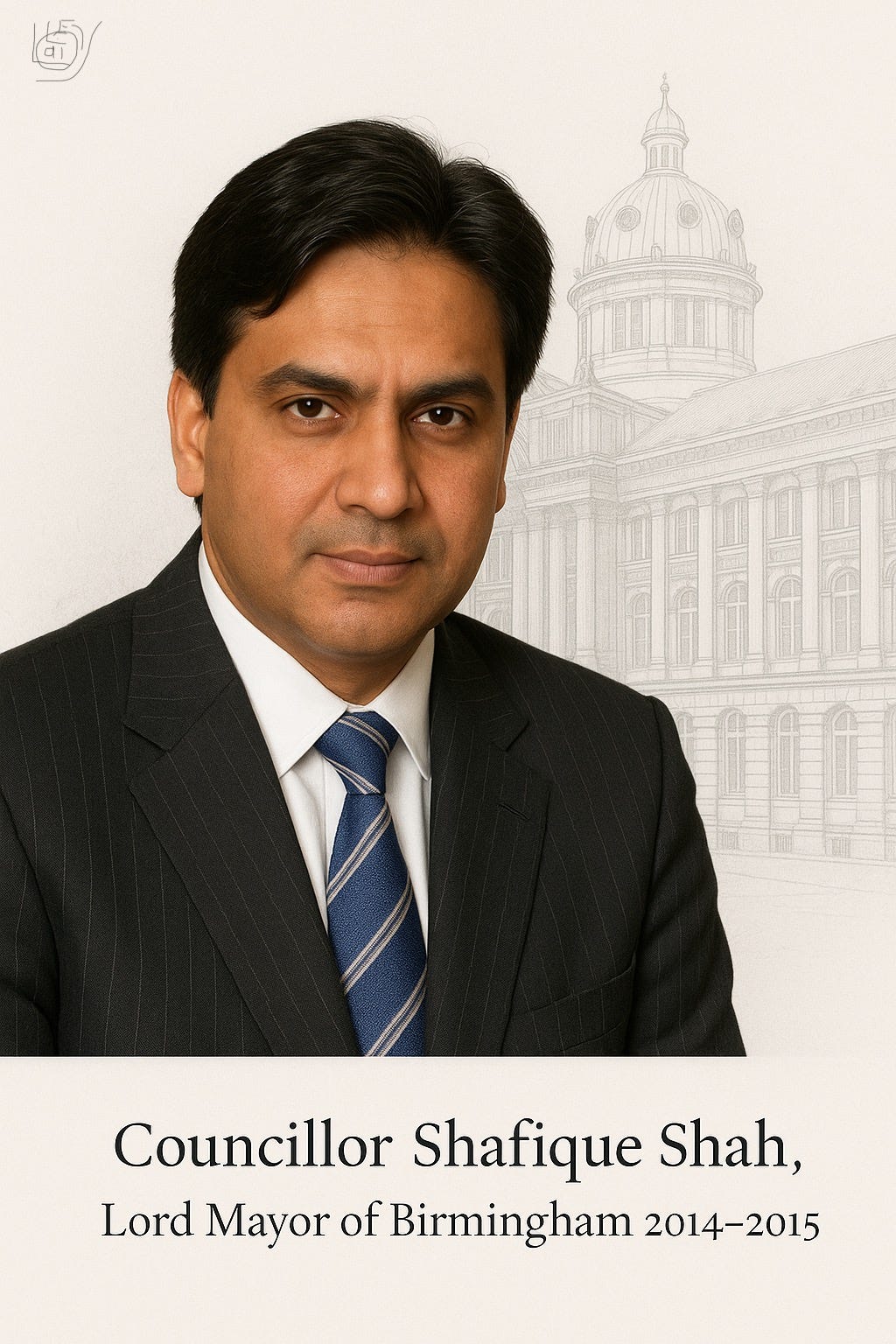
That brings us to Councillor Shafique Shah, Lord Mayor of Birmingham from 2014 to 2015.
He is a serving councillor.
He is Labour.
He has completed the Lord Mayoral year.
He meets every requirement of protocol.
And unlike many processes governed by rigid rules, this one ends well.
Shafique Shah is a gentleman of the first order. He was an excellent Lord Mayor. He understands the ceremonial role without mistaking it for power. He understands people. He listens. He carries the office with grace rather than ego.
There is no doubt whatsoever that he would make an outstanding Deputy Lord Mayor again.
A Word on Lord Mayor’s Deputies for Life
There is one final distinction worth explaining, because it is often misunderstood.
Once you have served as Lord Mayor, you become a Lord Mayor’s Deputy for life, whether or not you remain on the council. This is separate from the elected office of Deputy Lord Mayor.
As of May 2026, there are sixteen former Birmingham Lord Mayors from this century who are still alive and, in theory, available to act in that capacity.
In practice, the number is far smaller.
Public life takes its toll. Health, age, and simple exhaustion narrow the field. Of those sixteen, perhaps half a dozen at most can realistically be relied upon to turn out, put on the chain, and carry out civic duties when called upon.
They form the city’s quiet civic reserve, experienced, dignified, and deployed only when needed.
When the System Quietly Gets It Right
This is not a story about intrigue or manoeuvring. It is a story about what happens when rules, memory, and experience are allowed to do their work.
Ken Wood deserves immense credit for his service. He has worn the chains with dignity, warmth, and credibility, and Birmingham has been well served by him. Protocol may say no, but respect remains, and rightly so.
What matters more is that when the arithmetic is done, when the exclusions are applied, and when the dust settles, the answer that emerges is not awkward or compromised, but reassuring.
Shafique Shah fits the office because he understands it.
He understands that the Lord Mayoralty is not about prominence, but presence. Not about authority, but trust. Not about being seen everywhere, but being right where you are needed.
Birmingham is a city that values continuity more than theatrics, and steadiness more than noise. In civic life especially, it rewards those who have done the work quietly and well, and who are still standing when the rules circle back around.
Sometimes the machinery looks opaque. Sometimes it looks old-fashioned. But every now and then, it produces exactly the right result.
This is one of those times.