

Change ahoy at the West Midlands Pension Fund
West Midlands pension politics is changing. Pensioners deserve prompt payment, councils deserve fair contributions, and taxpayers deserve answers.

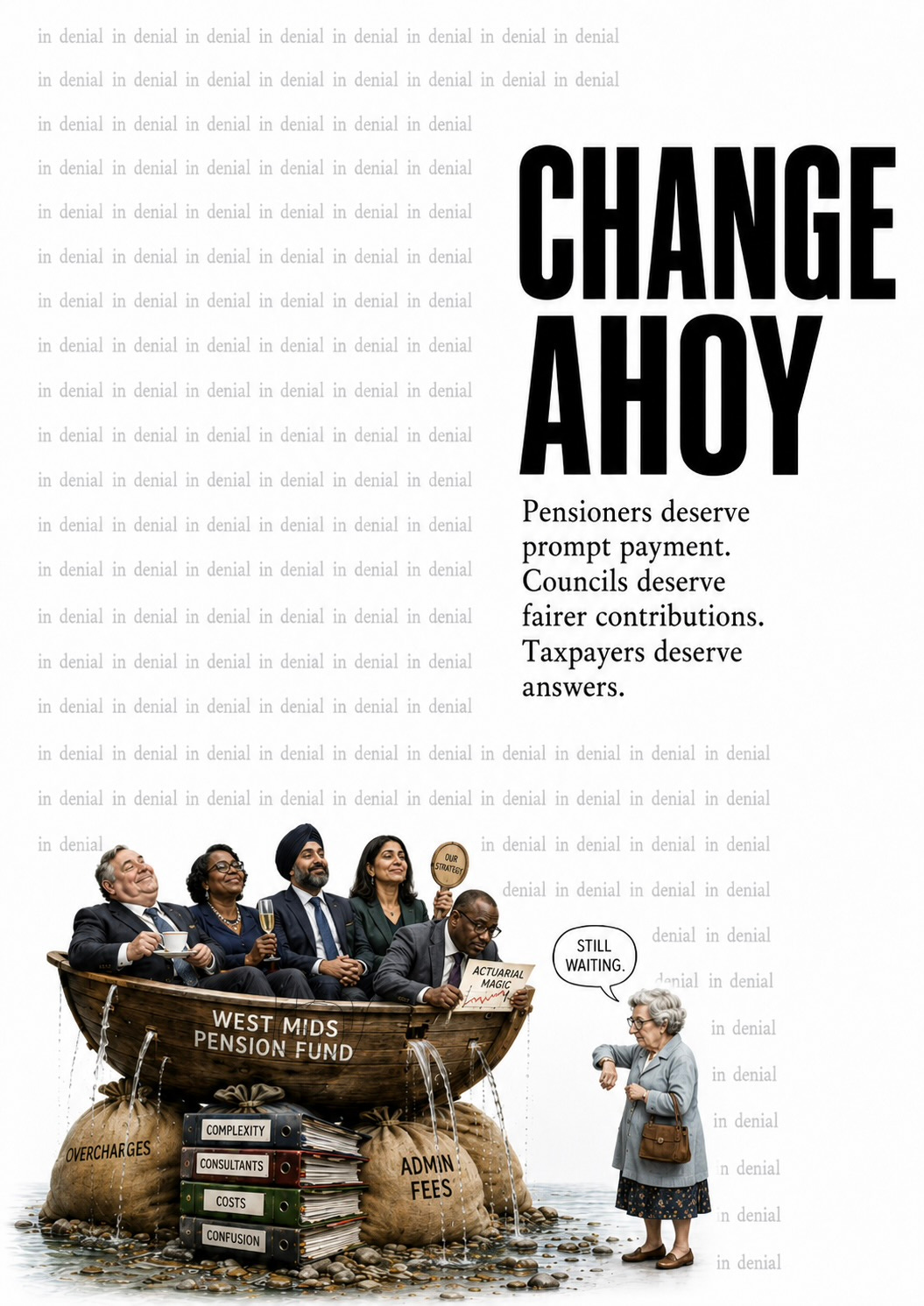
For years, Professors John Clancy and David Bailey have been chipping away at the West Midlands Pension Fund with that most dangerous of weapons in public life: common sense. Again and again they have questioned whether councils, schools and other public employers have been paying more than necessary into a fund already strong enough to meet its obligations. Again and again, the pension establishment appeared to greet their arguments with the warm enthusiasm usually reserved for a wasp at a picnic.
Yet persistence has a habit of becoming vindication. What once sounded like a lonely campaign against an immovable wall of official intransigence now looks rather different.
Kensington and Chelsea’s 0 per cent employer contribution decision has blown a hole through the old defence. The question is no longer whether Professors Clancy and Bailey were being awkward. The question is whether they were right too early, while the officials were either in denial, asleep at the switch, or simply far too comfortable with a system that made little sense to anyone outside the sacred fog of pension administration.There are moments in local government when a dry committee report lands with the force of a brick through a very comfortable window. The Royal Borough of Kensington and Chelsea may just have thrown one.
Its pension fund has approved a 0 per cent employer contribution rate for the council and Kensington and Chelsea College. Not because pensions are unsafe. Not because pensioners are to be squeezed. Not because public servants should be denied what they have earned. Quite the reverse. The argument is that the fund is strong enough to pay its promises while releasing hard-pressed public employers from contributions which may no longer be justified at previous levels.
That matters in the West Midlands.
It matters because the West Midlands Pension Fund is not some dusty back-office contraption humming away behind a filing cabinet in Wolverhampton. It is one of the largest Local Government Pension Scheme funds in the country. It touches pensioners, current workers, councils, schools, academies, police, fire, colleges, universities and, at the end of the long municipal food chain, the council taxpayer. That familiar creature who is regularly invited to pay more, receive less and be grateful for the opportunity. It also matters because the politics around the fund is changing.
For years, the old Labour and Tory order has sat on pension bodies with the solemn expression of people guarding the Crown Jewels, when in truth too many have looked more like nightclub doormen waving through the regulars. The officer says. The actuary says. The investment adviser says. The committee nods. The taxpayer pays. The pensioner waits. The fund grows. The fees flow. Everyone looks serious. Everyone says “fiduciary duty”. Nobody asks why the bill is quite so fat. That old rhythm is now under pressure.
Labour has been badly weakened across the West Midlands. The Conservatives are hardly riding into town on a white charger either, unless the charger has failed its MOT and is being pushed by a councillor with a rosette. Reform, the Greens and independents have changed the electoral weather. Whether one likes that or not is beside the point. The new councillors arriving around the region will have fresh mandates, fewer old loyalties and, one hopes, a sharper appetite for asking simple questions.
And simple questions are exactly what the West Midlands Pension Fund now needs. How large is the surplus? Why are employer contributions set where they are? What assumptions sit beneath them?
How much has been paid in investment management fees? How quickly are pensions being processed? How many members have been left waiting? How many complaints are being upheld? Why does governance still look designed for the comfort of insiders rather than the confidence of pensioners and taxpayers?
None of this is anti-pensioner. Quite the opposite. The first duty of any pension fund is painfully obvious. Pay the pensioners properly, promptly and accurately. A pension is not a Christmas card from the council. It is deferred pay. It is money already earned. Any administration system that leaves people waiting, chasing or wondering when their income will arrive has failed at the human level, however glossy the annual report and however grand the investment presentation.
Indeed, the West Midlands Pension Fund has felt obliged to publish customer service updates telling members that key payment processes are back to business-as-usual standards. That is meant to reassure. It may do so. But it also raises the rather obvious question of what “usual” had become before normal service had to be announced like the return of a missing bus.
A pension fund should not need a round of applause for paying pensions properly. That is the job. It is not a gold-star moment. It is not a civic miracle. It is not the municipal equivalent of landing a plane on one wheel in a thunderstorm. It is the thing the fund exists to do.
The second duty is just as important. Do not overcharge employers simply because the system has always done so, or because advisers have wrapped caution in a language so complex that elected councillors quietly lose the will to live somewhere around paragraph 14.7, appendix C.
Kensington and Chelsea has now shown that a different question can be asked. If a fund is strong enough, why keep taking money at the old rate? If pensions can be paid securely, why lock away public money that councils, schools and public services desperately need now?
The answer may be that the West Midlands is different. Fine. Then show us.
Publish the assumptions. Explain the funding position in plain English. Show the downside risk. Show the upside. Show the effect on council budgets if contributions were reduced. Show what safeguards would protect members. Show why 0 per cent is impossible, if it is impossible. Show why a staged reduction is not possible, if that is the case. But do not hide behind complexity.
Complexity is the velvet curtain behind which far too much local government failure has spent a comfortable retirement. It is the language of “nothing to see here”, spoken fluently by people who always seem to know where the public money went, but only after it has gone.
The West Midlands Pension Fund’s Pensions Committee is made up of councillors. Ten come from Wolverhampton, as administering authority. Six come from Birmingham, Coventry, Dudley, Sandwell, Solihull and Walsall. So the politics of those councils matters directly.
There is another wrinkle here, and it is not a small one.
The current structure is often spoken about as though it had been brought down from Mount Sinai on stone tablets, somewhere between the commandments and the council constitution. It was not. It is a governance arrangement. It was made by people. Subject to the relevant legal and constitutional requirements, it can be reviewed by people.
That matters because Wolverhampton is the administering authority. If the next third of Wolverhampton comes up and Reform takes full control, the political temperature around the fund changes again. The very authority with the ten seats and the formal administering role may be controlled by councillors with a direct political interest in questioning the fund’s assumptions, contribution levels, fees, service performance and governance structure.
That does not mean anyone can simply kick the door in and rearrange the furniture before lunch. Local government has rules, and then rules about the rules, and then a subcommittee to consider whether the rules about the rules were properly stapled. But it does mean the current arrangements should not be treated as sacred.
Is the present balance between Wolverhampton and the metropolitan authorities right? Should the administering authority carry more weight, or less?
Should the metropolitan districts have more say if their employers and taxpayers are carrying the cost? Should trade union representatives continue to debate but not vote? Should pensioner and member representation be strengthened? Should the whole thing be reviewed in the light of a changed political map?
These are the kind of questions the old order tends to greet with the expression of a man whose sherry has been watered down. Yet they are perfectly legitimate. Public money is involved. Public workers are involved. Public confidence is involved. The days when pension governance could be treated as a private conversation between officers, advisers and councillors with heavy folders may be coming to an end.
Reform has made local government pension funds a specific political target. Reform UK Richard Tice MP has questioned fees, performance, contribution levels and governance. Some will agree with him. Some will not. That is politics. But councillors who arrive with an instinct to challenge rather than doze gently through the briefing pack may be exactly what this system needs.
The old parties should not sneer too quickly. They had years to ask the awkward questions. They preferred the comfort of the nodding room.
And what of pensioners themselves? They should be put at the front of this debate, not hidden behind actuarial smoke. If there have been delays, backlogs or service failures, let them be reported plainly. If performance has improved, say so and prove it. If complaints have been reduced, show the figures. If members have been left waiting for money, explain why and say what has changed.
A pension fund that cannot consistently deliver timely service to its members should not expect a standing ovation for clever investment charts. People cannot eat a pie chart. They cannot pay the gas bill with a governance dashboard. They cannot take a “funding strategy statement” to the supermarket and ask whether it covers the weekly shop.
This is not an argument for gambling with pensions. It is an argument against gambling with council tax, public services and public trust.
If a fund is genuinely in surplus, and if pensions can be paid securely, then money extracted from employers beyond what is needed is not prudence. It is hoarding. It is the quiet diversion of public money from today’s services into yesterday’s actuarial anxieties.
The West Midlands has councils under immense pressure. Birmingham has already been through civic financial humiliation. Social care is stretched. Neighbourhood services are thin. Council taxpayers are exhausted. Schools and public bodies are under pressure. Every unnecessary pound locked away is a pound not spent on the living city.
For too long, too many councillors have behaved as though pensions were too complicated for democratic challenge. That is not prudence. That is surrender wearing a lanyard.
And let us be honest. The old municipal left has too often confused spending other people’s money with moral seriousness. It has not been enough to ask whether contributions are fair, whether funds are overprovided, whether services are efficient, or whether taxpayers are being rinsed through technical language. The answer has too often been: carry on, comrades, there is always another household bill to absorb the theory.
The Conservatives have hardly covered themselves in glory either. Many of them watched the same machinery run, nodded at the same reports, and then acted shocked when someone suggested the machine might be eating the furniture.
The fund must serve three groups fairly: pensioners, current workers and employers. At present, too many ordinary people may reasonably wonder whether a fourth group, advisers and fund managers, has had the easiest ride of all.
So yes, change ahoy.
The new sheriffs, if they are coming, should arrive with five demands.
First, a public comparison between the Royal Borough of Kensington and Chelsea decision and the West Midlands Pension Fund position.
Second, a clear report on whether employer contributions can be reduced, and by how much.
Third, a full fee and performance review, written in English rather than in the sacred dialect of municipal fog.
Fourth, a service recovery report on payment delays, complaints and pensioner experience.
Fifth, a governance review of the Pensions Committee, including political balance, member representation and voting rights.
No pensioner should lose a penny. No worker should be frightened. But no council taxpayer should be overcharged because old parties, old officers and old advisers got used to the comforting sound of one another’s voices.
Kensington and Chelsea has opened the door. The West Midlands should now walk through it, preferably before someone forms a working group to consider the possibility of drafting a framework for discussing whether a door exists.