

Children Die, Systems Survive: The Failure No Inquiry Fixes
Across the West Midlands, children known to the system have died despite warning signs being recorded. Reviews follow, lessons are noted, but meaningful accountability remains rare.

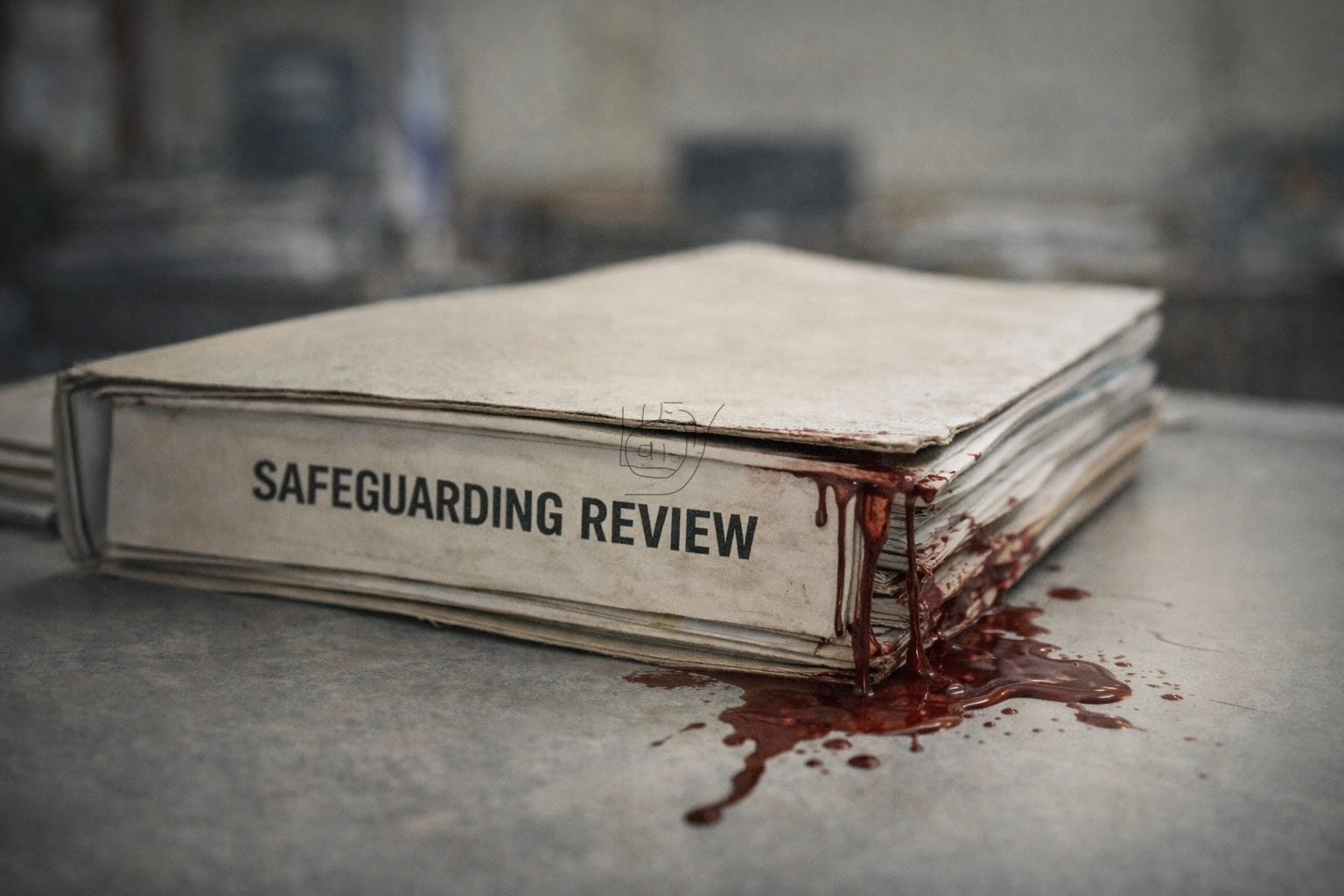
THE APOLOGY MACHINE: CHILDREN DIE, SYSTEMS SURVIVE
In the days after a child dies at the hands of violence or neglect, the language arrives almost immediately. Senior figures express deep regret. Agencies acknowledge that opportunities were missed. Reviews are commissioned, processes are examined, and assurances are given that lessons will be learned. It is a ritual now so familiar that the wording often feels pre-written. Yet behind that language sits a harder question. If the same failures are identified time and again, why do the outcomes remain so unchanged, and why does accountability so rarely follow?
The publication of the Southport attack inquiry on 13 April 2026 provides a fresh and brutal example. The report concluded that the deaths of three young girls could and should have been prevented. It identified failures in information sharing, a lack of clear ownership of risk, and systemic weaknesses across agencies. That finding is not simply about one incident. It is a lens through which to examine a wider and more uncomfortable pattern.
Across the West Midlands, and over many years, children known to the authorities, or visible enough to have been protected, have died in circumstances where intervention was possible but insufficient. The details differ, but the structure does not. Information exists. Responsibility is shared. Action is delayed, diluted, or lost. Afterwards, the system explains itself.
The case of Arthur Labinjo-Hughes murder remains one of the clearest modern examples. Arthur died in Solihull on 17 June 2020, aged six. By the time of his death, multiple agencies had already built a fragmented but significant picture of concern. The national review into his murder identified weaknesses in information sharing, a lack of robust professional challenge, and a failure to properly understand the child’s lived experience. Practitioners relied too heavily on the account given by his father, while concerns raised by wider family members were not given sufficient weight. Arthur was not invisible. The system saw parts of him, but failed to assemble those parts into action.
That conclusion is not new. More than a decade earlier, the death of Khyra Ishaq murder exposed the same structural weaknesses. Khyra died in Handsworth, Birmingham, on 17 May 2008, after prolonged starvation and abuse. The Serious Case Review found missed opportunities for intervention and highlighted failures to properly assess risk, particularly in relation to her removal from school and the absence of effective oversight of her home environment. It concluded that safeguarding processes had not operated with sufficient rigour to protect her.
What links these cases is not simply tragedy, but repetition. Across years and different administrations, the same findings recur. Missed opportunities. Poor information sharing. Lack of coordination. Failure to challenge. The language evolves only slightly, but the substance remains strikingly consistent. Systems designed to protect children continue to identify risk without consistently acting on it.
There is also a stark imbalance in how failure is treated depending on who commits it. When parents neglect or abuse a child to the point of serious harm or death, they face prosecution, conviction, and often long custodial sentences. The state acts with clarity and force, and rightly so. Yet when professionals, trained and salaried precisely to identify and act on that same risk, fail in ways that contribute to the same outcome, the consequences are fundamentally different. Reviews are commissioned, apologies are issued, and systems are said to have fallen short, but individuals rarely face sanctions that reflect the gravity of the failure. One form of neglect leads to prison. The other leads to process.
Over time, this begins to resemble a culture of administrative containment. Failure is acknowledged, but managed. Responsibility is shared until it becomes indistinct. Language softens the edges of accountability. The system does not deny error, but it absorbs it. Apology becomes the mechanism through which failure is recognised without materially altering the position of those involved.
If safeguarding is to mean anything, that imbalance cannot remain. Where risk to a child is known and documented, there must be clear ownership at a senior level. Responsibility cannot be allowed to dissipate across agencies and committees. Where reviews identify failures to act on known risks, failures to escalate, or failures to coordinate effectively, those findings should lead to formal disciplinary processes with meaningful outcomes. Dismissal should not be exceptional where gross safeguarding failure is established.
There is also a legitimate, if uncomfortable, question about financial consequence. Where catastrophic safeguarding failure is linked to identifiable senior oversight, it is reasonable to ask whether pension protections and long-term financial security should remain entirely untouched. At present, the system allows individuals to preside over serious failure and leave with their position largely intact. That disconnect between outcome and consequence weakens public confidence and undermines the credibility of reform.
Structural change is also required. Senior safeguarding roles should be subject to fixed-term, performance-linked contracts, with renewal dependent not only on procedural compliance but on demonstrable outcomes. Alongside this, there is a strong case for independent national oversight with the authority to review local findings, mandate action, and publish conclusions without local filtering. Without external challenge, systems have a natural tendency to protect themselves.
None of this removes the difficult truth that some parents fail their children, sometimes gravely. Safeguarding systems exist because of that reality. When both fail, parent and state, the outcome is tragically predictable. What these cases demonstrate is not a lack of knowledge, but a failure to act decisively on what is already known.
From Birmingham in May 2008, to Solihull in June 2020, to the findings published in April 2026, the pattern has proved remarkably durable. Children die. Agencies apologise. Reviews identify familiar weaknesses. The system absorbs the shock and continues.
Until that changes, these inquiries risk becoming less instruments of reform than rituals of absolution, carefully worded processes in which failure is acknowledged, lessons are recorded, and the professional order remains largely undisturbed.
Sadly 'the system' you describe in one area of public interest reflects the wider, national weakness in public Inquiries, at whatever level, such as the single child abuse at the local i.e. Solihull (Arthur was not the only case). Then the spectacular Grenfell Tower Inquiry and now Southport Inquiry, let alone the COVID Inquiry. All appear to have the same result: "words, calls for change and then zip". Yes, there can be exceptions, I can only quickly recall one, the Bichard Inquiry after the Soham child murders in 2002, his report in 2004 resulted in major reforms to safeguarding, including the creation of the Independent Safeguarding Authority (now Disclosure and Barring Service - DBS).
"Grooming" remains a "hot potato" and locally in Dudley in early 2026: https://www.bbc.co.uk/news/articles/clyzy0y20qlo and https://www.bbc.co.uk/news/articles/cevkg7k01j2o
No wonder that 'trust' in the professions and public institutions has declined. See: https://www.ipsos.com/en-uk/ipsos-veracity-index-2025
I know this sort of performance from my 25 years service in the Civil Service. It's called bureaucracy, and the specific failure is consultation, or more precisely " we haven't got the time/energy to pass the information on to the next level". There are several ways to look at that. One way is a Trade Union way. Not enough staff. Too heavy a work load. Both those problems, when rejected by management and the higher echelons, increase sick absences and loss of interest/enthusiasm/determination, which ultimately result in looking for another employer.