

In the lull between Christmas and the New Year, when Parliament is quiet and the political noise briefly subsides, there is space to ask a different kind of question. Not who is winning today, or who landed the last punch before recess, but what the country is actually thinking as it turns the page on another year. That reflective territory is long occupied by Lord Ashcroft.
A Conservative peer and one of Britain’s most experienced political pollsters, Ashcroft has made a habit of publishing surveys at moments like this, away from the heat of elections and leadership contests. His polling is less about prediction than diagnosis. It probes voters’ instincts, their doubts, their second thoughts and their judgements of political personalities. Read in this in-between week, his final poll of the year offers a revealing snapshot of a country pausing, uncertain, and quietly reassessing its leaders before the year ahead begins.
What emerges is not a nation in revolt, nor one content with the status quo, but something more unsettled. A Britain that feels tired, economically anxious and unconvinced that any of its current leaders quite understand it.
The Christmas Table Test
Ashcroft’s now-familiar Christmas questions, playful on the surface, are often the most revealing. Asking voters to imagine party leaders at a festive gathering strips away policy briefings and media choreography and exposes how politicians are felt, rather than how they present themselves.
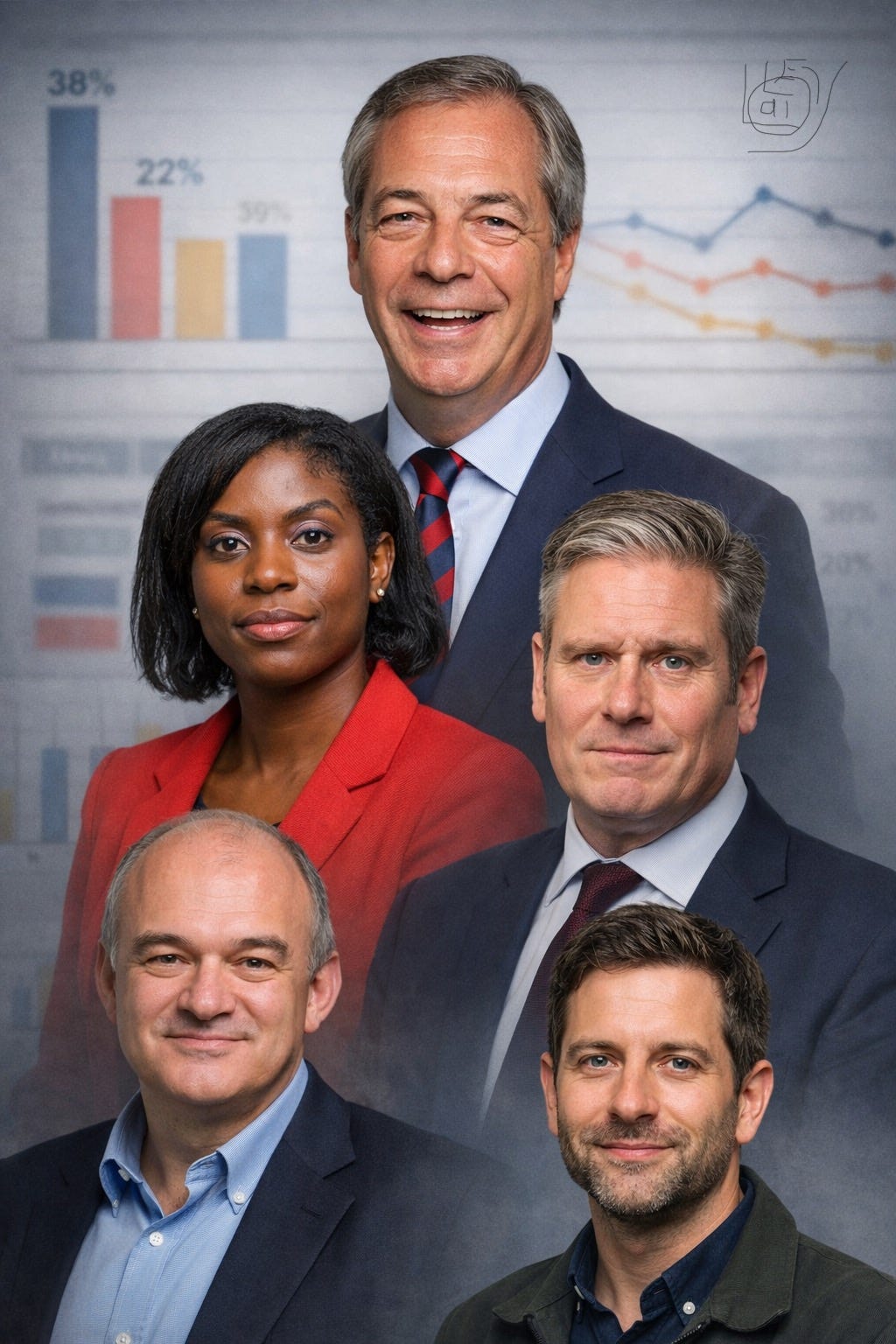
Keir Starmer, once again, is cast as the awkward presence. Polite, competent, earnest, but also dull. The man likely to deliver a boring speech, slip away early, or retreat to watch the King’s Speech while others talk around him. It is not hostility, but it is not warmth either. The problem for Starmer is that indifference is often more dangerous than dislike.
Kemi Badenoch, by contrast, comes across as more human. The leader people imagine helping to clear up, bringing something useful, or being unexpectedly charming under the mistletoe. This does not translate automatically into electoral dominance, but it does suggest a personal appeal that outpaces her party’s current standing.
Nigel Farage remains an outlier. The man voters expect to burn the lunch, disappear down the pub, and still somehow be the most entertaining person in the room. He is not trusted, but he is understood. In a political era where authenticity often trumps competence, that remains a potent combination.
These questions are not trivial. They reveal a deeper truth. British voters increasingly judge leaders as people first and politicians second. And on that measure, many of today’s figures are failing to connect.
Fairness Still Matters
Beyond the festive framing, the poll touches on something far more serious: public attitudes to justice and the rule of law. Asked about proposals to restrict jury trials in order to clear court backlogs, voters remain instinctively resistant.
A clear majority still believe jury trials are more likely to deliver fair outcomes than judge-only hearings. Speed and efficiency matter, but not at the expense of legitimacy. Even more telling is the suspicion that reforms are not purely administrative. Many respondents believe cost-cutting, or a desire for greater state control, sits behind the proposals.
This matters because it exposes a fault line in contemporary governance. Governments increasingly talk the language of efficiency, delivery and systems management. Voters, meanwhile, still care deeply about fairness, transparency and the sense that justice is done in public, by peers, not simply processed behind closed doors.
It is a reminder that Britain’s institutional instincts remain conservative in the small-c sense. Change is tolerated, but only when it feels rooted in principle rather than convenience.
The Cost of Living Hangover
Unsurprisingly, the cost of living dominates voters’ concerns. It remains the single most important issue facing the country, ahead of the NHS, social care and immigration. This is not ideological anxiety, but practical fear. People worry about heating bills, food prices and whether their income stretches far enough into the new year.
The poll also finds that more people expect to have less money to spend this Christmas than last. That matters. Christmas spending is often treated as a barometer of confidence. When households pull back during the festive period, it suggests caution rather than optimism.
Politicians talk frequently about green shoots and long-term plans. Voters are still focused on survival. That gap between narrative and lived experience continues to define British politics.
Angela Rayner and the Limits of Loyalty
One of the more striking findings concerns Angela Rayner and the prospect of her return to senior office. Fewer than a third of voters think it would be acceptable. Even among Labour supporters, enthusiasm is muted.
Rayner is not uniquely unpopular, but she appears to embody a broader problem for Labour. Loyalty within the party does not automatically translate into credibility with the country. Voters remain unconvinced that reshuffling familiar faces amounts to renewal.
More damaging still is the perception that Rayner would make a weaker prime ministerial prospect than Starmer. For a party already struggling to project confidence and authority, that is not a comfortable position.
Who Do You Trust With the Economy?
Asked who would do a better job running the economy, voters give a narrow edge to the Conservative pairing of Badenoch and Mel Stride over Starmer and Rachel Reeves. But the most telling response is the size of the “don’t know” column.
This is not a ringing endorsement of anyone. It is an admission of uncertainty. After years of shocks, crises and reversals, trust in economic management has eroded across the board. Voters are no longer convinced that any party has a firm grip on the levers of prosperity.
That uncertainty creates space. It also creates risk. When confidence is low, politics becomes volatile.
Election Fatigue and Second Thoughts
On the question of timing, the country is divided. Around four in ten voters would like an election in 2026. A larger group would prefer to wait until 2029. The appetite for an early contest is strongest among Conservatives and Reform supporters, suggesting frustration rather than confidence.
Perhaps more revealing are voters’ second-choice preferences. Reform voters tend to lean Conservative as a fallback. Conservative voters scatter more widely, naming Labour, the Liberal Democrats and the Greens. Traditional loyalties are loosening. The electorate is hedging its bets.
This fragmentation does not point to a single insurgent force, but to a slow unravelling of old certainties. The two-party system still dominates, but it no longer commands instinctive allegiance.
A Quiet Moment Before the Noise Returns
Taken together, Ashcroft’s final poll of the year paints a picture of a country between chapters. Not angry enough to revolt, not content enough to settle. Voters are sceptical, cautious and increasingly focused on character as much as competence.
They want fairness preserved, living standards protected and leaders who feel real. They are tired of managerial language and unconvinced by recycled personalities. They are not demanding miracles, but they are asking for honesty and connection.
Politics rarely pauses, but this narrow window between Christmas and the New Year offers something close to stillness. The polls are taken, the speeches are over, and the country is left alone with its thoughts. What this survey captures is not a surge of enthusiasm or a collapse of faith, but a long, collective exhale.
As the new year begins, the challenge for those who seek to lead is not simply to speak louder or move faster, but to listen more carefully. The electorate is not drifting aimlessly. It is weighing, comparing and quietly recalibrating. Those who mistake that mood for apathy may find, when the noise returns, that the ground has already shifted beneath them.
Thank you to everyone who has read, shared and supported GRIT over the past year. These pieces are written in the belief that politics deserves space, context and honesty, especially when the headlines move on too quickly. I wish you a peaceful New Year and look forward to continuing the conversation in the months ahead.