


Politicians often tell journalists they entered politics because they want to serve the public. It is almost expected. After interviewing politicians for many years, I have learnt to nod politely before moving on to the next question. Cllr Alan Feeney gave me exactly the same answer. The difference was that, by the end of our conversation, I believed him. Whether you agree with his politics or not, there is a consistency about the man that is difficult to ignore. Long before Reform UK, before the Conservatives, before council chambers and election campaigns, there appears to have been a simple desire to make things work better for other people. That thread runs through almost every chapter of his life.
He traces it back to school. If there was a project to organise, he was the pupil who somehow found himself running it. Becoming a prefect merely formalised what he was already doing. Leadership, he insists, was never about status. It was about making sure things happened. Those instincts later took him through hospitality, funeral services, the prison service and eventually local government.
His working life has been anything but ordinary. Fifteen years in hospitality, including the Paragon Hotel during its heyday, taught him that everyone deserved respect. He later became a funeral celebrant, entrusted by grieving families to help them through one of life’s hardest days. It demanded compassion above everything else. The move into the prison service might seem an unlikely next step, yet he speaks about it with the same philosophy. Discipline matters, he says. Standards matter. But respect matters too. He describes himself as a non-judgemental prison officer who believed people responded better when they were treated fairly without compromising authority. Listening to him, it becomes clear that his views on justice were shaped more by experience than ideology.
One episode, however, appears to have cast the longest shadow over his life. Years ago, after losing accommodation linked to his employment, he found himself on the brink of homelessness. He expected the system would help. It did not. A friend’s sofa prevented what could have been a very different future. The experience shocked him. It taught him that there are times when you simply have to paddle your own canoe. Yet it did not leave him bitter. Instead, it reinforced another belief: communities thrive when people are willing to serve one another. Self-reliance and public service are not contradictions in Cllr Feeney’s world. They sit comfortably alongside each other.
Perhaps that explains his political journey. He spent years as a loyal Conservative, holding office within the local party and believing in its principles. Then, in his view, the party changed. Good people were passed over while careerists prospered. Public service slipped behind political ambition. Eventually the excuses ran out. He left, spent time as an Independent and later joined Reform UK.
It would be easy to dismiss that as simply another Conservative defection. I came away thinking it was more nuanced. Cllr Feeney speaks about Reform less as an electoral vehicle than as somewhere he feels politically at home. He gives the impression of someone who had already settled on his philosophy and then found a party that reflected it.
Ask him what Reform stands for and he doesn’t launch into a rehearsed speech. Instead, he asks a question.
“What’s your biggest problem?”
Only then, he says, does he explain how Reform believes it can help. It is an answer that says as much about Alan Feeney as it does about his party.
Today Cllr Feeney serves on both Birmingham City Council and Solihull Council, having previously served on Worcestershire County Council. That breadth of experience is unusual. Serving communities on both sides of the Birmingham–Solihull boundary also gives him an unusual perspective. In Solihull, he says, residents worry about planning applications, HMOs and protecting neighbourhoods from overdevelopment. In Birmingham the conversations are different. People want bins collected, potholes repaired and the basics working properly again. Throughout our conversation he repeatedly returned to one phrase: getting the basics right. Strip away the party labels and it may be the simplest summary of his political philosophy.
When I asked which achievement made him proudest, he didn’t mention winning elections. Instead he spoke about helping secure the abolition of child bereavement fees, removing burial costs from parents who had already suffered the unimaginable loss of a child. Whatever your politics, that is local government making a real difference.
Away from politics there is another side to Cllr Feeney. He is a lifelong thespian who has appeared in amateur productions of Shakespeare and opera. Covid affected the strength of his singing voice, so these days he concentrates on straight acting. Proudly Scottish, his accent has survived many years south of the border.
Then there is Star Trek.
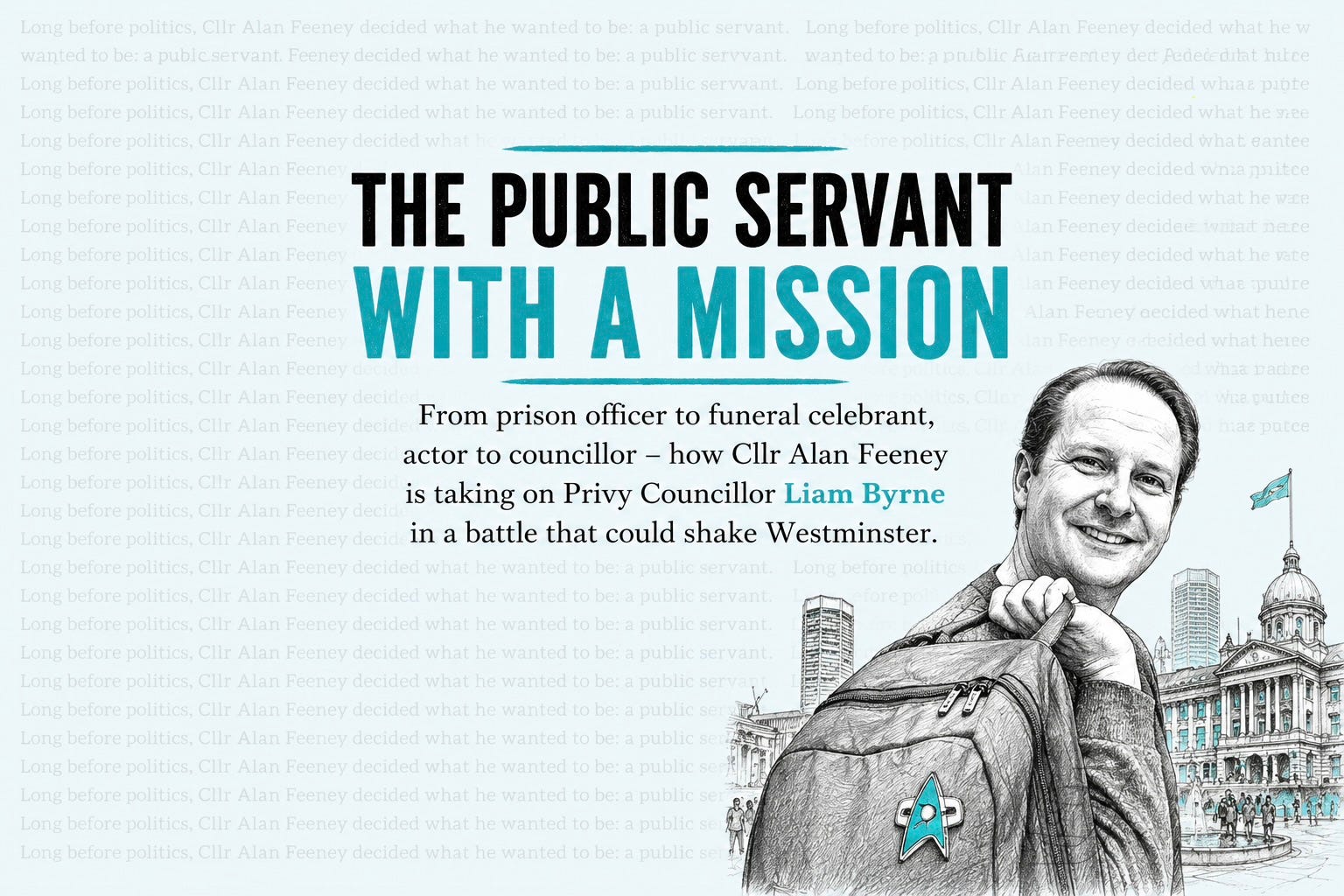
The single Star Trek badge on his rucksack is easy enough to notice. The weight of the rucksack is something else entirely. Curious, I picked it up and nearly put my back out. Somewhere between the chargers, cables, paperwork and assorted gadgets, I began to wonder whether he’d quietly slipped the warp drive from the USS Enterprise inside as well. Representing communities in two authorities clearly requires carrying much of the office on your back. The badge reveals his personality. The weight reveals the practical reality of modern public service.
Towards the end of our conversation, Cllr Feeney spoke passionately about creating a youth hub in Birmingham Hodge Hill and Solihull North. He described it as one solution capable of tackling many problems at once. I think he may be right. Give young people somewhere safe to go, something worthwhile to do and adults prepared to invest their time in them, and you begin addressing crime, isolation, boredom and lost opportunity together. One idea really can solve more than one problem.
His ambitions now stretch towards Westminster. Cllr Feeney hopes to become Reform UK’s parliamentary candidate for Birmingham Hodge Hill and Solihull North and, if selected, take on Liam Byrne at the next General Election. Electoral Calculus currently projects Reform as strongly placed in a constituency that voted heavily to leave the European Union in 2016, although projections remain just that. Elections are won by voters, not forecasting models.
As I left, my thoughts returned to that unexpectedly heavy rucksack with its single Star Trek badge. It already carries the tools of a councillor serving two authorities. Should the voters eventually send Cllr Feeney to Westminster, it may become heavier still.
Whatever happens at the next General Election, however, I suspect one thing will remain unchanged. Cllr Feeney remarked that if politics ended tomorrow, he would still be out litter-picking because public service mattered more than political office.
Readers will reach their own conclusions about Reform UK and about Cllr Alan Feeney. My task was simply to introduce the man I met.
After spending time in his company, I came away with one overriding impression. Long before Cllr Alan Feeney became a Reform politician, he had already decided what he wanted to be.
A public servant.
Nice bloke...
Thank you for this. I was fascinated by it, and I hope he achieves all his intentions. Both council wards and a constituency deserve this level of service.