

Comrade Biggs Arrives in Birmingham
He can cost Birmingham more than £10,000 a month, yet most residents have never met him. Time to shine a light on John Biggs.

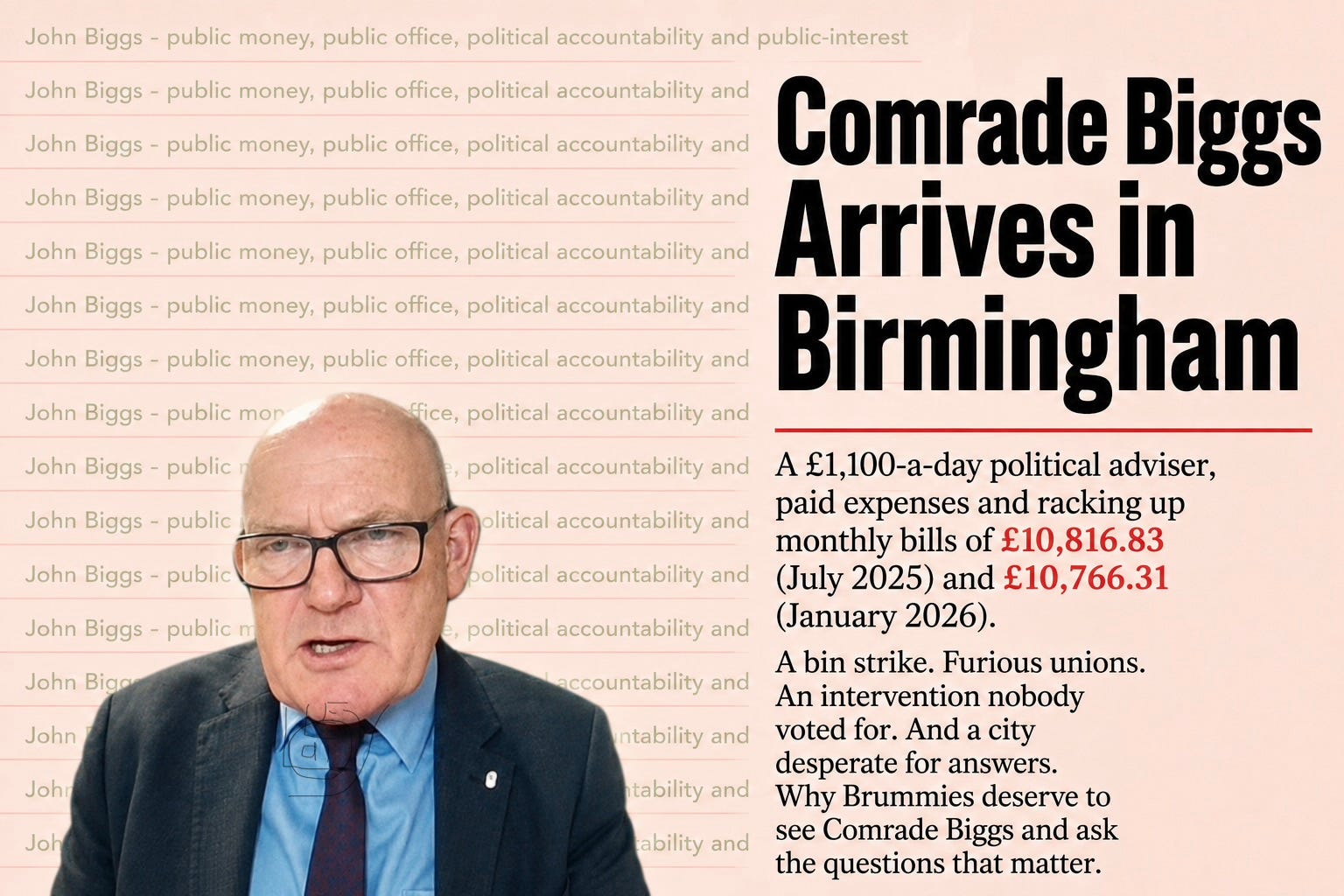
Every Soviet system had one. The general ran the army. The engineer built the bridge. The accountant counted the beans. But standing quietly behind them all was the political officer, the Commissar. His job was not to know more about tanks than the tank commander or more about steel than the steelworker. His job was to make sure everyone remained pointed in the correct political direction. Which brings us neatly to Birmingham and the curious case of John Biggs.
Officially, Biggs is not one of Birmingham’s statutory commissioners. He is a political adviser, appointed as part of the wider commissioner team and paid at £1,100 a day for up to 150 days a year. For those keeping score at home, that is potentially £165,000 before expenses. Yet despite that price tag, he remains remarkably difficult to find. There are no commissioner surgeries where residents can wander in and ask awkward questions. No public sessions where Brummies can challenge the intervention team face to face. No obvious opportunity to ask why a city of more than a million people is now subject to a form of oversight carried out by individuals who remain largely unseen. There is a website. There are profiles. There are organisation charts. There are carefully prepared words. What there is not, at least in any meaningful sense, is public accessibility.
Instead, Comrade Biggs sits somewhere behind the electronic wall of officialdom, inside the intervention machine, part of the commissioner team but not one of its most visible public faces. A political presence operating in a city already governed by commissioners, advisers, boards, panels and governance structures that seem to breed in dark cupboards whenever somebody utters the phrase “best value”. So perhaps it is time to shine a little light into the corner.
John Biggs is not a neutral technocrat who wandered into Birmingham carrying a calculator and a management textbook. He is a Labour veteran whose career stretches across decades of East London politics. Councillor. Council leader. London Assembly member. Mayor of Tower Hamlets. Political operator. Whatever else one thinks of him, nobody could accuse him of lacking political experience. That, in fact, is precisely what makes his appointment so interesting. The commissioners deal with finance, governance, housing, waste, Oracle and the rest of Birmingham’s municipal wreckage. Biggs appears to occupy a different space altogether. He is the political adviser. The man who understands councillors, factions, political pressures and the art of persuading elected representatives to keep marching even when the road ahead resembles a sinkhole with decorative lighting.
The title may say adviser. The function looks remarkably like Commissar. Now before somebody reaches for a complaint form, let me be clear. I am not suggesting Comrade Biggs has arrived in Victoria Square wearing a fur hat, carrying a copy of Pravda and demanding councillors sing revolutionary songs before scrutiny meetings. Though having attended enough council meetings over the years, I would observe that such a requirement might actually improve participation. No, the point is much simpler than that. If Birmingham is paying for political advice, residents are entitled to ask what sort of political advice they are buying.
Because Tower Hamlets under Biggs was no municipal paradise. Children’s services were judged inadequate before later improving. Liveable Streets became politically controversial enough to trigger unrest inside his own Labour movement. There were rows over youth services, rows over spending priorities, rows over the treatment of vulnerable residents and rows over public money. There was also Tower Rewards, a name that sounds less like an employment dispute and more like a loyalty card scheme where after ten visits to the council offices somebody hands you a complimentary muffin and a commemorative pen.
Workers heard something rather different. Tower Rewards became one of the most bitter workforce disputes in local government. Unions were furious. Staff resisted. Campaigners mobilised. Labour activists found themselves watching a Labour administration accused by critics of pursuing the kind of workforce restructuring normally condemned when carried out by Conservatives. This matters because disputes tell us something about political character. When pressure arrived, Biggs did not acquire a reputation as a municipal hugger. His supporters would call him determined. His critics would call him uncompromising. Either way, he demonstrated a willingness to confront organised opposition when he believed he was right.
Which brings us neatly back to Birmingham. A Labour government. A commissioner regime appointed by that government. A council Labour has now lost control of. A workforce dispute dominating headlines. Trade unions furious. Residents exhausted. And somewhere inside the intervention machine sits Comrade Biggs, a former Labour mayor whose own political history includes a bruising confrontation with organised labour. You do not need to allege conspiracy to find that interesting. You do not need to invent secret meetings or coded instructions. You simply have to ask reasonable questions. What advice was being given? What lessons from Tower Hamlets were being applied? Did that advice make settlement more likely or less likely? If Birmingham is paying for political advice, surely residents are entitled to understand whether that advice helps solve disputes or merely manages the politics surrounding them.
The financial side raises further questions. Publicly released figures show Biggs receiving not only fees but also hotel, subsistence and travel expenses. In July 2025 his total monthly cost was shown as £10,816.83. In January 2026 it was £10,766.31. In February 2026 it was £8,704.29. This may all be entirely proper. Indeed, there is no reason to believe otherwise. But it is not invisible money. It is public money. Birmingham residents are entitled to know who is spending it, what they are doing and how they can be questioned about it. Accountability is not an optional extra that arrives after the bill has been paid.
That is why visibility matters. If Birmingham pays the political adviser, Birmingham should be able to see the political adviser. Which brings me to a public offer. Comrade Biggs, let us have a coffee. No ambush. No show trial. No Politburo minutes. Just one former Labour councillor talking to another. I remain a fellow member of the Labour Party. Like you, I have sat through impossible meetings, read reports that should probably have carried health warnings and watched local government perform feats of bureaucratic gymnastics capable of astonishing Olympic judges. There is even an East London connection. My dad’s side of the family came from East Ham. Between us we should be able to manage at least ten minutes of nostalgic conversation before moving on to Birmingham’s current experiment in government by invisible steering group.
So come on, John. Coffee. Public place. Civilised conversation. You can explain what a £1,100-a-day political adviser actually does for Birmingham. I can ask why Brummies cannot simply meet the commissioner team and put questions to them like adults in a democracy. No fur hats required. No secret handshakes. No coded references to the Five Year Plan. Just a straightforward discussion about who governs Birmingham, how they govern Birmingham and why the people paying the bills seem to have so little opportunity to engage with those doing the governing.
Because Birmingham has had quite enough government by closed door, internal memo, invisible adviser and digital brick wall. If Biggs is part of the commissioner team, let him be seen. If he is influencing political decisions, let that influence be explained. If he is merely offering harmless wisdom, let the public hear some of it. And if his role is helping government navigate the political consequences of Birmingham’s collapse, residents deserve to understand that too. The commissioners may hold the formal powers, but every Soviet system knew the most interesting figure was not always the person sitting in the big chair. Sometimes it was the quiet man standing just behind it.
Biggs has been around for a while now. As to the rest of your very reasonable questions - no one knows ? Well the minister and his inner circle of mandarins will but they ain't saying ...
You make many salient points. I am surprised that a political post actually exists… why has he arrived now… and to whom will he be talking? Officials? … surely not… their masters are the present council not the last…the Commissioners?… surely not… as this will bring them into the political arena and they are meant to be non-political… to the Council leaders?… surely not… they are not Labour and what experience does Biggs have with a Council with Reform as the biggest party but in opposition… to the Labour rump? Maybe? But then the State should not be paying a political appointee… two further points outside this matter… I wait for an investigation into the last administration… perhaps I will have to wait until 2029… is he coming to bury bad news! Last, my analysis of the last local election is complete and will be available in full next week… somewhere on line as yet I know not where… this will include detailed maps and charts… but with regard to this a brief comment: are the electoral registers for each ward a figment of the imagination just like the councillors’ registers of interest were? This is a serious matter because the size of the electorate affects whether a ward has one or two councillors. How seriously are these checked… I hope more seriously that the Registers of Interest which, by the admission of officials, were nIf the actual electorate is distorted this can affect the whole democratic process. Looking it detail at turnout for each ward over many years I come to some interesting conclusions.