


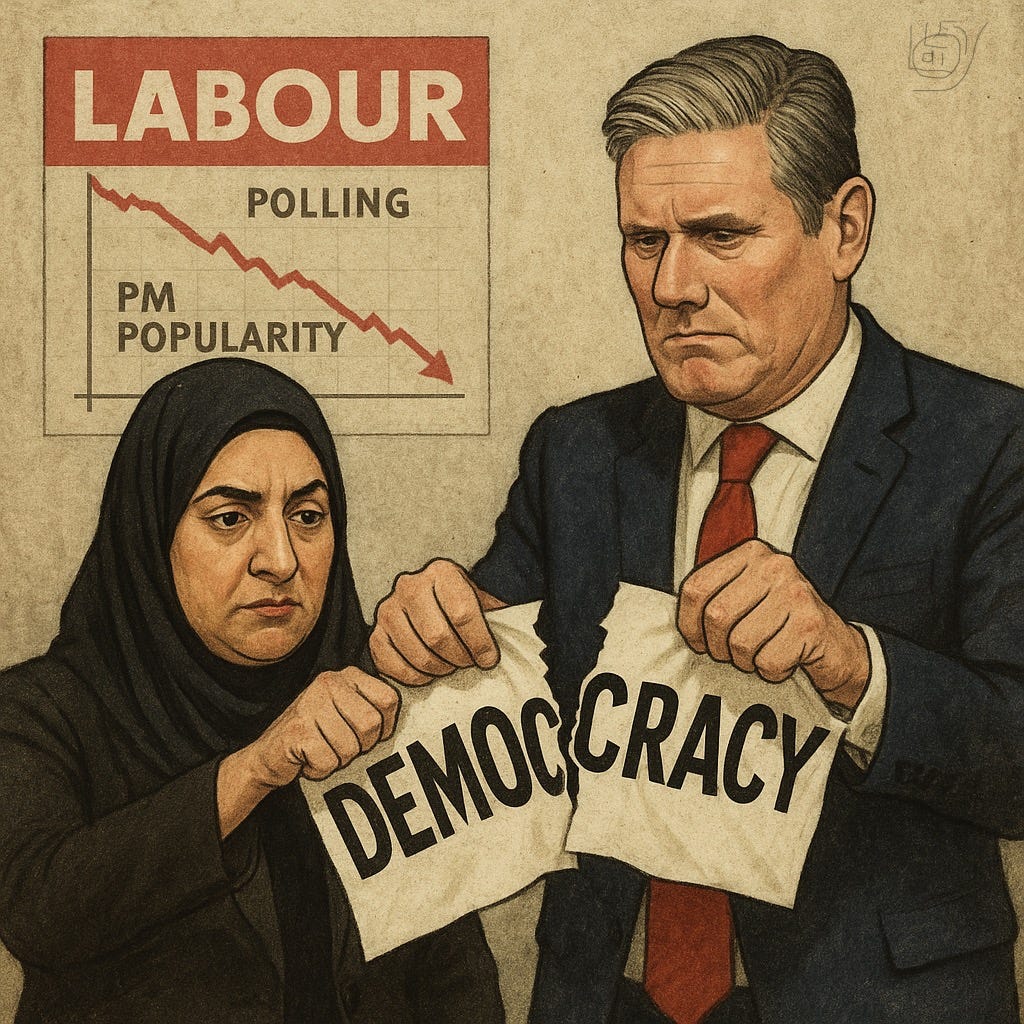
There is something almost poetic about the way British democracy is being dismantled these days. Not with riots. Not with a referendum. Not even with a half decent parliamentary debate. Labour now prefers the quiet, administrative suffocation of anything that lets ordinary people choose who governs them. The abolition of elected Police and Crime Commissioners is only the latest victim of this creeping political euthanasia. Scratch that. It is the latest badge of shame for a party that increasingly treats the vote as an inconvenience.
Whatever one thought of David Cameron, and I was never a card carrying admirer, of Dave, he at least grasped the basic grammar of democracy. He understood that policing needed a visible and accountable figure. Someone the public could sack. Someone who had to look voters in the eye. In an age when so much in politics was drifting toward bland managerialism, Cameron’s PCC reform was one of the rare acts in modern British politics that handed real authority to ordinary people rather than draining it away into Westminster’s damp vaults. On that alone the man deserves credit. He trusted the public. He believed in the simple, ancient idea that citizens should choose who holds power over public safety. Dave of course gave us the democrat institution that PCCs are.
Contrast that with Labour now. Shabana Mahmood once publicly praised our own Simon Foster, the PCC for West Midlands, for making dangerous driving a policing priority. She said she supported his efforts. Yet today she leads a Home Office that declares the entire PCC system a failed experiment. She presides over a government that will grind the office into dust by 2028. Not because voters demanded it. Not because the system was collapsing. But because Labour has decided that democracy itself is a nuisance. Something to be managed, trimmed, softened and preferably avoided when the outcome might favour someone outside the Labour inner circle. Some would see Simon as a residue of the Corbyn years. Maybe, but to me he is a nice decent guy who does a bloody good job.
And if you think I exaggerate, look at what Labour has already done. Last year they postponed local elections across vast swathes of England. Norfolk, Suffolk, Essex, Hampshire, West Sussex, East Sussex, Surrey, Isle of Wight, Thurrock. Entire counties. Millions of residents denied the right to vote because central government declared that the timetable no longer suited them. This was not for reasons of public safety or national crisis. It was because Labour wanted to re organise local government on their terms and, quite coincidentally of course, avoid elections in areas where opposition or rising parties like errm Reform UK, looked set to make gains. This was not housekeeping. It was manipulation.
Elections were cancelled and shifted like furniture. A ballot moved from the public’s hands into Labour’s administrative toolkit. When the ballot box threatens to deliver the wrong result, you move the ballot box. When an elected position gives too much power to the public, you abolish the position. When accountability makes life awkward, you drown it under another committee.
Which brings us straight back to PCCs and the West Midlands.
Simon Foster is accountable to every one of us. Three million people. Three million voters. Three million voices who can hire him, fire him, question him, challenge him and demand answers. Believe you me he promptly answers questions and does things for the little people. As Foster himself warned after Labour announced the abolition, getting rid of PCCs is “a serious mistake that strips away a layer of democratic accountability at a time when policing needs more openness, not less.” He is right. You do not remove scrutiny in a policing crisis. You strengthen it.
Labour’s replacement for the PCC will not be answerable to three million people. It will almost certainly be answerable to one person. The West Midlands Mayor. One politician behind closed doors. One signature. One line of command. If that is Labour’s idea of local democracy, they need a drastic rethink. Because a PCC stands before the public and answers for policing across the whole region. A mayor does not. A mayor already juggles transport, housing, planning, regeneration and half a dozen sprawling portfolios. Labour now wants to bolt policing oversight onto the same overloaded office and pretend it is an upgrade.
The danger here is not academic. It is understood by people who actually work in policing governance. Steve Turner, the Cleveland PCC, put it bluntly. “Police governance belongs in the hands of the public. Taking it away is an attack on democracy.” Attack is the right word. Once policing oversight is centralised under a single political figure, the public does not get oversight. They get a hierarchy. They do not get scrutiny. They get a chain of command.
Even former PCCs with no dog in the current fight can see where this is going. Martyn Underhill, the former independent PCC in Dorset, explained what PCCs brought that never existed before. They brought visibility. They brought clarity. They brought someone the public could point to when things went wrong. As Underhill put it, “PCCs increased transparency. You knew who was making the decisions. With combined authorities, that clarity disappears.” He is right. Transparency dies the moment responsibility becomes a team effort. Once you are dealing with deputies, boards, advisers and background operators, no one is ever truly responsible. And that is precisely why Labour prefers it.
Three million people represented by one elected watchdog. Or three million people reduced to a footnote under one mayor’s inbox. That is the choice. Labour knows which option gives them more control and it is not the one that gives you a vote.
This is what makes Labour’s behaviour genuinely frightening. This is not a single misstep or a one off bureaucratic tangle. It is a theme. A pattern. A slow shift in how power is held and by whom. Last year they cancelled local elections. This year they abolish PCCs. Next year it will be something else. Remove the watchdog here. Delay the ballot there. Replace elections with appointments. Push the public further back from the table each time.
This is soft authoritarianism. It is the belief that voters cannot be trusted and should not be given too much influence. It is the belief that as long as democracy is technically still breathing, you can suffocate it slowly without anyone noticing. It is the belief that control is more important than consent.
Say what you like about Cameron. He never tried to cancel your vote. Labour has. Say what you like about the PCC model. It was imperfect. It needed reform. But it was democratic. It was visible. It was accountable. It gave the public someone they could name. Someone they could blame. Someone they could remove.
Labour’s alternative gives you none of that. Instead you get centralisation, committee politics and accountability that dissolves the moment you ask who is responsible. Democracy becomes something that happens inside the system, not something that happens for the people.
Call it what it is. Scrapping PCCs is not reform. It is democratic vandalism. Cancelling scheduled elections is not tidying up the system. It is a disgrace. Postponing ballots until the ruling party feels safe is not governance. It is manipulation. These actions do not belong in a free and confident democracy. They belong to a government that fears the people and fears the vote.
That is the difference. Cameron trusted the public. Labour does not. And that should worry every voter in the land.