

DILDOS IN THE COMMONS..!!
From Edwina Currie’s controversies to Samantha Niblett’s “summer of sex”, South Derbyshire sends Westminster its boldest voices yet.

South Derbyshire is not a constituency that arrives quietly in Westminster. Those of us with longer memories will recall Edwina Currie, a Conservative MP who first made her name as a Birmingham councillor at Birmingham City Council, carrying the sharp elbows of municipal politics into the national arena. She had a talent for saying what others would not, and sometimes what they should not. A ministerial career undone by a blunt warning about salmonella in British eggs. A private life that later spilled into public view through her relationship with former Prime Minister John Major. Fame, infamy, and very little in between, followed by a second life in broadcasting and writing, where controversy became currency rather than career-ending. Currie never quite left the stage, she simply changed the stage she performed on.
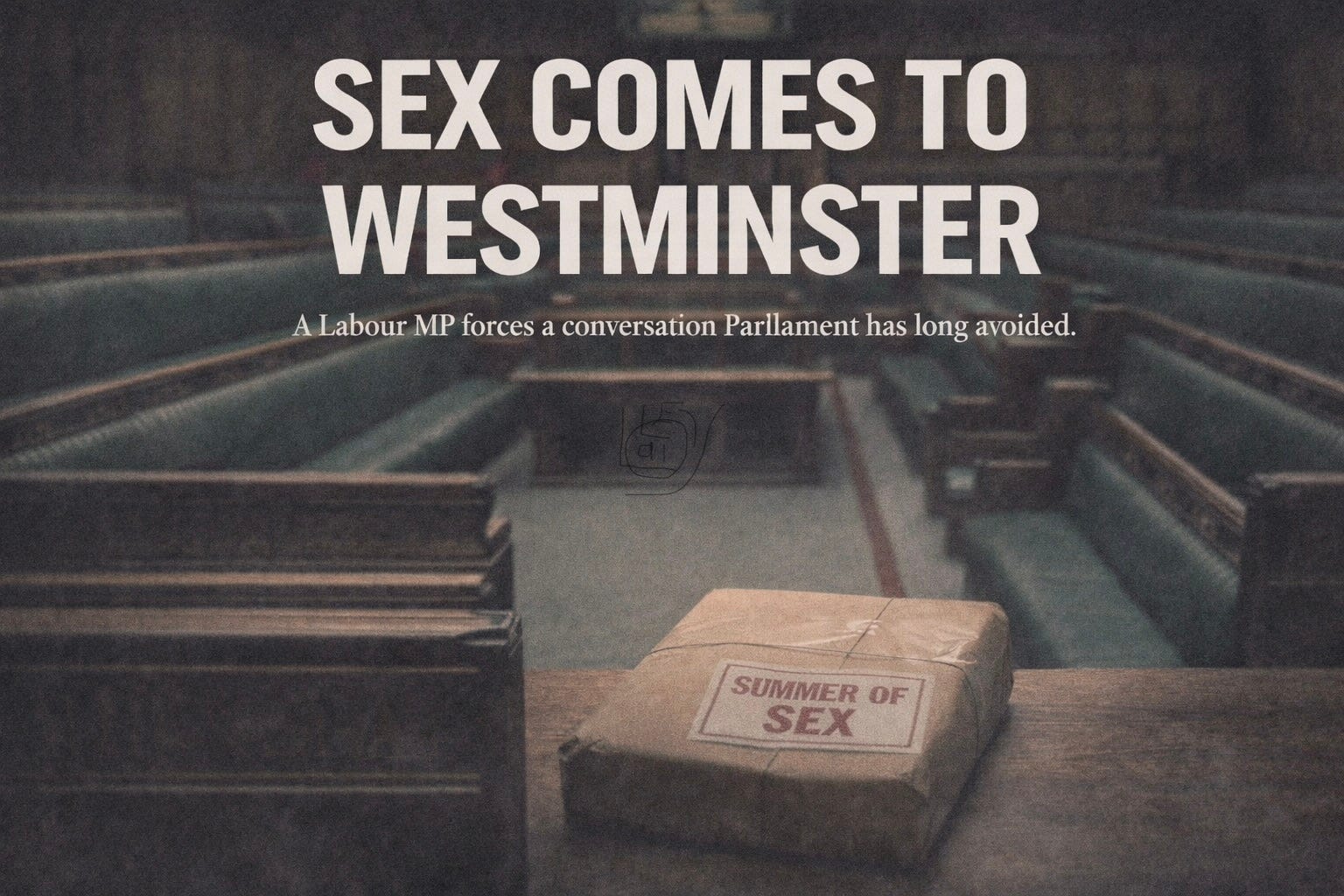
And now the same seat sends a very different kind of disruptor to Westminster. Samantha Niblett is a Labour MP who does not come from council chambers or the factional skirmishes of 1980s Birmingham. Her background is in technology, data, and the modern corporate world, shaped less by place than by profession. Yet the instinct feels oddly familiar. Where Currie shocked by force of personality, Niblett provokes by design. Her declaration of a “summer of sex”, and her intention to bring sex toys into Parliament to stimulate open discussion, is not a slip of the tongue. It is a deliberate act of political communication, designed to force a conversation many would prefer to avoid.
At first glance, it is easy to recoil. Parliament is a place of law, scrutiny, and national seriousness. The idea of sex toys crossing its threshold, even something as commonplace as a dildo, feels to many like a jarring collision between the private and the public. One can almost imagine the Speaker being asked to rule on whether an arm’s-length distance should be maintained between Honourable Members, in keeping with the centuries-old convention designed to prevent swords being drawn on the floor of the House. It is absurd, faintly comic, and entirely modern all at once.
That discomfort is real, and it should not be dismissed lightly. There are questions of judgement, tone, and propriety that deserve to be asked. But stopping at embarrassment risks avoiding a far more serious and pressing issue.
Because beyond the chamber, and far from its traditions, a different reality has taken hold. It is now widely reported that teenage boys and young men send unsolicited images of their erect genitalia to girls and young women, often without invitation and with little apparent understanding of the impact. What would once have been shocking has, in some circles, become normalised behaviour.
At the same time, there are increasing and deeply troubling accounts from women of being subjected to expectations shaped by online pornography, including pressure towards acts such as choking during sex, presented as routine despite the absence of discussion, consent, or understanding. What is depicted as performance on screen is too often carried into real relationships without context, care, or mutual agreement.
Surveys and research in the UK have consistently shown that a significant proportion of women report receiving unsolicited explicit images online, while others describe pressure to accept behaviour influenced by what partners have seen on the internet. Reports from organisations working in this field have raised sustained concerns about harmful expectations, including aggressive conduct being normalised without conversation or consent.
This is not something that can be hidden away or ignored in the hope it resolves itself. It is a cultural shift happening in plain sight, and one that demands an adult response.
In that context, Niblett’s willingness to talk openly about sex, however jarring the language or theatrical the delivery, may not be as misplaced as it first appears. There is a case, and a serious one, that silence has allowed misinformation to fill the gap. A generation raised online has not been met with a corresponding honesty offline. If Parliament is, in part, a reflection of the society it serves, then perhaps it was inevitable that these conversations would arrive, sooner or later, at its door.
That does not mean the method is beyond criticism. Parliament is not a podcast studio, nor a stage for provocation as performance. There remains a question of judgement, of tone, and of whether the deliberate courting of controversy strengthens or weakens the argument being made. The risk is not simply that the message is lost, but that it is trivialised, reduced to headline and spectacle rather than substance.
What is striking, however, is how the nature of political controversy itself has changed. Currie’s moments came as eruptions, unscripted and often costly to her career. Niblett’s feel constructed, calibrated for a media environment in which attention is currency and visibility is power. The Midlands has not lost its capacity to produce outspoken representatives, but the source of that outspokenness has shifted. It no longer emerges from the rough and tumble of local government, but from a culture that prizes disruption and rewards those who can command the narrative.
South Derbyshire, then, offers a small but telling lens on a larger transformation. From a Conservative MP shaped in Birmingham’s council chambers to a Labour MP shaped in the world of technology and modern communications, the journey reflects a wider change in how politics is conducted and consumed.
And perhaps, in this case, it is worth ending on a note that Westminster does not always allow itself. Sex, in its proper place, is not something sordid or shameful. It is a fundamental part of human connection, at its best rooted in consent, respect, and mutual enjoyment. That is the aspect so often absent from the distorted portrayals that dominate the online world.
If Samantha Niblett MP is attempting, in her own striking and unconventional way, to draw attention back to that truth, then she may be doing more than simply provoking a reaction. She may, in fact, be performing a quietly important public service.
Good point and well made ... thank you Liz
Parliament needs to discuss these matters. Women have been putting up with unwanted photos for years, time it was taken seriously. If they can debate about abortion, they can debate about unasked for porn pics.