

Druids Heath and Ladywood: When the Market Decides Who Gets a Home
Several weeks ago Birmingham’s biggest housing regeneration scheme fell over because the numbers were missing. Now the numbers are on the table, and they tell a more troubling story.

Several weeks ago Birmingham’s biggest regeneration scheme collapsed because the council failed to publish the numbers. Now the numbers are there, and they change the question. This is no longer about whether the process was followed. It is about whether the model itself works.
Druids Heath is one of Birmingham’s largest post-war council estates, with around 1,800 existing homes facing demolition and replacement. Ladywood, closer to the city centre, is larger still, with plans for thousands of new homes over the next two decades. These are not small schemes. They are test cases for how the city now thinks about housing.
Druids Heath is not unique. Look at Ladywood, a major inner-city regeneration programme on a far greater scale. Different geography and different land values, but the same underlying approach. The council assembles the land, a private partner delivers the scheme, viability determines what gets built, and delivery stretches across decades. This is not municipal housebuilding in any meaningful sense. It is the council acting as broker.
The viability documents for Druids Heath are blunt. Around £930 million in projected costs, around £850 million in projected returns, and a gap of roughly £120 million. Alongside that sits a reduction in social rent housing. This is not expansion. It is substitution. And it only works if the market improves. If prices rise, the scheme moves. If they do not, it stalls. That is not strategy. That is dependency.
There is nothing inherently wrong with the private sector. It does what it is supposed to do. It builds for profit. When profit is there, it builds. When it is not, it waits. Across the country, hundreds of thousands of homes with planning permission remain unbuilt, not because developers have failed, but because the numbers do not work. The system is doing exactly what it was designed to do. The problem is that it builds what is profitable, not what is needed.
Ladywood, for all its higher land values and stronger commercial pull, shows the same pattern. Long timelines, phased delivery, promises now and certainty later. Residents are told that change is coming, but they are the ones asked to move first. That is where resistance begins.
The opposition seen in both Druids Heath and Ladywood is not irrational. It is rooted in experience. Residents are being asked to accept disruption and uncertainty now in exchange for promises of homes not yet built and terms not always fixed. That is not resistance to change. It is resistance to risk, and more precisely to risk being transferred from the system onto the community.
Consultation follows a familiar script. Workshops are held, documents are published, engagement takes place. Yet the fundamentals remain unclear. How many social homes there will be, who will be able to return, and on what terms. Consultation begins to look less like decision-making and more like reassurance. It measures engagement, but it does not guarantee consent.
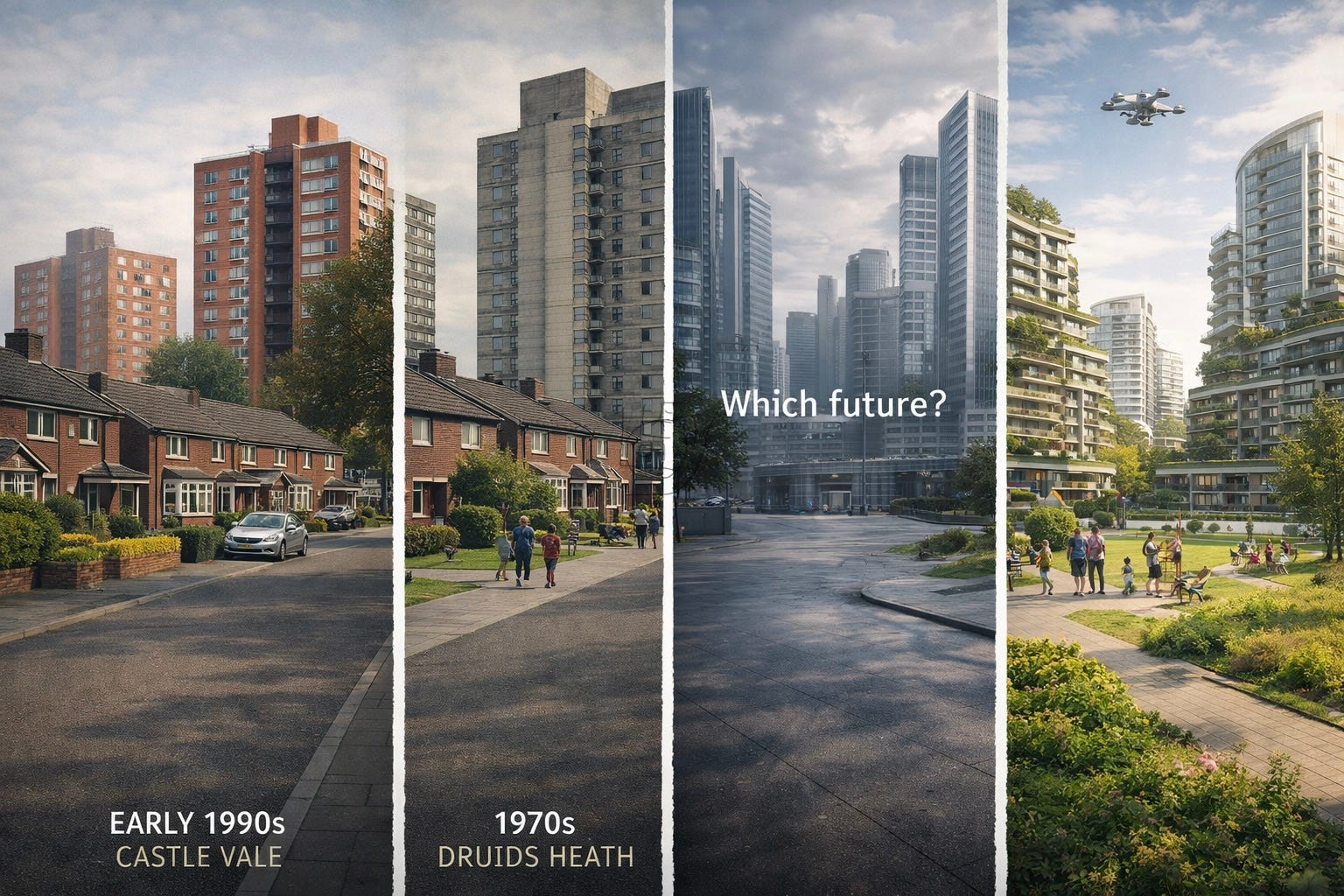
There was a time when Birmingham approached regeneration very differently. I was around during the work at Castle Vale, as the local councillor, under the Housing Action Trust. The team there could be, at times, distinctly superior in manner. They saw themselves as better than traditional council housing officers. But they did the job, and they did it properly. The estate was transformed, and crucially, that transformation has lasted.
There is a simple test that tells you whether regeneration has worked. Before the changes at Castle Vale, private hire drivers would take you there, but they would insist on being paid upfront. After the work was done, they were prepared to be paid at the end of the journey. That is not a statistic or a consultant’s report. It is a lived measure of confidence in a place. By that measure, the Housing Action Trust passed with flying colours.
It is worth remembering what that model actually was. A publicly driven housing programme, funded by government, delivered with a clear social housing purpose, and using contractors to build what was required. The private sector built it, but it did not shape it.
Druids Heath itself was built on a similar principle. The city council decided homes were needed and instructed the private sector to build them. There were no complex partnership structures, no viability negotiations, no shifting obligations. The requirement was clear and the delivery followed. Fifty years on, whatever its flaws, it remains a functioning housing estate. That is not nostalgia. That is evidence.
Set against that, the modern approach begins to look less convincing. Complex partnerships, viability gaps, long timelines and uncertain outcomes. The private sector is no longer delivering a brief. It is shaping it.
It is also fair to say that neither of the main political parties has shown sustained interest in rebuilding social housing at scale. Birmingham has seen moments of intent. The last serious push came ironically under Conservative cabinet member John Lines, whose model sought to reintroduce council-led housebuilding. Since his departure, that direction has quietly faded. Labour, now in control, has not revived it. If anything, the emphasis has shifted further towards partnership models and viability-led delivery.
That leaves an increasingly obvious question.
If the established parties are not pursuing large-scale social housing, where does that leave the argument?
Reform UK has grown rapidly, drawing support from working-class communities, including those living in or reliant on social housing. Its current housing policy position focuses heavily on demand, reducing migration, limiting access, and prioritising local allocation. That speaks directly to pressures people feel.
But it does not yet amount to a housing strategy.
Even if demand is reduced, the delivery model does not change. Developers still build for profit. Viability still governs outcomes. Social housing still struggles to stack up.
So the question becomes sharper.
Is Reform developing a housing policy beyond restricting access to migrants, one that addresses how homes are actually built? And as its support increasingly comes from communities dependent on secure, affordable housing, will it begin to offer a model that reflects that reality?
Because the evidence in Birmingham is already there.
Publicly led models, whether through the Housing Action Trust or earlier municipal building, have delivered estates that have endured. Not perfect, but lasting. Not theoretical, but proven.
The current model, by contrast, is still trying to prove itself.
Druids Heath. Ladywood. Different estates. Same model. Same uncertainty.
And the same unanswered question remains.
When housing is needed but not profitable, who builds it?