

Druids Heath: The Housing Dream That Fell Over a Missing Piece of Paper
Four weeks ago the High Court knocked Birmingham’s biggest housing regeneration scheme back to the start. The legal flaw was technical. The questions it raises are not.

Four weeks is a curious amount of time in politics.
Long enough for a story to slip quietly down the news agenda. Long enough for officials to move on to the next meeting, the next briefing note, the next consultant’s report. Long enough for something awkward to fade from public conversation.
But it is not long enough for the consequences to disappear.
At the beginning of February the High Court quashed Birmingham City Council’s outline planning permission for the redevelopment of the Druids Heath estate. The scheme was enormous. Around 1,800 existing homes were to be replaced with roughly 3,500 new dwellings in a regeneration programme stretching over two decades.
The vision was ambitious. Demolition, new streets, new housing, new community infrastructure. The kind of large-scale estate transformation that Birmingham once carried out with municipal confidence.
And then it fell over.
Not because regeneration was rejected. Not because the courts ruled the project unlawful in principle. But because the council had failed to publish a crucial document explaining the financial arithmetic behind the scheme.
In planning language it is called the Financial Viability Assessment.
In ordinary English it is simply the spreadsheet that explains how the numbers work.
The court did not say the scheme was wrong. It said the public should have been allowed to see the numbers before the decision was made.
The council conceded the point.
Permission was quashed.
And Birmingham’s largest housing regeneration scheme found itself back at square one barely three months after being approved.
Was anyone sacked for this major blunder? Most likely not.
The vote that started it all
The planning committee decision itself was already tight.
The application was approved in October last year after a six–six split among councillors, with the chair using a casting vote to push the scheme through.
It is worth saying clearly that the High Court did not criticise councillors personally. Planning committees can only make decisions based on the material placed in front of them.
If a key document is not published or properly identified, members cannot interrogate it.
Councillors cannot challenge numbers they are never shown.
Which leads to the uncomfortable question.
How did Birmingham City Council manage to push one of the largest regeneration schemes in its history through the planning system without ensuring the financial case behind it was fully available?
That is not ideology.
That is competence.
Was anyone sacked for this major blunder? Most likely not.
Watching Druids Heath rise
There is also a personal memory here that is hard to ignore.
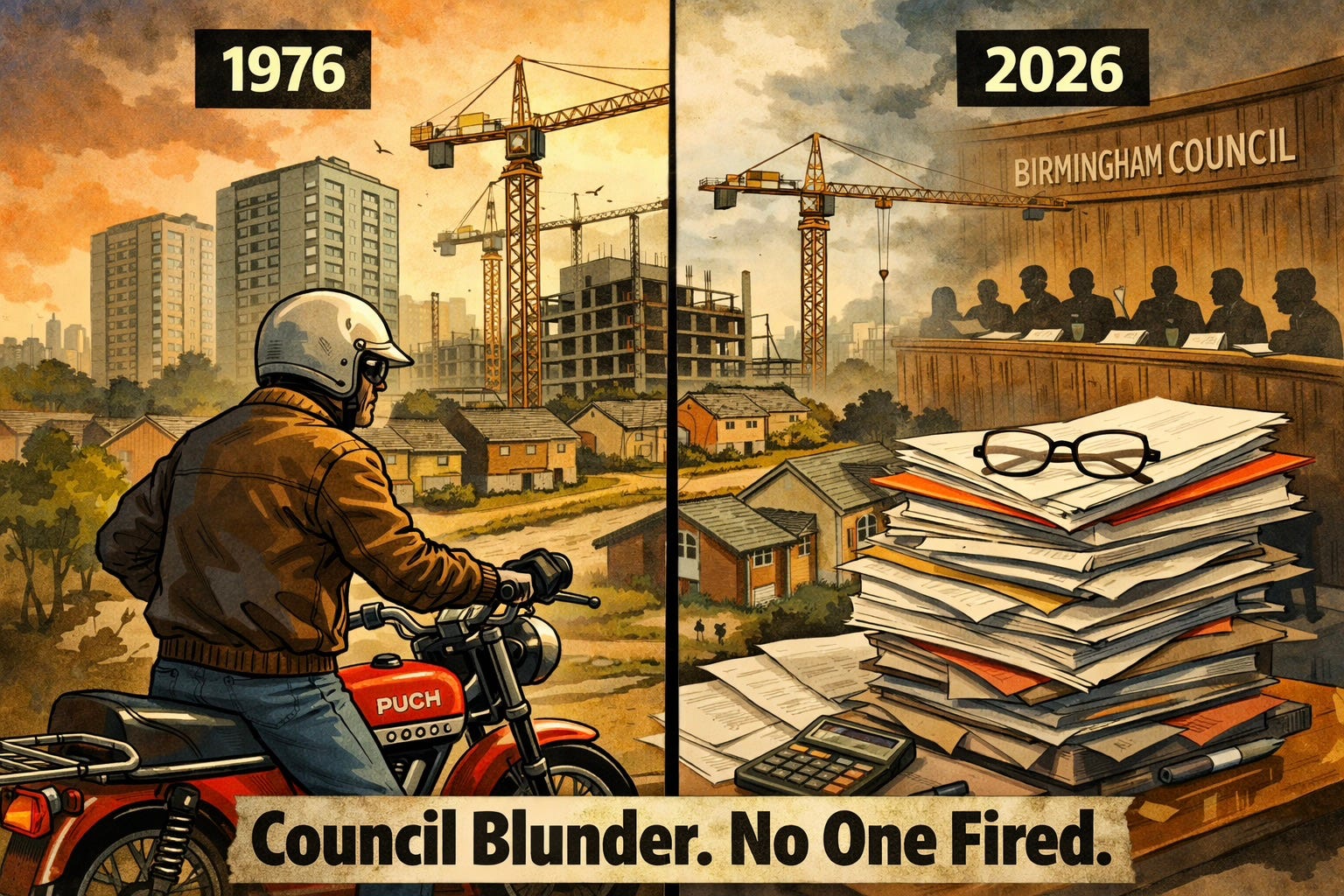
In 1976 I rode past Druids Heath most working days on my moped. A Puch M50 Grand Prix. Austrian. You could not really buy British bikes by then, but I was not about to buy Japanese either, so Austrian it was.
I was living in Shirley at the time and had started my apprenticeship at BSA Guns.
BSA did not run its own apprentice workshop, so like many apprentices in Birmingham I was placed at a larger training school. In my case that was the apprentice workshop at Triplex in Kings Norton. Apprentices from BSA worked there alongside Triplex apprentices and lads from a number of smaller engineering firms across the city.
It was Birmingham as it used to be. A city of factories, apprenticeships and engineering shops, all feeding the industrial machine that powered the place.
My ride to work took me straight past Druids Heath as the estate was being built.
You could watch it rising week by week. Timber frames going up, panels being lifted into place, rows of houses taking shape where open ground had been before. Streets that had been lines on an architect’s drawing slowly became real roads with real homes.
Whatever else you might say about the architecture of that era, Birmingham knew how to build housing then.
Druids Heath itself was developed in the late 1960s and early 1970s as part of the city’s huge municipal housing programme. Thousands of homes went up across Birmingham in those decades as the council tackled slum clearance and population growth.
Estates like Druids Heath were not regeneration concepts buried in consultant reports and viability spreadsheets.
They were simply built.
Millions spent before a single brick is laid
Fast forward nearly fifty years and the story looks rather different.
Large regeneration projects today consume vast amounts of officer time and consultancy work long before construction begins.
Planning officers. Housing regeneration teams. Planning consultants. Architects. viability specialists. environmental assessments. legal teams.
Add those hours together and the cost begins to mount.
A cautious estimate suggests that between officer time, consultancy work and legal costs, somewhere between two and four million pounds of public effort may already be embedded in the Druids Heath regeneration process.
That does not mean the money has been wasted entirely. Much of the work can still be reused when the scheme returns.
But a procedural failure of this kind means part of the process must now be repeated. Reports must be amended. Documents must be republished. Timetables must be rewritten.
And the public is entitled to ask the obvious question.
What might Birmingham have achieved with that money if it still possessed the municipal housing machine it once did?
At roughly £200,000 per home, three million pounds could build around fifteen council houses outright. Those homes would generate rental income for the city for decades.
Instead the money has largely been absorbed by the administrative machinery that now surrounds regeneration.
The cranes have been replaced by consultants and spreadsheets.
From municipal housing to viability modelling
Birmingham once built housing with confidence.
The city had the organisational capacity to plan neighbourhoods, acquire land and deliver homes directly through municipal programmes. Structures such as the Birmingham Municipal Housing Trust reflected that philosophy.
Over time that system has been dismantled or diluted.
Today the council tends to rely on regeneration frameworks and private development partnerships. Affordable housing levels are negotiated through viability assessments rather than determined through municipal policy.
In other words, spreadsheets now decide what gets built.
That approach is now standard across much of England.
But it has consequences.
When the viability model becomes the foundation of a planning decision, transparency becomes essential. If the public cannot see the numbers, trust evaporates.
That is exactly what happened in the Druids Heath case.
The contradiction in Birmingham’s housing landscape
There is another tension in Birmingham’s housing story that makes the Druids Heath episode even more revealing.
While the council pursues large regeneration schemes intended to modernise housing, other parts of the city are experiencing rapid growth in multi-occupancy living.
Family houses are being converted into Houses in Multiple Occupation. Exempt accommodation providers have expanded rapidly in certain districts.
Walk through parts of Birmingham today and you can see both housing realities side by side.
On one hand the city is demolishing estates in the name of regeneration.
On the other it is quietly presiding over the fragmentation of traditional housing stock through HMOs.
To residents the contrast can feel stark.
The official narrative speaks of improved housing quality and modern neighbourhoods.
The everyday experience in some streets is an increasing density of multi-occupancy housing.
Those two trends sit uneasily together.
One month later
Four weeks have now passed since the High Court quashed the planning permission.
The obvious questions remain.
Has the full viability report now been published?
Has the planning application been corrected and resubmitted?
What changes have been made inside the council to ensure this kind of procedural failure cannot happen again?
Those are not hostile questions. They are simply the questions any responsible city should ask itself after such a public stumble.
Nearly fifty years ago I watched Druids Heath rise as I rode to work through south Birmingham’s factories on my Austrian moped.
Back then the houses went up faster than the paperwork.
Today the paperwork seems to arrive faster than the houses.
And until Birmingham rediscovers the administrative discipline needed to match its housing ambitions, regeneration schemes may continue to trip over the very bureaucracy meant to deliver them.
Was anyone sacked for this major blunder? Most likely not.
Druids Heath deserves better ☹️
Great piece Mike