


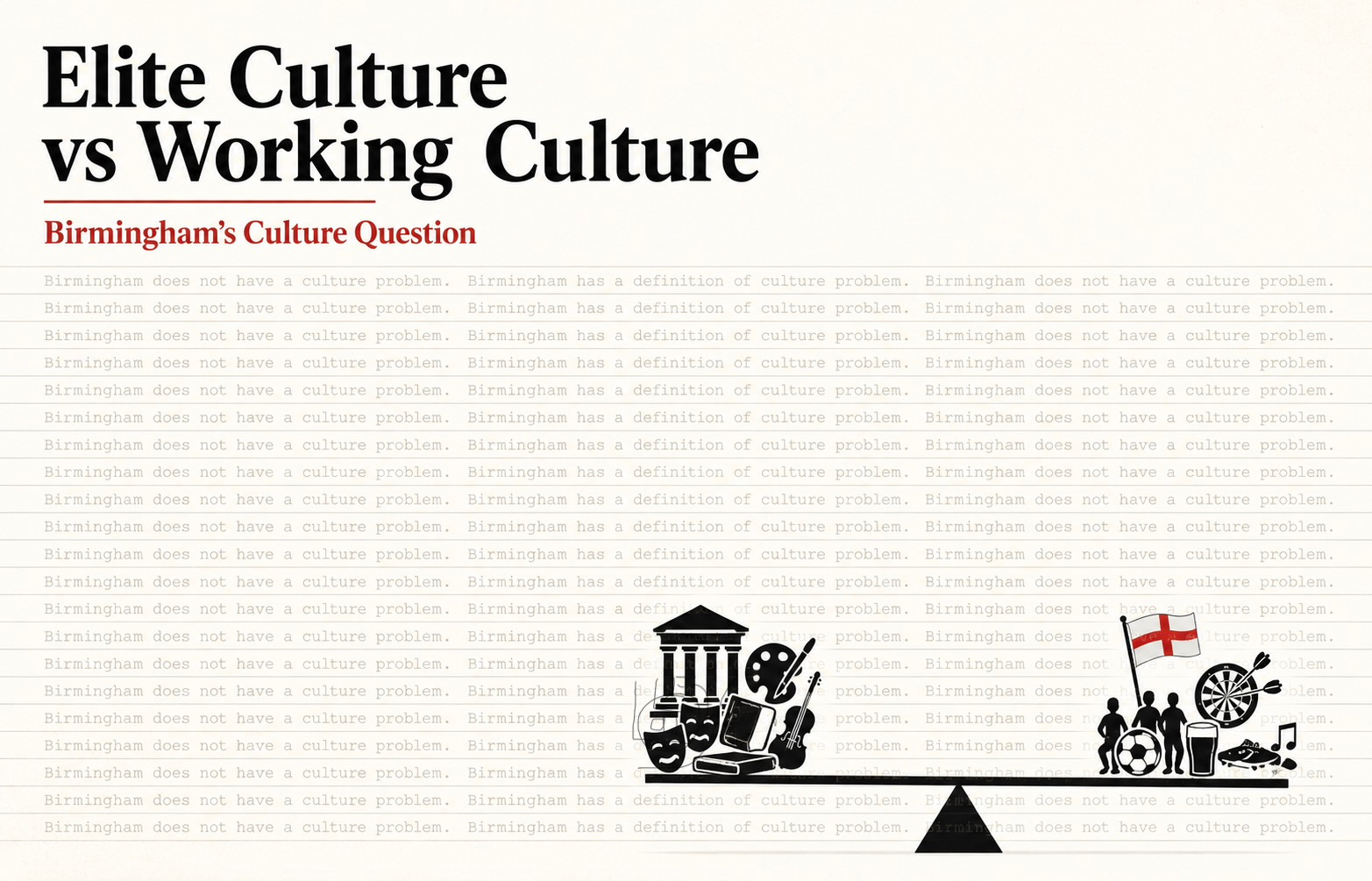
Birmingham does not have a culture problem. Birmingham has a definition of culture problem. That may sound like a small distinction, but it goes to the heart of how a city decides what matters, who gets recognised, and where public money goes. Birmingham City Council’s scrutiny committee, chaired by Cllr Alex Yip, has been looking at how culture can play a part in regeneration. That is worthy work. Culture does help places grow, recover and believe in themselves again. But before Birmingham decides how culture can regenerate the city, it might first need to ask a more basic question. Whose culture are we talking about?
For the purposes of this article, I am calling one thing elite culture and another thing working culture. That is not meant as an insult to either. Elite culture means museums, galleries, orchestras, ballet, opera, professional theatre, heritage bodies, major venues, strategic cultural programmes and funded cultural organisations. Birmingham would be a poorer city without them. Working culture means the stuff many Brummies actually do: grassroots football, darts, snooker, pool, brass bands, pub music, working men’s clubs, Sunday league sport, angling, classic car meets, motorcycle clubs, beer festivals, karaoke nights, local festivals and volunteer led community activity. Birmingham would be a poorer city without those too.
That is why Cllr Yip’s position is interesting. As scrutiny chair, he clearly recognises that culture matters to civic life. He recognises it so clearly, in fact, that he and his Conservative colleagues pressed for the Cross of St George to be displayed outside the Library of Birmingham in support of England. Good. That accepts an important principle. Football is civic culture. If England on the telly is important enough to light one of Birmingham’s most recognisable buildings, then football is not just sport. It is identity, belonging, memory, argument, hope, disappointment, noise, ritual and community. In other words, it is culture.
By the time this article is published, England have beaten Mexico after more than 100 minutes of brilliant, breathless football in Mexico’s own temple of the game. It was not short of theatre: a VAR decision, a sending off, Kane scoring a penalty, then Kane being judged to have conceded one at the other end as Mexico dragged themselves back into it. Elsewhere, Norway had already knocked Brazil out, which is the sort of sentence that explains why football remains so gloriously daft and so dangerously addictive. Football is not a sideshow to culture. It is highly infectious civic drama. Few museums, theatres or galleries can make a city feel the same emotion at the same moment quite so quickly. If football deserves civic recognition when England play, does grassroots football deserve cultural recognition every other week of the year?
This is where scrutiny has a real opportunity. The published material identifies substantial support for elite culture. Birmingham City Council papers refer to additional support for Birmingham Museums Trust and a proposed settlement covering future years. The budget also includes a new annual Investing in Culture fund, and the Cultural Action Area programme has been supported over several years. There are grants, programmes, cultural organisations, heritage work, venues and strategic partnerships. None of that is wrong. Museums matter. Galleries matter. Theatres matter. The orchestra matters. The ballet matters. Heritage matters. But on the face of the published papers, the identifiable money speaks fluent elite culture.
What is much harder to identify is an equivalent dedicated cultural budget for working culture. Where is the line in the accounts for darts leagues? Where is the support for pub music nights? Where is the cultural recognition for Sunday league football, snooker clubs, brass bands, angling clubs, motorcycle meets, classic car events, beer festivals, supporters’ groups and working men’s clubs? Some support may exist in other budgets. It may be hidden under sport, public health, neighbourhoods, events, wellbeing, community grants or regeneration. But that is precisely the point. If the city cannot clearly show where working culture is supported, scrutiny should ask why not.
So the simple Midlands GRIT reading of the published material is this. Elite culture: substantial identifiable public support. Working culture: no equivalent dedicated cultural budget identified in the papers reviewed. Unknown or unclear: scrutiny needs to establish whether support exists elsewhere within council budgets and publish the answer. That is not a verdict. It is a question. If Birmingham City Council is already investing properly in working culture, excellent. Show us where. If it is not, then the city needs an honest debate about whether cultural spending reflects the cultural lives of ordinary Brummies.
This is not a call to cut elite culture. It is not philistinism with a pint glass. In fact, I do not drink beer. I do not drink alcohol at all. So if anyone is tempted to imagine this as some misty eyed demand for public subsidy for my own Saturday afternoon habits, they can stand down immediately. The point is not whether I like beer, football, opera, ballet or darts. The point is that public culture should not be defined only by the people most fluent in funding applications, strategy documents and board papers.
Working culture often survives because someone unlocks a room, collects subs, runs a raffle, washes the kit, sorts the WhatsApp group, books the band, prints the fixture list, marks the pitch, carries the chairs, makes the sandwiches and hopes enough people turn up to pay the bills. Elite culture has trustees, development directors, bid writers, consultants and access to funding conversations. Working culture has volunteers with carrier bags full of receipts. Both forms of culture matter. Only one usually gets called culture by the people holding the cheque book.
Cllr Yip and the scrutiny committee can do Birmingham a service by digging into this properly. They should ask how the council defines culture, how much cultural money goes to elite culture, how much goes to working culture, and how much sits in budgets that are so unclear ordinary residents could never find them. They should ask whether cultural funding follows participation, prestige, heritage, tourism, social value, regeneration, geography, lobbying strength or institutional habit. They should ask whether the city recognises the cultural value of the football terrace, the darts league, the brass band, the social club, the pub stage, the angling match and the Sunday team with the same seriousness it gives to the gallery, the concert hall and the theatre.
The bloke watching football from the terraces, the woman running the darts league, the retired engineer polishing his classic car, the unpaid coach keeping children busy on a wet Sunday morning, the band playing in the back room of a pub, the volunteers organising a local festival and the people holding together clubs that reduce loneliness, improve health and create community are not outside Birmingham’s culture. They are part of it. They pay council tax too. They may not always use the language of cultural regeneration, but they often do the work of regeneration without calling it anything grand at all.
Perhaps the biggest cultural question Birmingham now faces is not whether it supports culture. It clearly does. The question is whether it recognises all of it. If football can light up the Library of Birmingham, perhaps scrutiny should now ask whether football clubs, darts leagues, brass bands, working men’s clubs, pub music, Sunday league sport, angling clubs and countless other grassroots activities deserve greater recognition when Birmingham decides where cultural money goes. That is not an attack on elite culture. It is a request that working culture is finally seen, counted and valued.