
Everyone’s Battle, Nobody’s Scorecard
Birmingham launched equality strategies, race pledges and action plans. Six years later, with the Children’s Trust spending more than £300 million a year, residents deserve the scorecard.

Kemi Badenoch, leader of the Conservative Party, has announced that she wants to scrap the Public Sector Equality Duty. The usual armies have duly taken up their usual positions. One side says common sense is returning. The other says civilisation is being reversed into a ditch while clutching a laminated diversity policy. But in Birmingham, there is a rather more interesting question. Would anybody actually notice?
Back in 2020, under Cllr John Cotton, then Cabinet Member for Social Inclusion, Community Safety and Equalities, Birmingham launched Everyone’s Battle, Everyone’s Business. It was ambitious, polished and full of fine civic intention. Birmingham was going to tackle inequality, confront structural disadvantage, address workforce race equity, examine pay gaps and put fairness at the centre of public decision-making. It had the title, the launch, the language and the glow of official virtue. If glossy paperwork could reduce inequality, Birmingham would now be so equal that every resident would be issued with a matching Labrador, identical curtains and a council-approved sense of moral improvement.
The really curious part is that John Cotton did not then vanish into political obscurity. He did not lose influence, leave the chamber, or get sent to chair a working group on the future of municipal flowerbeds. He became Leader of Birmingham City Council. Today, following the May 2026 elections, he has largely faded from the centre of Birmingham politics. Yet during the crucial years, the man who helped launch the flagship equalities programme possessed more influence than anyone else in the city administration. In normal organisations, that would be called an opportunity. In Birmingham, however, it appears to have become something else: a fine strategy followed by the familiar civic mist of action plans, updates, reviews, refreshed reviews and solemn reports explaining how previous reports would be monitored by future reports.
That is the problem. Birmingham is not short of equality language. It is drowning in it. The city has strategies, objectives, impact assessments, action plans, consultation exercises, internal challenge processes and all the usual public-sector embroidery. What is much harder to find is the simple public scorecard. What was promised? What was delivered? What failed? What was delayed? Who was accountable? What decision changed because equality evidence showed real harm before the damage was done?
This matters because Birmingham’s record since then has not exactly resembled a golden age of competent, fair and accountable government. The city suffered one of the largest equal pay disasters in local government history. It effectively went bankrupt. Commissioners arrived. Services declined. Assets were sold. Residents paid more and received less. Yet through it all, the equalities machine continued to hum away in the background, producing the reassuring noise of an engine that may or may not have been connected to the wheels. Indeed, the cruel irony is that while Birmingham was producing equality strategies by the pallet load, it was simultaneously sitting on one of the largest equal pay liabilities ever seen in local government. The city quite literally bankrupted itself over an equality issue. If there is a more expensive way to demonstrate a gap between aspiration and delivery, I have yet to find it.
Nor is this just about the main council machine. Birmingham Children’s Trust receives more than £300 million of council money to deliver children’s services. It is not a minor civic side room with a kettle and three folders. It is one of the largest and most important public service bodies in the city. It talks extensively about equality, diversity, inclusion and workforce race equality. Excellent. But once again the question is not whether the words exist. They do. The question is whether the public can easily see the scorecard.
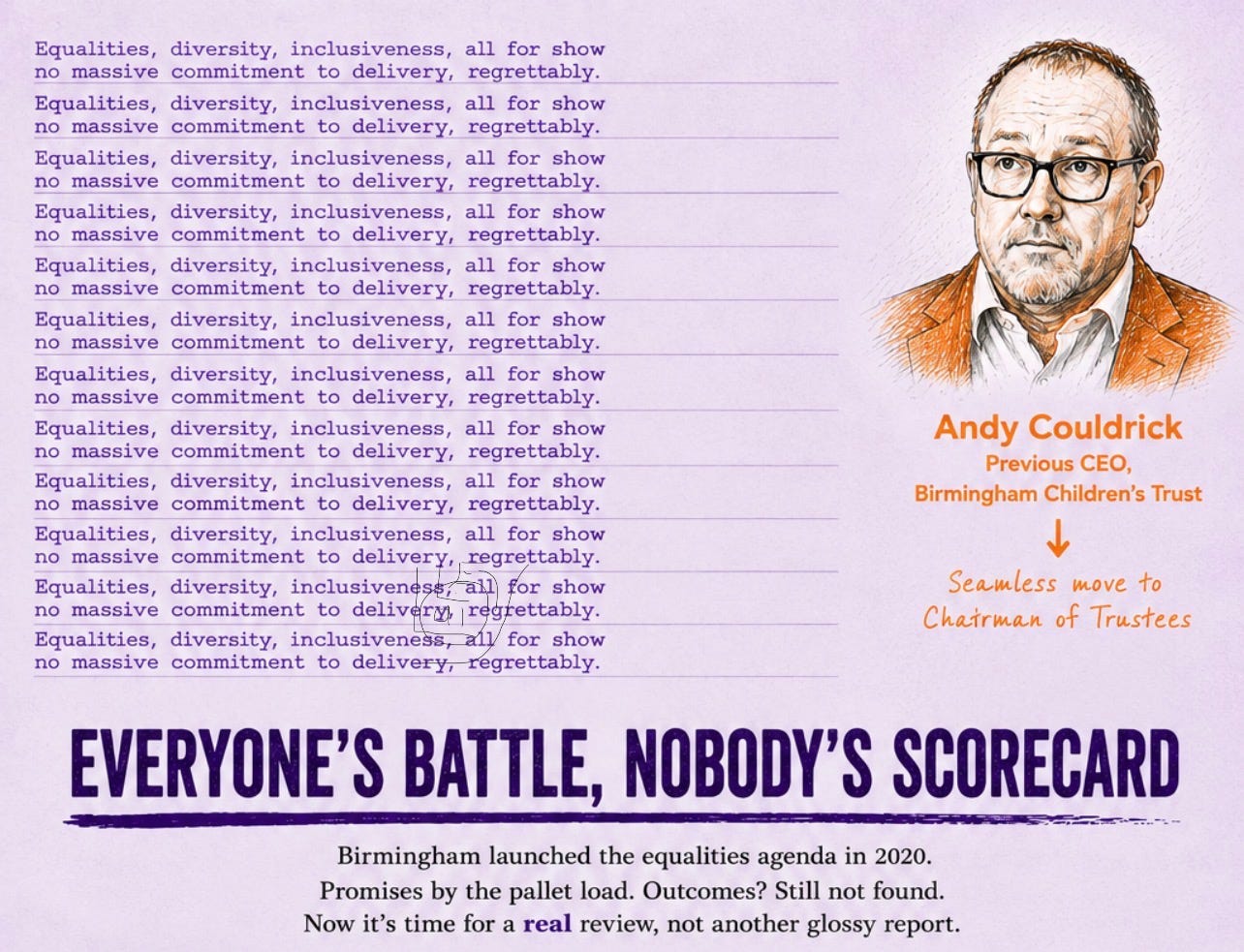
Then there is the governance curiosity of Andy Couldrick, who served as Chief Executive of Birmingham Children’s Trust before retiring and becoming Chair of the Trust Board. That may have been entirely proper. It may have been justified on grounds of continuity and experience. But in a city that endlessly lectures others about openness, fairness, representation and opportunity, residents are entitled to ask simple questions. Was the chair role openly advertised? Who else was considered? What was the selection process? What equality and governance safeguards were applied? Those are not allegations. They are exactly the sort of questions Birmingham likes asking of everybody else.
This is where the Kemi Badenoch argument becomes more complicated than the Westminster shouting suggests. She wants to abolish the Public Sector Equality Duty. But Birmingham’s difficulty may not be the existence of equality duties. Birmingham’s difficulty may be the apparent inability to demonstrate, in plain public language, what those duties have actually changed. If Equality Impact Assessments are shaping decisions, show us where. If the race action plan worked, show us how. If the race pay gap ambition was met, publish the result. If the Children’s Trust is delivering against its equality promises, let residents see the evidence without needing a miner’s lamp, a legal dictionary and three spare afternoons.
Of course, this is no longer just a Labour problem, although Labour owns the original wallpaper. Labour launched Everyone’s Battle, Everyone’s Business. Labour controlled the council. John Cotton became Leader. The city then hit financial catastrophe, equal pay disaster, governance collapse and commissioner control. Labour cannot now pretend the equalities machine belongs to somebody else. It built the machine, painted it in civic pastel colours and invited everybody to admire it.
But the new political actors do not get a free pass either. The Liberal Democrats campaigned on accountability, local responsiveness and a different way of running Birmingham. The Greens campaigned on fairness, ethical leadership and real scrutiny. Conservatives now hold important scrutiny positions. Splendid. Then let us see it. If the new Birmingham settlement means anything, it should mean that the city stops admiring its own reports and starts testing its own results.
So here is the challenge. Let the new scrutiny chairs conduct a proper review of Birmingham’s equalities machinery. Not another officer celebration. Not another PowerPoint parade. Not another report congratulating a previous report for bravely existing. A real review. Start with Everyone’s Battle, Everyone’s Business. Then examine workforce representation, the race pay gap promise, Equality Impact Assessments, Children’s Trust governance, child poverty, service cuts and the actual effect of equality assessments on major decisions.
Ask one question: what happened?
Not what was intended. Not what was announced. Not what was launched. What happened?
As a former scrutiny chairman, I would be happy to assist. I appreciate that some in the Council House may greet this offer with the warm delight usually reserved for a wasp entering a nudist colony, but the offer stands. If Birmingham’s new political actors meant what they said in May, this is their chance to prove it.
For six years and many more Birmingham’s political class has spoken the language of equality with almost religious devotion. Labour launched strategies. The Greens promised fairness. The Liberal Democrats promised accountability. The Conservatives promised scrutiny. Wonderful. Let us now gather them around the same table and ask a question so simple that Birmingham City Council will probably need three working groups and a consultant to avoid answering it.
What measurable outcomes are to be and when actually delivered?
Because Kemi Badenoch may want to tear down the Public Sector Equality Duty. But in Birmingham, residents might reasonably ask whether the wallpaper was ever attached to anything more substantial than a press release.