


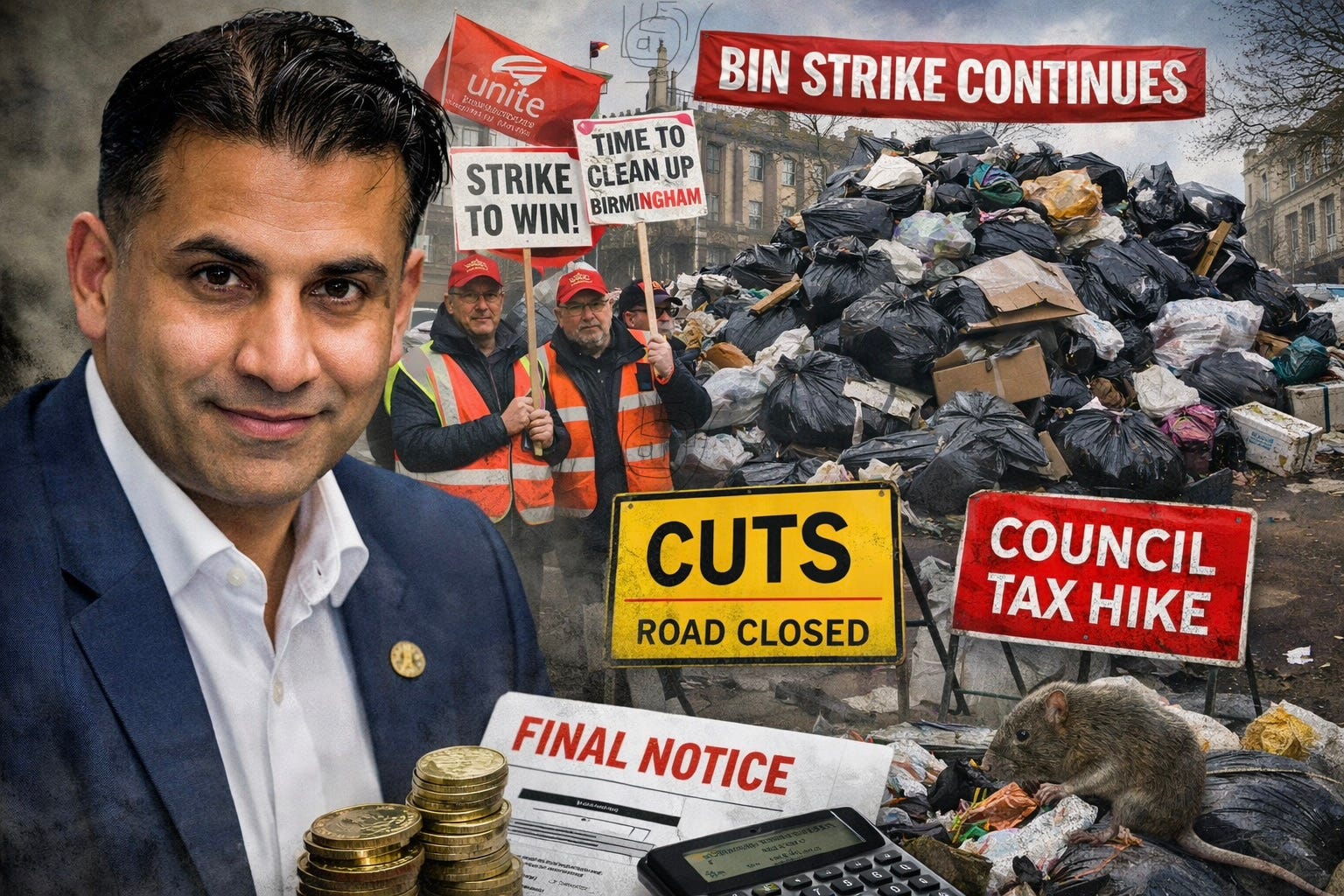
At Cabinet this week, as Birmingham City Council approved its draft budget and sent it forward for Full Council approval, councillors were told there was something to be excited about. Yet across the city, residents are still living with a bin strike that has lasted more than a year. That tension, between optimism inside the chamber and frustration on the streets, defines the real politics of this budget far more than any headline figure.
The draft budget contains around £95 million in savings. Adult social care faces reductions of £33 million. Children’s and families services £31 million. Housing £12.6 million. Council tax will rise by 4.99 per cent.
Standing at the Cabinet table was Councillor Majid Mahmood, Labour councillor and the Cabinet Member responsible for waste services, in other words the councillor effectively in charge of resolving the bin strike, or, as some might say with a raised eyebrow, not in charge of resolving it.
He told colleagues:
“This is a budget we can get excited about now. Look forward to delivering the services that the people of this city need and deserve.”
He continued:
“Overall we can now have a budget where it is the residents’ priorities that we are investing in.”
Excited.
Residents’ priorities.
Services people need and deserve.
These are confident words. They are designed to signal recovery and renewal after a period in which Birmingham has been defined by bankruptcy headlines and financial instability.
But words carry weight when spoken by the Cabinet Member responsible for the very service currently locked in dispute.
Because on the same day that Cabinet spoke of excitement, Unite the Union wrote directly to councillors.
The union’s letter was not buoyant. It was blunt.
It argued that failure to resolve the bin strike has cost more than the council is saving by cutting children’s services. It highlighted reductions to adult social care, children’s services and housing. It pointed out the maximum council tax rise. It stated that Unite estimates the strike has cost the authority up to £33 million.
The union’s central argument was straightforward: the strike can only be resolved through negotiations, and talks that were previously close to agreement during conciliation at ACAS have stalled.
Unite called for three things:
• Share the legal advice.
• Negotiate in good faith with decision makers in the room.
• Return to a deal based on the “ballpark” proposal discussed during ACAS conciliation.
That is not rhetorical flourish. It is procedural pressure.
And then came the wider appeal.
In a subsequent message to residents, Unite reminded Birmingham that refuse workers have now been on strike for over twelve months in opposition to pay reductions it says could reach £8,000. It described the council’s approach as “fire and rehire” and confirmed that compulsory redundancies have followed.
More significantly, it urged residents, community organisations and businesses to write to their councillors and MPs demanding action.
The warning was clear:
They must act to end the bin strike or be held accountable in May.
This is no longer an internal employment dispute. It is an electoral issue.
Which brings us back to the Cabinet table.
If this is a budget driven by residents’ priorities, is a year-long bin strike not one of those priorities?
Because for many voters, it is not theoretical. It is visible. Weekly. Repetitive. Unavoidable.
And if this is the moment when alignment with residents has been discovered, the implication is difficult to ignore.
What guided decision making before?
You cannot emphasise “now” without inviting comparison with what came previously.
There is no need for exaggeration. The contradiction stands on its own.
On one side, a Labour Cabinet Member responsible for waste services speaking of excitement and renewed alignment with residents.
On the other, a union publicly asserting negotiations have stalled, costs are mounting, and accountability is approaching.
The budget now moves to Full Council. Debate will follow. Votes will be recorded. Opposition parties will continue to press the strike as evidence of drift.
But outside the chamber, the test is simpler.
Residents are not measuring fiscal strategy. They are measuring functionality.
Excitement in politics is earned through visible competence.
If this budget truly reflects what people need and deserve, then the most immediate proof will not be found in a spreadsheet.
It will be found on the streets.
Until the strike is resolved, optimism inside the chamber will continue to collide with reality outside it.
And in May, voters will decide which one mattered more.