


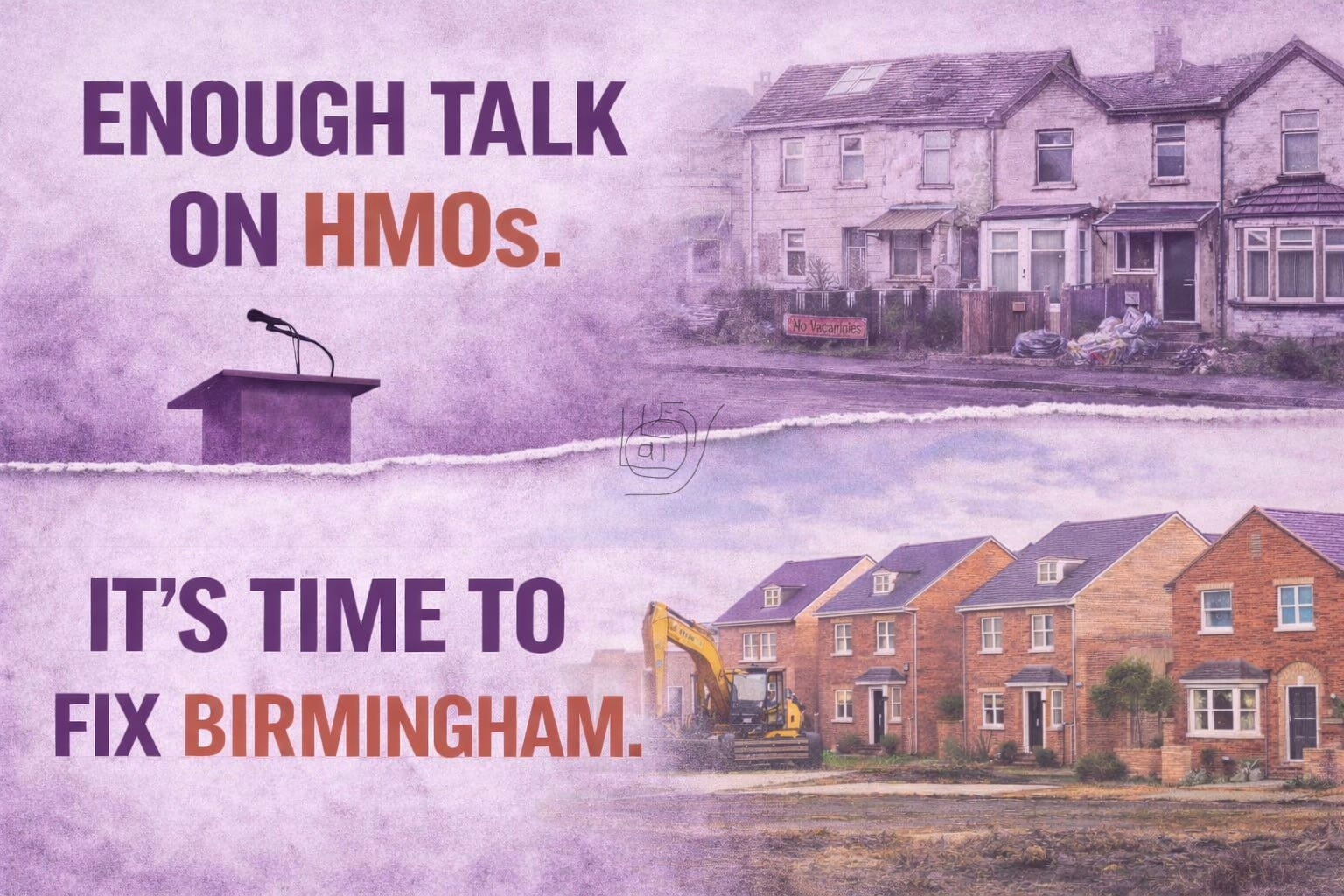
EXCLUSIVE: Enough talk. What are you going to do about Birmingham’s HMO crisis?
This series has not been built on guesswork or second-hand chatter. It comes from access to detailed information held inside the council itself, a comprehensive dataset mapping thousands of properties, operators and concentrations across Birmingham. It is the kind of material the public rarely sees in full, but it shows exactly what is happening, where it is happening, and how fast it is spreading.
And what it shows is this.
Thousands of HMOs and exempt accommodation properties across Birmingham, clustered into the same areas, run at scale, known to the council, inspected time and again, talked about endlessly by politicians, and still growing. At some point, the talking has to stop, because this is no longer about understanding the problem. It is about whether anyone is prepared to do something about it.
In places like Erdington, this is not theory. It is reality. Streets change first, then the surrounding roads, then the wider district. Stability drops, turnover rises, and the feel of an area begins to shift. That shift feeds straight into the high street. Regular custom weakens, businesses struggle, and over time the mix of shops changes. Investment pulls back, confidence dips, and the area slowly loses its footing. This is not dramatic. It is gradual. But it is relentless.
People who live there can see it happening. And once it takes hold, it is hard to turn back.
Labour cannot avoid this, and neither can Paulette Hamilton, the Member of Parliament for Erdington. She has already said it plainly, describing the “unchecked proliferation” of HMOs and exempt accommodation as “devastating communities”, warning that parts of Birmingham are “crippling neighbourhoods and overwhelming local services”. Those are her words. Yet here we are, with the system still expanding and areas like Erdington still carrying the load. If that is the diagnosis, then where is the treatment?
The Conservatives say the problem sits in a loophole. Robert Alden argues that exempt accommodation has been allowed to spread because it sits outside normal planning rules. Their answer is to bring it fully into the planning system and impose what are known as Article 4 controls. Put simply, that means removing the automatic right to convert properties and forcing landlords to apply for permission before turning homes into HMOs. In plain English, it means the council gets to say yes or no, instead of watching it happen street by street. That is a clear position, and if it is right, it should be delivered quickly and it should make a visible difference.
The Liberal Democrats have been even more blunt. Baber Baz has said exempt properties are “ruining the community spirit”, while Roger Harmer has said that “for all the talk, far too little has actually been done”, calling the situation a “scandalous failure of governance”. That is not polite disagreement. That is a direct hit, and it carries an expectation that something materially different would follow.
The Greens, where they have spoken locally, have not held back either. Siobhan Harper-Nunes, a serious contender in the mayoral race, called for “a map of every single HMO”, demanded inspections, and said of the worst properties, “this cannot go on… this house must be shut down permanently”, adding that she would “hound them until they are gone”. That is not the language of committees. That is the language of enforcement, and it sets a high bar.
Reform comes at this from a different angle. John Lambert has described HMOs and exempt accommodation as fuelling “anti-social chaos”, promising to “crack down hard on dodgy landlords and unsafe HMOs”. There is less policy detail, but there is no shortage of intent, and at this point that matters, because people are not short of plans, they are short of results.
That is the dividing line. Birmingham does not lack strategy documents, policy frameworks or well-paid officers producing carefully worded responses. What it lacks is action. Not another review, not another consultation, not another set of findings that confirm what everyone already knows while the problem continues to grow. Action that is visible, consistent and effective.
Labour has had years, and the system has expanded. The Conservatives and Liberal Democrats have put forward positions that can be tested. The Greens are promising to push enforcement hard. Reform is promising to move fast and hit hard. So the question is no longer who understands the problem. The question is who will actually do something about it.
There is also a deeper problem that cannot be ignored, and that is supply. Birmingham has allowed itself to become dependent on a model that was never meant to carry this level of demand. Instead of building proper, long-term social housing at scale, the city has leaned too heavily on external providers and partnership models that bring their own financial priorities with them. That has created a system where expansion is driven as much by margin as by need.
If that is the structure, then it is no surprise what the outcome looks like.
If you want to change the outcome, you have to change that balance. That means building again as a local authority, directly, at scale, and with a clear purpose. Not diluted schemes, not developments shaped by external return, but housing built to provide stability, not churn.
At the same time, enforcement has to mean something. If a landlord is persistently failing, if standards are repeatedly breached, if properties are being run in a way that damages both residents and neighbourhoods, then the response cannot be another warning letter or another slow process that leads nowhere. It has to be firm, consistent and, where necessary, decisive.
Because regulation only works if it changes behaviour.
And if it does not change behaviour, then it is not being used properly.
This is not about punishing good operators. There are HMOs in Birmingham that are well run, properly managed and provide decent accommodation. They prove the model can work. The issue is the rest, the ones that drag standards down, cluster into areas and slowly erode them over time.
That is where the focus has to be.
Less tolerance for failure. More insistence on standards. And a willingness to act when those standards are not met.
Because without that, nothing changes.
There is, however, another reality that now comes into play. The Liberal Democrats, the Greens and the Conservatives are unlikely to take control of Birmingham City Council on their own. Labour and Reform may be best placed to lead, but even that is uncertain. Which means power may be shared, negotiated or dependent on others.
And if that happens, the words being spoken now matter even more.
Because those who do not lead may still decide. They may hold the balance of power. They may be the ones who insist that action happens, who force the issue, who turn promises into conditions.
Or they may not.
Because this election is not just about who wins. It is about who acts. Paulette Hamilton MP, Cllr Robert Alden, Cllr Baber Baz, Cllr Roger Harmer, Siobhan Harper-Nunes, John Lambert, these are the voices shaping this debate today, and some of you may well be shaping this city tomorrow. When that moment comes, will you stand by the words you have used, or will you find somewhere quieter to sit while nothing changes?
Absolutely and of course do little or nothing as your excising housing stock deteriorates.
This is what happens when you increase the population by 10% without building homes for them to live in.