
EXCLUSIVE: My Full Birmingham 2026 Election Prediction, 101 Seats, One City, No Clear Winner
An exclusive ward by ward projection of Birmingham’s 2026 local elections. Reform rises, Labour weakens, and across 101 seats the numbers point to one outcome, not control, but negotiation.

Birmingham 2026
A city on the turn, but not yet decided
30 March, I think, marks the opening of nominations for Birmingham’s local elections, with papers due in by 9 April. Do not trust me on that, check it yourself if you are standing, but I believe I am somewhere close.
That small administrative detail is where it all begins.
From there, the machinery starts to move. Papers filed. Names confirmed. Quiet conversations turning into campaigns.
And then, on 7 May, it becomes very real.
All 101 councillors in Birmingham face election. That happens once every four years, and whoever emerges in control will shape how billions of pounds are spent across the city, on housing, services, infrastructure, and the daily fabric of life.
This is not abstract.
It is the machinery of Birmingham itself, and for a few weeks, every part of it is up for contest.
A model, not a prophecy
What follows is a structured attempt to understand what might happen.
Not guesswork, not headline chasing, but a deliberate effort to map a complex system that rarely behaves neatly.
It is anchored to a central assumption that Reform UK sits at around 29% to 30% in Birmingham, with a working range between 27% and 31%.
That range matters.
Because small movements in vote share at this level do not produce small outcomes. They produce structural change.
Beyond that, I have pushed the model out to 35%, not because I expect it, but because it shows what happens when pressure builds beyond the expected range.
Call it a stress test.
A way of asking, not just what is likely, but what is possible.
Because if you are analysing the fate of 101 councillors across dozens of wards, each with their own dynamics, histories, and personalities, something will be wrong somewhere.
It has to be.
A factor missed. A candidate underestimated. A local issue misread.
If you spot it, well done.
That is the nature of this kind of work.
The limits of prediction
There is a temptation to treat elections as if they are mechanical.
They are not.
They turn on small things.
Weather. Turnout. Mood. Timing.
If the 4th, 5th and 6th of May land as warm, bright days, turnout shifts. People who might otherwise stay at home decide to walk to a polling station.
If, at the same time, there is heavy media focus on illegal migration, with visible crossings and a perception, fair or otherwise, that nothing is being done, that too can influence behaviour.
And it does not do so evenly.
It moves some voters more than others. It sharpens some choices and softens others.
That is one example.
There are many others, some local, some national, some impossible to predict in advance.
And each of them has the potential to disrupt even the most carefully constructed model.
So what follows is not certainty.
It is direction.
The shape of the city
Step back from the detail and a broader picture begins to emerge.
Reform are rising.
Not incrementally, not tentatively, but in a way that is now visible across multiple parts of the city.
A few years ago they barely existed in local electoral terms. Now they are competitive in wards that would once have been dismissed out of hand.
Labour remains the largest force.
But it is no longer dominant.
Its vote is softening in places, fragmenting in others, and being challenged in ways that were not present in previous cycles.
The Conservatives continue their long decline, squeezed from both sides, losing ground in areas they once held comfortably.
But to describe Birmingham as a three-party contest is to misunderstand it.
Because it isn’t.
A multi-bloc city
Birmingham now behaves less like a traditional party system and more like a set of overlapping blocs.
Labour still sits at the centre, but no longer commands the whole field.
Alongside it, a Reform and Conservative space is emerging, sometimes competing, sometimes overlapping, drawing from similar pools of voters but expressing different political instincts.
There is also a Liberal Democrat and Green layer, more localised, more structured, often underestimated, but capable of holding ground where organisation exists.
And then there is the fourth bloc, Independents and ICA-aligned figures.
Less visible in national conversation, but in Birmingham often decisive.
Embedded locally, known personally, and able to disrupt assumptions that rely too heavily on party labels.
No single bloc dominates.
And that matters.
Because it means the election alone will not decide control.
The Green Crescent
There is one part of the city that stands apart.
Across Selly Oak, Bournville, Stirchley, King’s Heath and into Moseley, a distinct political geography is emerging.
Not loudly, not suddenly, but steadily.
The Green Crescent.
Here, Green support is not superficial. It is organised, embedded, and increasingly resilient.
It has activists. It has continuity. It has a sense of place.
While other parts of the city shift more dramatically, the Crescent builds in a different way, slower, but more durable.
It does not dominate Birmingham.
But it anchors part of it.
And in a fragmented system, anchors matter.
The tipping point
All of this leads to a simple but important conclusion.
At around 30% Reform support, Birmingham moves into no overall control territory.
Below that, Labour remains the largest force, even if weakened.
At that level, the system begins to fragment.
And above it, something more significant happens.
Reform does not just rise.
It becomes the leading force in the city.
But even then, and this is critical, it does not automatically take control.
Because Birmingham does not collapse into a two-sided contest.
The Liberal Democrats hold their ground. The Greens continue to build in their areas. Independents remain embedded and influential.
Which means power is not simply won.
It is assembled.
Negotiated.
Constructed after the votes are counted, not just determined by them.
Where this leaves us
What this model suggests is not a clean victory for any one party.
It suggests something more complex.
A city moving away from single-party control and towards something more fluid, more contingent, and arguably more unstable.
A system where numbers matter, but relationships matter just as much.
And where the outcome on the night is only the beginning of the real story.
Final word
This is a serious attempt to understand a complex election.
It is grounded, structured, and deliberately cautious.
It will not be perfectly right.
Because no model ever is.
But it does show something clearly.
The direction of travel.
And in Birmingham, that direction is away from certainty.
And towards negotiation.
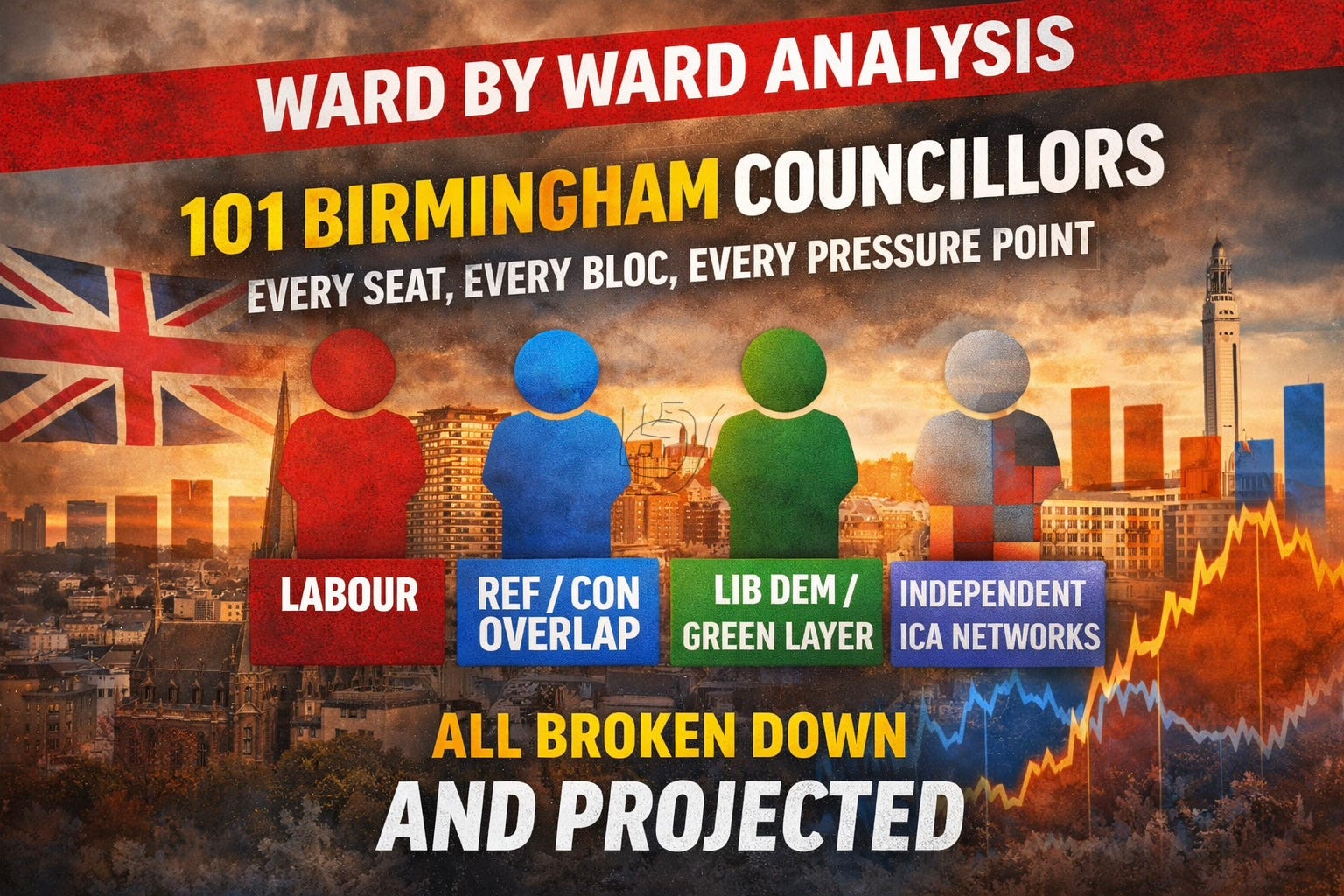
The ward picture, where this election is actually decided
What follows is the working detail behind the headline numbers.
This is where the model either stands up or falls apart.
Each ward has its own character, its own history, and often its own internal politics that do not map neatly onto national trends. Some behave predictably. Others do not. Some move slowly. Others shift all at once.
Taken together, they form a patchwork that explains why Birmingham is so difficult to call, and why small changes in vote share can produce disproportionately large changes in outcome.
How to read this:
This is not a spreadsheet. It is a guided view of where pressure is building, where it is contained, and where it may yet break.
EDGBASTON
Seats | Current councillors | Local factor | Reform pressure | Likely outcome
Edgbaston
2 | Conservative x2 | Alden personal vote | Medium | CON HOLD
North Edgbaston
2 | Labour x2 | Demographics | Low–Medium | LAB HOLD
Harborne
2 | Labour x2 | Independent split | Low | SPLIT
Bartley Green
2 | Conservative x2 | Local influence | High | MARGINAL
Quinton
2 | Labour x2 | Swing ward | High | MARGINAL
Summary
Edgbaston remains one of the city’s more balanced battlegrounds. Labour and Conservatives still anchor the area, but neither does so securely. Reform is present, particularly in the outer wards, but not yet decisive. This is pressure without collapse, movement without breakthrough.
ERDINGTON
Seats | Current councillors | Local factor | Reform pressure | Likely outcome
Castle Vale
1 | Labour | Narrow base | Medium | LAB HOLD
Erdington - Conservative Leaders seat
2 | Conservative x2 | Strong machine | Medium | CON HOLD
Gravelly Hill
1 | Labour | Demographic shift | Medium | LAB HOLD
Kingstanding
2 | Split | Reform terrain | Very High | REF BREAK
Oscott
2 | Split | Open field | Very High | REF BREAK
Perry Common
1 | Labour | Weak incumbent | Very High | REF GAIN POSSIBLE
Pype Hayes
1 | Labour | Weak org | High | MARGINAL
Stockland Green
2 | Labour x2 | Shift underway | High | SPLIT
Summary
If Reform are to demonstrate real momentum, it is here. Erdington contains multiple wards where pressure is not just visible but acute. The pattern is consistent, where Labour is thin or Conservatives are divided, Reform has a pathway. This is one of the clearest indicators of how far the shift has gone.
NORTHFIELD
Seats | Current councillors | Local factor | Reform pressure | Likely outcome
Allens Cross
1 | Labour | Vacancy | Very High | REF GAIN
Frankley
1 | Conservative | Independent strength | High | MARGINAL
Kings Norton North
1 | Labour | Weak base | High | MARGINAL
Kings Norton South
1 | Green | Strong incumbent | Medium | GREEN HOLD
Longbridge
2 | Conservative x2 | Weak org | High | SPLIT
Northfield
1 | Labour | New councillor | High | MARGINAL
Rubery
1 | Conservative | Strong incumbent | Medium | CON HOLD
Weoley
2 | Labour x2 | Weakening | High | SPLIT
Summary
Northfield is not collapsing, but it is loosening. What were once reliable alignments are becoming conditional. Reform is competitive across multiple wards, but not dominant. The result is fragmentation rather than takeover.
YARDLEY
Seats | Current councillors | Local factor | Reform pressure | Likely outcome
Acocks Green Lib Dem Leaders seat
2 | Lib Dem x2 | Mixed incumbency | High | SPLIT
Sheldon
2 | Lib Dem x2 | Strong machine | High | LD HOLD
Small Heath
2 | Labour | Fragmented | Low | SPLIT
South Yardley
1 | Lib Dem | Stable | Medium | LD HOLD
Tyseley
1 | Labour | Open | Medium | MARGINAL
Yardley East
1 | Lib Dem | Reform terrain | Very High | REF GAIN
Yardley West
1 | Lib Dem | Pressure | Medium | MARGINAL
Summary
Yardley remains structurally Liberal Democrat, but no longer comfortably so. Reform is beginning to cut into areas that were once considered secure. The foundation holds, but the edges are under sustained pressure.
LADYWOOD
Seats | Current councillors | Local factor | Reform pressure | Likely outcome
Alum Rock
1 | Labour | ICA pressure | Very Low | LAB HOLD
Balsall Heath
1 | Labour | Fragmentation | Very Low | LAB HOLD
Bordesley
1 | Labour | Community vote | Very Low | LAB HOLD
Ladywood
2 | Labour | Open field | Low | SPLIT
Nechells
1 | Labour | Weak base | Low | MARGINAL
Newtown
1 | Independent | Strong | Very Low | IND HOLD
Soho
2 | Mixed | Mixed electorate | Low | SPLIT
Summary
Reform does not feature meaningfully here. The contest is internal, Labour against Independent and ICA-aligned candidates. This is a reminder that not all parts of Birmingham move in the same direction.
PERRY BARR
Seats | Current councillors | Local factor | Reform pressure | Likely outcome
Aston
2 | Mixed | Entrenched | Very Low | HOLD
Birchfield
1 | Labour | Friction | Low | MARGINAL
Handsworth
1 | Labour | Instability | Low | MARGINAL
Handsworth Wood
2 | Labour | Split | Medium | SPLIT
Holyhead
1 | Independent | Strong | Very Low | HOLD
Lozells
1 | Labour | Fragmenting | Low | IND GAIN
Oscott
2 | Mixed | Open | Very High | REF BREAK
Perry Barr
2 | Lib Dem | Reform terrain | High | SPLIT
Summary
Few areas better capture Birmingham’s complexity. Independents, Labour, and Reform all play a role, but none dominate. Outcomes here will depend as much on candidates as on party labels.
HODGE HILL
Seats | Current councillors | Local factor | Reform pressure | Likely outcome
Bromford
2 | Labour | Strong incumbents | Medium | LAB HOLD
Garretts Green - Labour Leaders seat
1 | Labour | Stable | Medium | LAB HOLD
Glebe Farm
2 | Labour | Reform surge | High | SPLIT
Heartlands
1 | Labour | Strong | Low | LAB HOLD
Shard End
1 | Labour | Weak | Very High | REF GAIN
Ward End
2 | Labour | ICA pressure | Low | SPLIT
Summary
Labour retains a core presence, but it is no longer uniform. Pressure is uneven, but real. Reform breaks through at the edges, while ICA influence disrupts from within.
SELLY OAK (the Green Crescent)
Seats | Current councillors | Local factor | Reform pressure | Likely outcome
Billesley
2 | Labour | Reform + Green | High | SPLIT
Bournbrook
2 | Labour | Green surge | Low | GREEN SPLIT
Bournville
2 | Labour | Open | Medium | GREEN GAIN
Brandwood
2 | Labour | Fragmented | High | SPLIT
Druids Heath - Green Leaders seat
1 | Green | Strong | High | GREEN HOLD
Highter’s Heath
1 | Conservative | Reform pressure | High | MARGINAL
Stirchley
1 | Labour | Green surge | Low | GREEN GAIN
Weoley
2 | Labour | Reform surge | Very High | REF BREAK
Summary
This is the Green Crescent in practice. Growth is steady rather than explosive, but it is real. Greens expand where organisation exists, while Reform competes at the edges. A layered and evolving political landscape.
HALL GREEN & MOSELEY
Seats | Current councillors | Local factor | Reform pressure | Likely outcome
Hall Green North
2 | Labour | Reform foothold | Medium | SPLIT
Hall Green South
1 | Conservative | Strong | Medium | MARGINAL
Moseley
2 | Lib Dem | Green surge | Low | SPLIT
Sparkbrook
2 | Labour | ICA | Very Low | SPLIT
Sparkhill
2 | Labour | ICA strong | Very Low | ICA BREAK
Summary
Fragmentation defines this area. Green, Independent, and ICA forces all shape outcomes. Reform is present, but not dominant. This is a multi-directional contest.
SUTTON COLDFIELD
Seats | Current councillors | Local factor | Reform pressure | Likely outcome
Four Oaks
1 | Conservative | Strong base | Medium | CON HOLD
Mere Green
1 | Conservative | Affluent | Medium | CON HOLD
Reddicap
1 | Conservative | Reform overlap | High | MARGINAL
Roughley
1 | Conservative | Suburban | High | MARGINAL
Trinity
1 | Conservative | Mixed | Medium | MARGINAL
Vesey
2 | Labour | Weak | High | REF BREAK
Walmley
2 | Conservative | Reform overlap | High | SPLIT
Wylde Green
1 | Conservative | Reform friendly | High | MARGINAL
Summary
What was once solid Conservative ground is now contested territory. Reform does not sweep, but it reshapes the landscape. The result is pressure, not immediate collapse, but unmistakable change.
Birmingham-wide position
Labour ~29–31
Reform ~28–30
Conservative ~12–14
Lib Dem ~8–10
Green ~8–10
Independent ~17–20
No overall control.
What happens if Reform moves beyond 30%
At 30%
The system fragments.
At 31%
Reform becomes the leading force.
At 33%+
A Reform-led administration becomes structurally possible.
But still not inevitable.
Because Birmingham is not a two-party system.
And in a multi-bloc city, power is not simply won.
It is negotiated.
Final word
This is not a prediction in the narrow sense.
It is a structured reading of a complex system.
It will not be perfectly right.
But it does show direction.
And Birmingham is moving, steadily and unmistakably, away from control.
And towards negotiation.
“I enjoyed the many hours spent on this I hope you enjoyed it as well, I hope even more I get close, fingers crossed.” Mike Olley