

EXCLUSIVE: Public-Interest Questions Raised Over MP Correspondence in Criminal Disclosure File
How Did Correspondence Involving Constituents and an MP’s Office Come to Appear Within Criminal Disclosure Material?

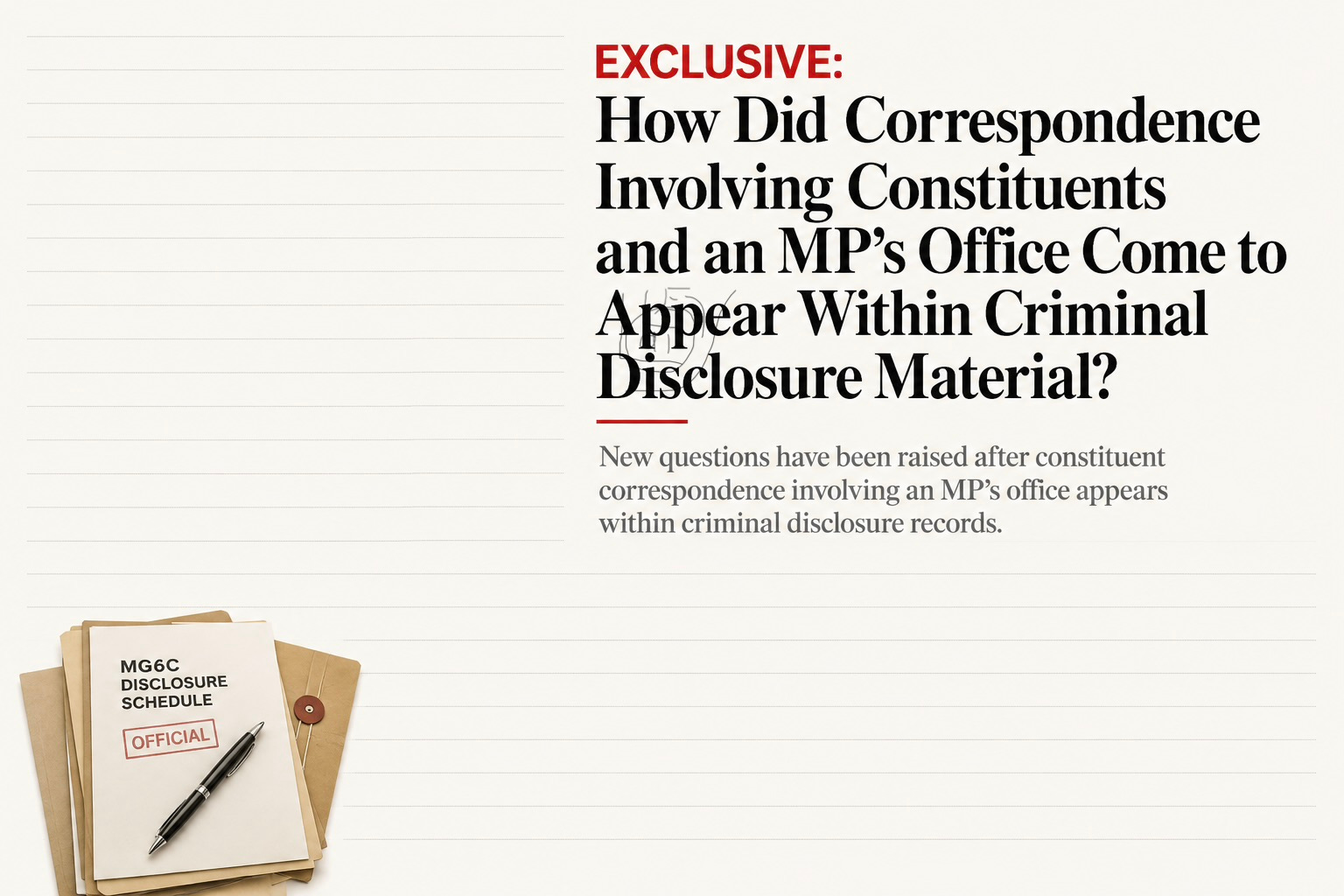
There are certain people in society we are supposed to trust completely. A doctor. A solicitor. A priest. And an MP. When ordinary people contact their MP they are often frightened, vulnerable or attempting to raise concerns involving institutions far more powerful than themselves. They write believing the conversation is confidential and believing the MP is acting solely in the constituent’s interest. If that trust begins to weaken, confidence in representative democracy weakens with it.
That is why serious public-interest questions are now being asked about how correspondence involving constituents and an MP’s office came to appear within criminal disclosure material connected to a West Midlands Fire Service related case. Last week detailed letters were sent to Preet Kaur Gill MP, Labour Chief Whip Jonathan Reynolds MP and Labour’s West Midlands regional director Sam Donoghue. Those letters raised concerns surrounding constituent correspondence appearing within a criminal prosecution disclosure file. At the time of writing, no substantive response has been received, not even a holding acknowledgement confirming the matter is being examined.
To understand why this matters, it is important to explain the issue clearly. Official disclosure schedules, commonly referred to as MG6C schedules, form part of the criminal justice process. They are formal records identifying material gathered during an investigation and considered within disclosure procedures by investigators, prosecutors and defence teams. These are not rumours or internet speculation. They are official criminal justice documents.
In this case the disclosure records reportedly refer to timelines of contact and bundles of emails involving constituents and the office of Preet Gill MP concerning allegations and complaints connected to West Midlands Fire Service matters.
That immediately creates an obvious public-interest question. How did correspondence involving constituents and an MP’s office come to appear within disclosure material connected to a criminal prosecution file?
There may be a straightforward and entirely lawful explanation. There may be proper procedural reasons why the material appeared there. At present, however, no explanation has been provided despite direct questions being raised.
Importantly, this article does not allege wrongdoing by any individual. It raises questions of process, transparency and public confidence which the institutions involved are entitled to answer.
The wider context nevertheless makes the matter sensitive. The concerns originally raised by constituents related to West Midlands Fire Service and matters surrounding a criminal investigation. During part of the relevant period Greg Brackenridge served as Chair of West Midlands Fire Authority while his wife, Sureena Brackenridge MP, also served as a Labour MP within the region.
There is currently no evidence that Greg Brackenridge, Sureena Brackenridge MP or Preet Gill MP improperly handled or disclosed confidential constituent material. That distinction is important and fairness requires it to be stated clearly.
However, the public is still entitled to ask how constituent correspondence came to appear within the disclosure process and whether the material was handled beyond the originally expected channels. Did the material pass directly to police? Directly to West Midlands Fire Service or Fire Authority representatives? Or through some other entirely lawful procedural route? At present the path the information took remains unclear publicly.
That uncertainty matters because public confidence depends not merely upon the absence of wrongdoing, but upon transparency where sensitive institutional relationships overlap. When concerns involve elected representatives, public authorities and criminal investigations, the handling of confidential information inevitably becomes a legitimate matter of scrutiny.
And this is where the issue becomes larger than any one politician or institution.
The concern is not simply about the integrity of individuals. It is about whether ordinary people can feel confident raising concerns involving powerful public bodies without fearing that sensitive correspondence may later appear in places they did not expect. If confidence in confidentiality weakens, people may simply stop coming forward altogether.
This also touches upon confidence in the wider justice process itself. These were not merely political conversations or party briefings. The material appeared within the context of criminal disclosure procedures connected to an active prosecution process. If ordinary members of the public begin believing that sensitive approaches to elected representatives may later appear within wider institutional or investigative systems without explanation, confidence in both politics and public institutions risks being weakened.
Yet despite repeated correspondence, no explanation has so far been provided. No reassurance. No transparency. Not even the courtesy of acknowledging the concerns being raised.
Labour frequently speaks about standards, integrity and public trust. But those principles matter most when difficult questions arise close to home. If there is an innocent explanation, provide it. If procedural clarification is available, offer it. Refusing to engage at all risks deepening public concern unnecessarily.
MidlandsGRIT would naturally publish any substantive response, clarification or correction provided by the individuals or organisations concerned.
A democracy can survive scandal, disagreement and political conflict. What becomes harder to survive is the gradual erosion of trust between ordinary citizens and those elected to represent them. Once people begin doubting whether sensitive approaches to public representatives will remain properly protected, something important begins to fracture.
And once public trust fractures, rebuilding it becomes extraordinarily difficult.