

EXCLUSIVE: They Knew About Birmingham’s HMO Crisis… And Let It Grow
Years of warnings, thousands of inspections, and still the same pattern. What has actually changed?

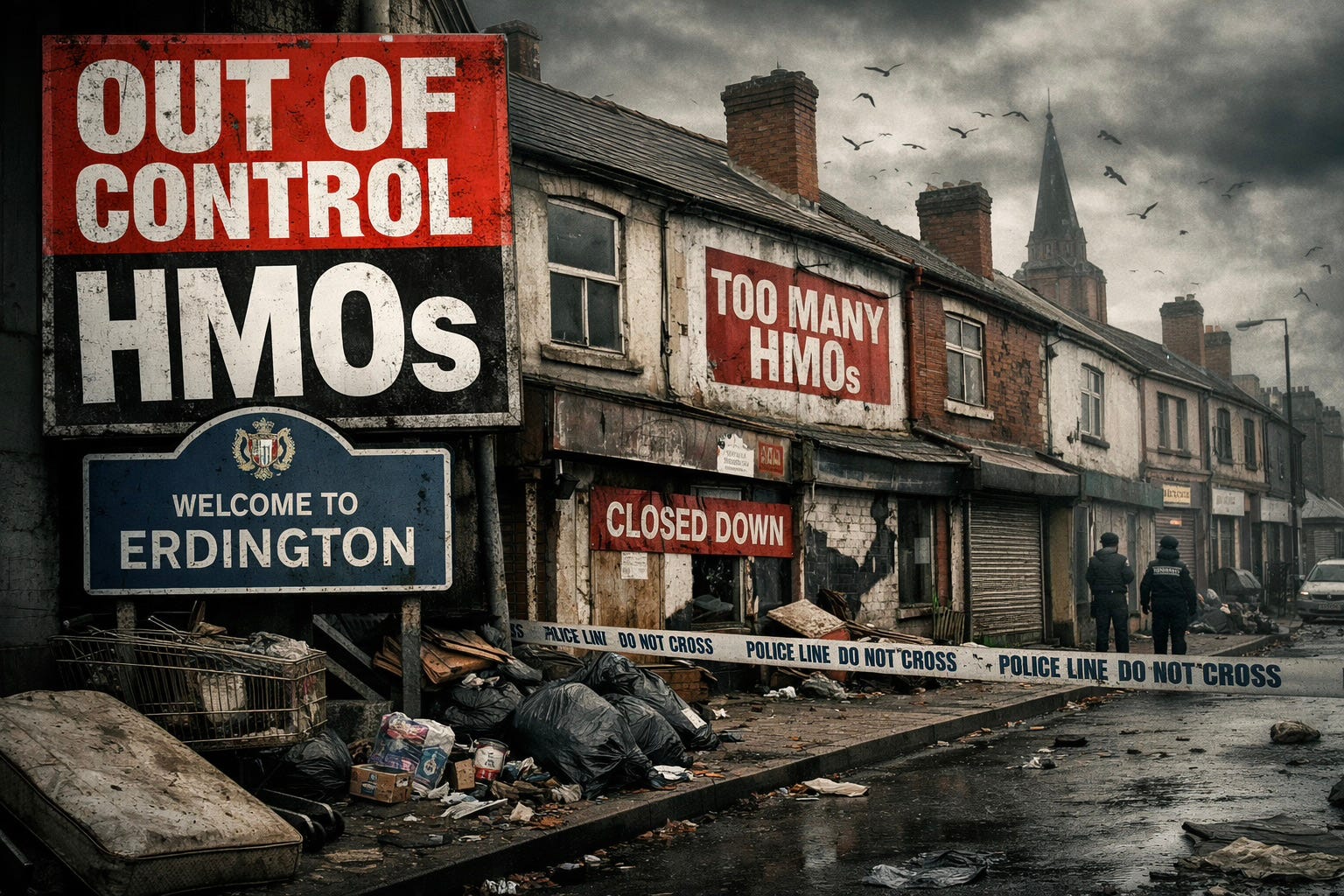
EXCLUSIVE: They knew. They inspected. So why hasn’t it changed?
If you live in Birmingham, you will almost certainly have come across the term HMO. It stands for House in Multiple Occupation, a property where several unrelated people live under one roof, each occupying a room and sharing facilities. On its own, that is nothing unusual. HMOs have existed for years and, when properly managed, they can provide a useful form of accommodation.
But that is only part of the picture.
Alongside traditional HMOs sits a rapidly expanding sector known as exempt accommodation. This is a form of supported housing, often used to house vulnerable individuals, where landlords can claim higher levels of housing benefit in return for providing support. In principle, it is meant to help people who need stability and assistance. In practice, across parts of Birmingham, it has grown into something far more controversial.
The numbers now run into many thousands of properties across the city. What is striking is not simply the scale, but the structure behind it. A relatively small number of organisations are operating at significant size, controlling portfolios that run into the hundreds and, in some cases, the thousands. Those properties are not evenly spread. They tend to cluster, with the same provider names appearing repeatedly across the same areas.
That clustering has real-world consequences, and it is visible in parts of Birmingham that have experienced sustained growth in this type of housing.
Erdington shows what happens when this model takes hold and is allowed to continue expanding. Over recent years, the number of HMOs and exempt accommodation properties has increased steadily, not in isolation but in clusters across the same streets and surrounding areas. What begins as a small number of conversions gradually builds into something more concentrated, with the same types of properties appearing again and again in close proximity.
Once that pattern begins, it does not remain contained within a single street. It extends outward. A road starts to change first, with increased turnover and a loss of long-term stability. That change then begins to affect neighbouring streets, and over time the wider area starts to feel different, not because of one property, but because of the cumulative effect of many operating under the same model.
That shift feeds directly into the high street and local centres. As the balance of housing changes, so does the nature of demand. Long-term residents who typically support a broader range of shops and services are replaced more frequently, and spending patterns become less consistent. Businesses that depend on stability and regular custom begin to struggle, and over time they are replaced by those able to operate on lower margins and higher turnover.
In Erdington, this has been visible over a number of years. Local people have seen changes in the mix of shops and services, with concerns raised about declining variety, reduced investment, and a gradual erosion of confidence in the high street as a place for long-term business. This is not a sudden collapse, but a steady shift that becomes more noticeable as it develops.
This is not about individuals living in these properties. It is about what happens when a particular housing model reaches a certain scale within a concentrated area. The effect is cumulative and extends beyond individual buildings into the wider functioning of a neighbourhood. Residents and local representatives have been raising these concerns for some time. The pattern can be seen, the impact can be felt, and the direction of travel is clear.
None of this is unknown to those in positions of responsibility. Birmingham City Council holds detailed information on these properties. It knows where they are, who operates them and how the system is developing across the city. It also has powers to regulate standards and to act where conditions fall short. Those powers are not insignificant. The council can inspect properties, identify hazards, issue improvement notices, restrict use and, in serious cases, close buildings altogether.
And inspections are taking place.
Recent figures show more than twelve thousand inspections carried out across the sector. Alongside those inspections, over two thousand hazards have been identified, and more than three thousand properties have required some form of further intervention. These figures point to a system that is being actively examined and where problems are being found.
However, when those figures are set against the level of formal enforcement action, a different picture begins to emerge. Civil penalties are relatively limited in number, and prosecutions are rare. When compared to the scale of inspections and identified issues, the level of formal action appears modest. That gap is difficult to ignore, because inspections identify problems but enforcement is what drives change.
There are, of course, reasons why enforcement does not follow every inspection. Cases must be properly evidenced. Officers have to prioritise the most serious risks. Resources are finite, and not every breach justifies immediate formal action. These are practical realities of any regulatory system. But the outcome remains the key test, and the outcome, based on the available data, is a system that continues to grow, continues to concentrate in certain areas, and continues to generate concern about standards and oversight.
There is also an important point about how inspection figures are understood. A high number of inspections does not necessarily mean a high number of different properties have been inspected. The same property may be visited multiple times, with each visit recorded separately. That is part of the process, but it means headline figures can give an impression of coverage that may not fully reflect the spread of activity. If some properties are subject to repeated visits while others are not inspected at all, then enforcement will inevitably be uneven.
That is not an accusation. It is a consequence of managing a large and expanding sector with finite resources. But it does bring the central issue into sharper focus. The council knows where these properties are. It knows who operates them. It is inspecting them in large numbers and identifying problems within them.
So why does the system continue to expand in the way that it does? Why do the same provider names continue to appear across new streets and new neighbourhoods? Why do concentrations persist in areas already under pressure, such as Erdington?
These questions go directly to the effectiveness of the current approach.
Concerns about HMOs and exempt accommodation are not new. They have been raised repeatedly by politicians, including those in positions of influence. Paulette Hamilton, the Member of Parliament for Birmingham Erdington, has spoken in particularly strong terms. In Parliament, she described the “unchecked proliferation” of HMOs and exempt accommodation as “devastating communities”, warning that some areas were among the worst affected in the city, “crippling neighbourhoods and overwhelming local services”. In an earlier debate, she pointed to Kings Road in Stockland Green, where more than 27 of 85 houses were in multiple occupation, linking that concentration to rising antisocial behaviour and declining conditions.
These are not vague concerns. They are clear, direct statements made on the public record, and they come from someone who understands the system from the inside, having held senior roles locally before entering Parliament. That makes the current position harder to reconcile, because if the problem has been identified so clearly, and its impact described in such strong terms, the question is what has followed from that.
Birmingham has not reached this position by accident or in a short space of time. The growth of HMOs and exempt accommodation has taken place over a number of years, during which the city has been under consistent Labour control. Over that period, concerns have been raised repeatedly about standards, about clustering, and about the impact on communities. Statements have been made. Warnings have been issued. The language used has often been strong.
Yet despite that, the system has continued to expand.
Areas such as Erdington have seen sustained growth, with concentrations becoming more established and the effects on neighbourhoods and high streets becoming more pronounced. The pattern has not been halted, and it has not been reversed. That creates a gap that is difficult to ignore, between what has been said and what has actually changed.
It is not enough to express concern. It is not enough to acknowledge that something is wrong. At some point, those concerns have to translate into visible and consistent action that changes the direction of travel. So far, that shift has not been evident.
This is not about slogans or party lines. It is about outcomes. If the system has grown to its current scale under the existing leadership, then it is reasonable for voters to ask what has been done to stop it, and why those efforts have not altered the trajectory.
That question becomes more immediate as the election approaches, because the issue now is not simply whether the problem is understood. It is whether there is the resolve to deal with it in a way that produces real and lasting change.
At some point, that gap becomes the story.
Birmingham is heading into an election. Candidates will speak about housing, about protecting communities and about raising standards. Those are the right issues to address. But voters are entitled to ask a more direct question.
If the powers exist, and if the problems are already known, why does the system still look like this?
Because at some point the question stops being about awareness and becomes a question of resolve. Not whether the issue is understood, but whether there is the willingness to deal with it.
'Exempt Accommodation' also can have deeper ties to organised crime through the wider fraud and taking advantage of the benefits system as EA removes one of the caps.
Perhaps Mike, you might want to investigate what becomes of the WM Police estate which gets sold off, who buys it and what they do with it. The facilities sharing arrangement with WM Fire Service has allowed the Police to release capital through sale of the estate. It would certainly be to WMP's benefit to maintain or develop that arrangement with WMFS. We can speculate what lengths they'd go to for that...