


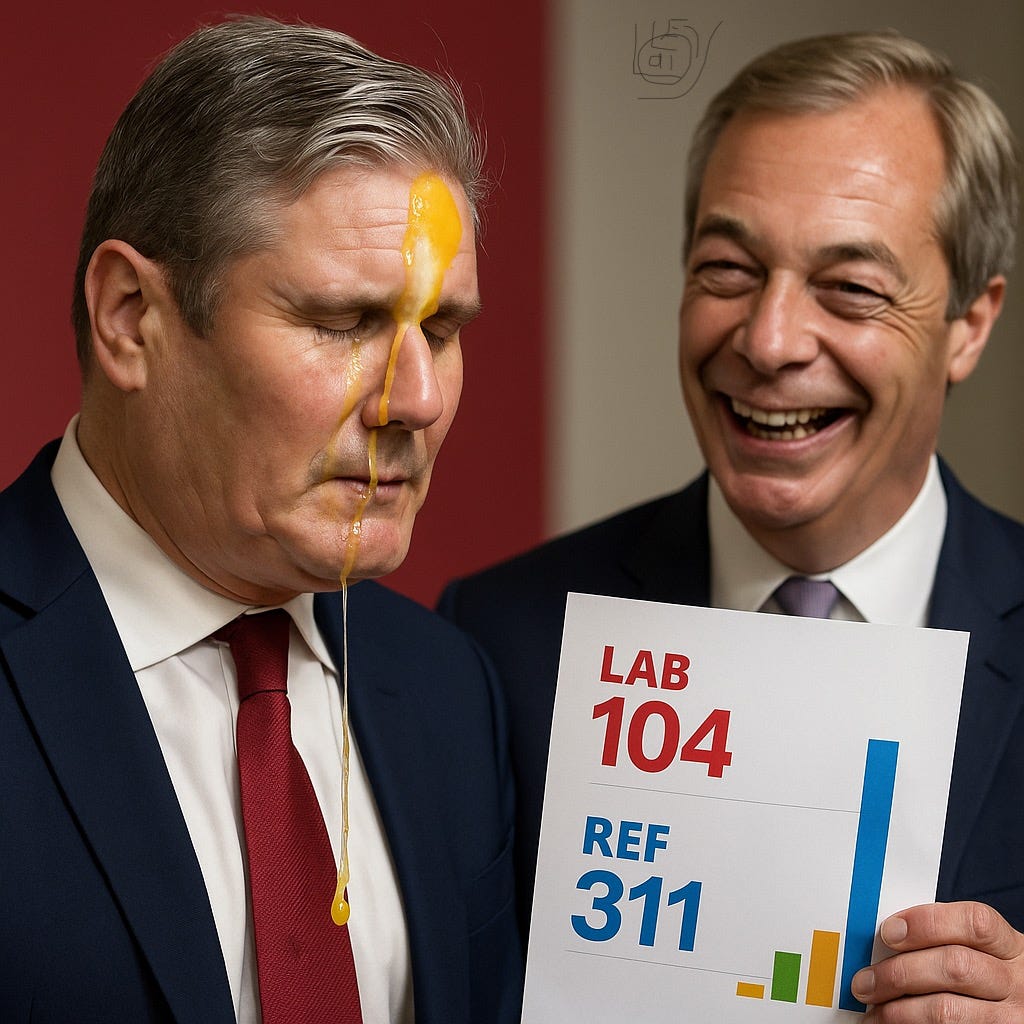
Something very odd is stirring inside the Labour Party. I have been a member long enough to recognise the faint tremor that runs through the leadership when anxiety moves in. One of Keir Starmer’s recent messages to the membership did not sound like the steady voice of a man with more than four hundred MPs behind him. It sounded like the appeal of someone who has checked the electoral weather report and discovered a hurricane building out at sea.
The official line was familiar. Reform UK’s Nigel Farage is dangerous. Farage is divisive. Farage must be stopped. And Labour would appreciate a few pounds from the faithful to stiffen the defences. Nothing unusual in that. But the tone was strained. There was something in the urgency that gave the game away. It was not the voice of a party standing firm. It was the voice of a party that has seen the polling numbers and reached for the whisky.
Because the truth is that while Parliament today looks like a Labour fortress, the projections for tomorrow paint a very different landscape. Reform has only five MPs on paper. Labour has hundreds. Starmer should be sleeping like a baby. Except he is not, because the respected modelling shows that if an election were held now, Farage would emerge with more than three hundred MPs and Labour with barely one hundred. In Birmingham the forecast places six seats in Reform’s hands, one with Labour and two with Gaza inspired independents. In the wider West Midlands Reform could take twenty two. Labour six. The Conservatives four. The numbers exceed the seats available but these are models not final scores. What matters is the direction of travel. The political ground is shifting like wet sand under the tide.
This is why Starmer is worried. And worry may be too gentle a word. If Labour’s majority is supposed to be secure, why is Reform, a party with almost no organisational machinery, tunnelling its way into working class communities that once would never have entertained them for more than a minute
Because people are not flirting with Farage. They are turning away from Labour. Real people from real streets. The very communities Labour claims to champion while increasingly failing to understand them.
Some of my own friends are telling me openly that they intend to vote for him. Black friends, Asian friends, Chinese friends, white working class friends. People who in the past might not have given Reform the time of day. And it is not because of that tired language of right wing and left wing. Those old markers have evaporated. It is not because they want to dismantle the welfare state either. It is because they feel Labour has drifted away from them. They feel dismissed. Looked down upon. Spoken to by a leadership that sounds like a management consultant reading from a prepared script. A party more at home in the refined lounges of north London than in the pubs of Perry Barr, Lozells or Sparkbrook.
And if anyone in Labour HQ thinks this drift is confined to a few restless British voters, they need to get out more. I was in Jamaica recently, just before the hurricane rolled in, and I met a whole range of African American holidaymakers. A turkey farmer. A real estate operator who looked like she handled serious property. An oil man. Others who were unmistakably upper middle class. Educated, assured, politically awake. Every single one of them said they vote for Trump without hesitation. Not in anger. Not in protest. It was simply where they felt the country’s future lay.
I also met Afro Caribbean British holidaymakers. They talked openly about Farage. Some had already voted for him. They did not see him through the cartoon lens pushed by the Westminster media. They saw him as someone prepared to speak plainly about the state of Britain. These were not disaffected white voters. These were black Britons who felt Labour no longer represented their instincts, hopes or frustrations. When communities like this shift, it is not a polling blip. It is a fault line moving under your feet.
Back home the Labour strategists still appear to believe the working class is a static museum exhibit that can be reliably summoned whenever the party needs moral authority. What they forget is that the working class includes everyone. Black, Asian, Chinese, mixed race, white, long established families, new arrivals, the whole tapestry of modern Britain. And across that tapestry the mood is sour. Not just with the country but with Labour.
So when the leadership decides to brand Farage a racist, they imagine they are delivering a knockout blow. The trouble is that the public are not reacting. The current allegations relate to things Farage is said to have said fifty years ago. A lifetime. People do not care. They simply do not. Many of us grew up in an era when the BBC broadcast the Black and White Minstrel Show, Bernard Manning, Alf Garnett and a whole parade of questionable stereotypes. If the national broadcaster normalised that language then we cannot pretend society was some gentle sanctuary of today’s sensibilities.
Farage struck a genuine chord when he told the BBC that if he must apologise for teenage remarks then perhaps they should apologise for decades of racist, sexist, homophonic televised caricatures pumped into the nation’s living rooms. And people nodded. Not because they approve of those old shows but because they remember the country as it was. They know that real life is lived in context not in the narrow ideological corridors of Westminster. People judge a politician by what he says today, not by what he might have said in 1975.
I understand it myself. I watched some of those shows at the time and I probably enjoyed them. Does that make me a racist? Maybe! Though I doubt my Afro Caribbean wife or mixed race children would recognise that idea. Most ordinary people understand perfectly well that life changes. People change. Britain changes. And they are not prepared to let half century old trivia dictate their vote. When Labour keeps pounding away at these attacks it only reinforces the sense that the party has nothing to say about the real problems facing the country.
Cost of living. Crime. Immigration. Housing. Health. Wages that have stood still for years. Communities left to fend for themselves. Labour shouts about Farage’s past while Farage talks about the country’s present.
That is political malpractice. It is gifting Reform an open goal.
Which brings me back to Starmer’s fundraising message. For a party that supposedly dominates the political landscape, it reads more like desperation than mobilisation. It is not normal for Labour to panic less than a year into a new Parliament. It is not normal for a governing party to lash out at a challenger that is not even the official opposition. Something profound is slipping.
If Labour wants to halt the slide it must stop talking about Farage and start listening to the voters moving towards him. Not lecturing them. Listening. Not moralising. Understanding. Because Reform is not Labour’s real problem. Labour’s real problem is that it has mistaken managerial competence for political purpose. It has slid into a belief that tidiness is enough when the country is crying out for direction. For something that feels like real change rather than corporate governance.
If the polls have any meaning they are telling a blunt truth. The public are punishing Labour not because they are in love with Farage but because Labour has forgotten who it exists to represent. Unless Starmer grasps this soon, he will not be leading a national renewal. He will be presiding over the collapse of the coalition that swept him into power.
This is the moment for clarity. Not for fear. Not for fundraising letters. But for political courage. Labour must speak plainly again. It must reconnect with working people. It must stop insulting voters by telling them what they are supposed to think about a man who, whether you like him or not, speaks in a language they recognise.
Because everything Labour is doing at present seems to be promoting Reform rather than stopping it. The country senses it. Farage senses it. The polls confirm it.
Starmer can turn this around. But he needs to start fighting the election that is actually unfolding rather than the one his advisers keep drawing on whiteboards. Britain is not the country imagined in Labour’s strategy papers. It is the country outside the window. And it will decide its own future whether Labour is ready or not.