

Film West Mids
Peaky Blinders proves Birmingham can create a global hit. Now the question is whether the region can build an industry to match it.

A few days ago, I found myself standing at Walsall FC, watching a stubborn 0–0 unfold under the kind of flat midweek light that drains all drama from the pitch.
Not much happening on the field. Quite a lot happening off it.
Because in the stands, I bumped into Richard Parker. No handlers, no choreography, no prepared lines. Just football and conversation. He was giving it full voice for Walsall despite his Bristol Rovers loyalties, which tells you something straight away.
So I put a question to him that had been sitting with me for some time.
By the numbers, the West Midlands still sits near the bottom of England’s regional screen economy.
He didn’t dispute the numbers.
He challenged the premise.
Have you counted the leverage?
The question that wasn’t being answered
The reason that exchange mattered is simple.
I had already done the work.
A comparative league table of England’s regional screen economies, built not on press releases but on underlying structure. Capital investment, production funding, population scale. Strip it all back and the conclusion was uncomfortable.
The West Midlands, despite its size and history, sat near the bottom.
Ordinarily, that is where you put the question to the Combined Authority.
But experience has a way of shaping behaviour. After a while, you stop asking. Not out of lack of interest, but because the answers rarely come. The silence becomes predictable.
So the question sat there, unanswered.
Until it didn’t.
The numbers, stripped back
If you look at the regional screen economy properly, three things matter.
First, infrastructure. The physical presence of studios, production facilities and anchor institutions.
Second, funding. The mechanisms that support development and production.
Third, scale. The population and economic base that sustains it all.
On that basis, the hierarchy across England is not difficult to map.
Greater Manchester built a system, anchored by the vast complex at MediaCityUK and supported by long-term broadcaster presence.
Yorkshire built an investment engine through Screen Yorkshire, using its content fund to leverage significant production spend.
Liverpool built a machine through the Liverpool Film Office, turning the city into one of the most filmed locations outside London.
The North East, smaller but focused, is beginning to move quickly.
And the West Midlands?
A developing cluster.
Modest development funding.
A large population.
Enough to be in the game, but not yet enough to lead it.
The part the numbers miss
And this is where Parker’s question lands with some force.
Because the screen industry does not operate on grant funding alone. It operates on what that funding attracts.
The West Midlands is now beginning to pull production spend into the region.
The agreement with the BBC will see network production rise towards £40 million a year. That is not a policy announcement. It is an economic current. Crews, suppliers, accommodation, services, all feeding into a growing ecosystem.
That is how industries form. Not through isolated investment, but through sustained flow.
One story, global reach
If you want a single example of that leverage, you do not need to look far.
Peaky Blinders.
Created by Steven Knight, rooted in Birmingham and the Black Country, filmed in places like the Black Country Living Museum, it has become one of the most recognisable British dramas in the world.
Now, with the film arriving on Netflix on 20 March, its reach extends further still.
Figures in the region of £300 million are often cited when the full economic impact is considered. Not just production budgets, but tourism, supply chains, and the wider halo effect that a global series creates.
Whether the precise number matters is almost beside the point.
What matters is what it represents.
Proof.
The real question
Because the West Midlands has now demonstrated something beyond argument.
It can produce world-class content.
The question is no longer whether the region has talent, or stories, or cultural depth.
It does.
The question is whether it can turn that capability into a system.
Why is Peaky Blinders the exception rather than the model?
Why did Manchester build a sustained production economy while Birmingham lost its anchor with the closure of BBC Pebble Mill Studios and spent years drifting?
Why is the infrastructure now emerging in Digbeth only taking shape at a point when others are already mature?
A centre of gravity, at last
Everything now points to Digbeth.
The BBC’s move into the Typhoo Tea Factory.
The development of Digbeth Loc Studios.
A growing concentration of creative businesses.
For the first time in years, the West Midlands has the beginnings of something it has lacked.
A centre of gravity.
Whether that becomes a functioning production hub or remains a well-branded regeneration project is the question that will define the next decade.
A different tone
What struck me most in that brief exchange at Walsall FC was not just the answer, but the willingness to engage with the question itself.
There was no attempt to deflect it, soften it or avoid it.
Direct conversation achieved more in a few minutes than formal channels often manage over weeks.
That is not a criticism of the Mayor.
If anything, it suggests he understands both the scale of the challenge and the nature of the opportunity.
And, quietly, there are signs that the Combined Authority itself is being reshaped from the top down. If that extends to how the region communicates and responds, it will not come a moment too soon.
A region that has waited
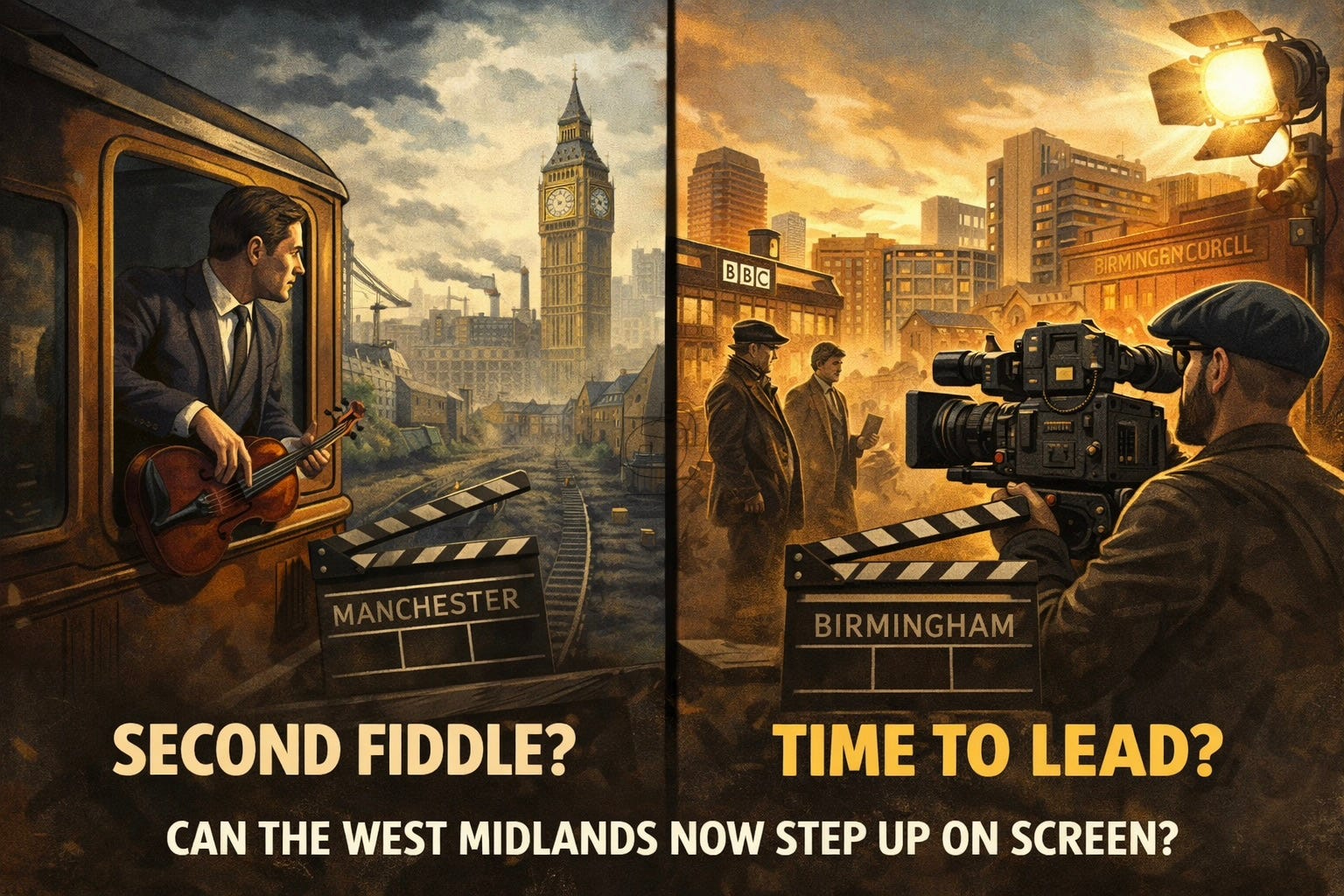
For much of the modern television era, Birmingham has played second fiddle.
While London dominated and Manchester built, the West Midlands drifted. It had moments of brilliance, deep reserves of talent, and stories that travelled. What it did not have was continuity.
Other regions moved forward.
Birmingham hesitated.
And for a long time, that was enough to fall behind.
Could this be the moment?
It would be premature to say the West Midlands has arrived.
It clearly has not.
But it is no longer unreasonable to ask a different question.
Could this be the point where the region stops waiting and starts attracting?
Could this be where one success becomes a pattern rather than an exception?
Could this be, finally, the moment where Birmingham steps out of second place?
From leverage to permanence
The answer will not come from one film, however successful.
It will come from what follows.
From whether Digbeth fills with production.
From whether local voices are commissioned, not just hosted.
From whether careers can be built here, rather than elsewhere.
Parker’s question still hangs in the air.
Have you counted the leverage?
The next question is the one that matters.
Can the West Midlands turn that leverage into something permanent?
The test
The release of the Peaky Blinders film is not just a cultural moment.
It is a test.
Because the West Midlands has proved it can create a global hit.
What it has not yet proved is that it can build an industry.
If that is now beginning to change, then this moment will look, in time, like the point where the region stopped proving its potential and started realising it.
If not, then Peaky Blinders will remain what it has always been.
An exception.
Funnily enough, there is a modern-day classic Western tale set in the West Midlands waiting to be told and filmed. A lone gunslinger from the hills outside of town (Staffordshire), a corrupt Sheriff and his sycophants (situated in WMFS and WMP), a new Sheriff trying to clean up (Oliver Lee) realising the corruption is the issue and eventually, the reckoning, figuratively (& ironically) everything burning down. Think High Plains Drifter in the industrial West Midlands