


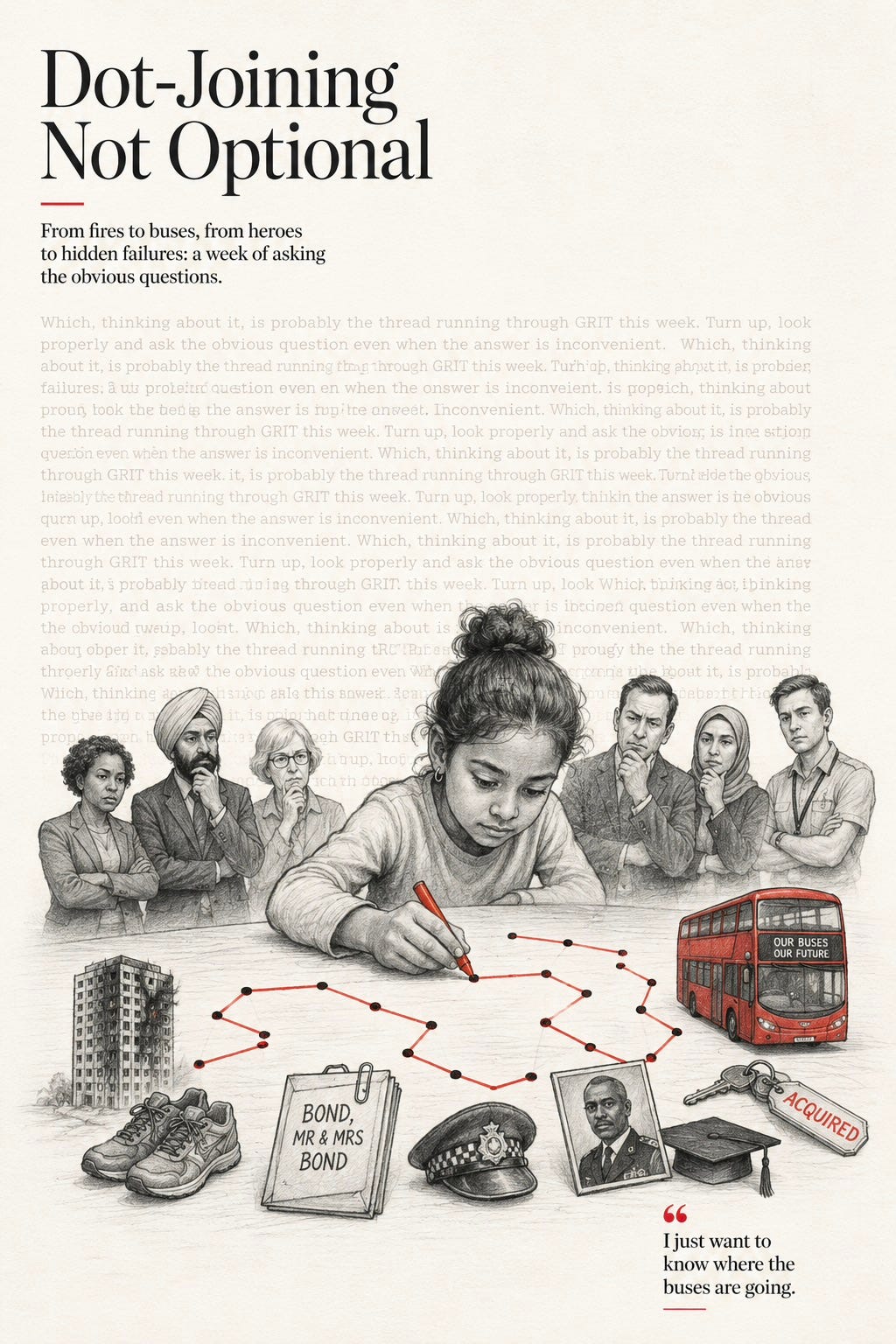
Another week disappears over the horizon at GRIT Towers and somehow I have spent it with burning heathland, a 70 year old man walking several million steps, BOND, MR AND MRS BOND, Warwickshire Police apparently struggling with the ancient investigative art of joining dots, two desperately sad stories about men once held up as Black role models and finally Richard Parker buying a bus company. Not a bus. A bus company. Or at least I think I understand that now, having spent the best part of two days trying to work it out.
We started with THE FIRE EXIT TEST, and Cllr Julien Pritchard once again spoiling a perfectly serviceable kicking. I had criticised him over affordable housing, he eventually came back with a decent answer, and then Druids Heath was hit by frightening fires and there he was, on the ground, talking to residents and actually being useful. I have friends and relatives around there who are hardly natural Green voters yet keep voting for Pritchard because he behaves like their councillor. Perhaps there is something in that. Politics has become terribly fond of deciding that somebody is either permanently wonderful or permanently dreadful according to the colour of the rosette they wear. I have never quite understood why. If I criticise somebody when I think they have got something wrong, I ought to be able to say they got something right. When residents were frightened and wanted somebody they knew to be there, Pritchard was there. The ivory tower, it turned out, had a fire exit and it opened onto Druids Heath.
Tuesday belonged to Graham Whittaker and Three Million Steps, which was probably the most cheerful thing I wrote all week because nobody needed arresting, investigating or explaining themselves afterwards. Graham has turned 70 and decided to walk three million steps in twelve months to raise money for Walsall FC Foundation. That is roughly 8,200 steps every day and somewhere around 1,400 miles. There are powders, potions, pills, watches, applications and probably some staggeringly expensive berry grown by monks on the side of a mountain that promises to keep us young. Graham has gone for shoes. Put them on, open the front door and walk. There is something wonderfully uncomplicated about it. The slight problem is that Walsall started winning when Graham walked around opposition grounds before matches, so what began as a health and fundraising exercise may now have become footballing superstition. If the Saddlers keep this up, supporters will have him doing laps whether his knees fancy it or not.
Wednesday was Warwickshire Police again, and BOND, MR AND MRS BOND, although sadly there was no Aston Martin, no exploding pen and nobody that I know of ordered a vodka martini. What there was instead was another question about something considerably less amusing, whether Warwickshire Police has a problem putting the dots together. Mr and Mrs Bond have been trying to get the force to look at what they say is a wider pattern rather than treating each individual piece as though nothing else existed before it. Mr Bond is himself a former police officer, they have documents, reports and correspondence, and their frustration is essentially a simple one. Has anybody sufficiently senior ever put the whole lot on one desk and looked at it as a whole?
And the reason that question matters goes beyond the Bonds. There was also the disturbing case of a woman who was exposed to a convicted sexual offender, where information which ought surely to have caused somebody to stop and join up what was known apparently did not do so. That takes this beyond bureaucratic irritation. Police forces hold enormous quantities of information precisely because one apparently unremarkable piece can become very important when somebody notices what is sitting next to it. Nobody expects every officer to know everything. We are entitled to expect the organisation to have systems capable of joining the important bits together, particularly where somebody may be put at risk. So Wednesday’s question was not whether Warwickshire Police possesses enough dots. It plainly does. It was whether anybody is actually joining them.
Thursday became darker still with TWO BLACK HEROES, TWO TRAGEDIES: AND TOO MANY QUESTIONS, looking at Wayne Brown and Jason Arday. They were very different men but both became important symbols of Black achievement. Brown became Britain’s first Black Chief Fire Officer. Arday became Cambridge University’s youngest Black professor. Those achievements mattered and the inspiration they gave people mattered. But both stories subsequently became considerably more complicated, and both lives ended desperately sadly.
The Brown story inevitably led back to Ben Walker, who says he raised concerns through proper channels before Brown was appointed, including concerns about due diligence. Brown’s claimed MBA was subsequently found not to have been completed and Grant Thornton criticised West Midlands Fire Service over its checking of educational qualifications. Walker meanwhile was arrested at Birmingham Airport in April 2023 after returning from overseas work and says armed officers were present. Two years later the CPS offered no evidence. I still want to understand who decided that was a proportionate way to deal with him, what risk assessment supported it and whether West Midlands Fire Service had any contact with West Midlands Police about Walker. Those are questions, not conclusions, and that distinction matters.
Jason Arday’s story created an equally uncomfortable problem. He inspired enormous numbers of people and suffered vile racist abuse. Neither fact means journalists and academics should have been prohibited from examining parts of his biography and academic work. Arday denied dishonesty. Liverpool John Moores University had previously cleared him. Cambridge subsequently opened another investigation after receiving new information and Arday resigned before it concluded. Then came his death. His family has spoken about misinformation and harassment. Somewhere underneath all of that is a principle I keep returning to. Equality means the same bar. It does not mean lowering the bar because somebody has become a useful symbol of progress and it certainly does not mean raising it because somebody resents their success. Institutions ought to be capable of celebrating achievement and checking facts at the same time.
And then came Richard Parker and the buses, which has occupied rather more of my brain than any sensible man should allow public transport governance to occupy.
I have spent the last couple of days trying to understand what Mayor Richard Parker has actually done with our buses and I make no apology for that because, judging by some of the language being thrown around, I am not entirely sure everybody else understood it straight away either. Nationalisation? Public control? Franchising? A bailout? The buses coming home? National Express going home? All of those descriptions have been wandering about and at one point I found myself wondering whether the Mayor had actually bought a bus company at all or merely bought the right to tell somebody else’s bus company where to send its buses.
Well, he has bought a bus company. Or, more precisely, the West Midlands Combined Authority is acquiring National Express’s West Midlands operation after its parent company Mobico decided it wanted out. This is the operation responsible for something approaching 94 per cent of bus journeys in the West Midlands, with around 4,800 employees and 1,300 buses, so Richard Parker could hardly wave goodbye and hope another bus company happened to turn up on Monday morning. He stepped in. Good for him.
That does not finish the story. It starts another one. The West Midlands is still heading towards franchising, where the public authority specifies routes, fares and timetables and private companies compete for contracts to operate services. Which means the public sector is buying the dominant private operator while simultaneously constructing a future in which private operators may compete to run buses under public control. Perhaps that is exactly the right answer. It may turn out to be excellent value. But taxpayers are entitled to know precisely what they have bought, what the assets are worth, who carries the risk and what eventually happens to the company they have just acquired.
Looking back, I suppose there was a thread to the week, although I certainly did not set out to manufacture one. It was mostly about looking at what people and institutions actually do rather than what the label says they do.
Pritchard is a Green Deputy Leader but on Sunday he was simply a local councillor doing his job. Graham Whittaker is not selling a revolutionary health programme, he is putting one foot in front of another. BOND, MR AND MRS BOND are not asking Warwickshire Police for a philosophical discussion about policing, they want somebody to look properly at what they have reported, and elsewhere in Warwickshire we have seen why failing to connect information can have consequences rather more serious than an unanswered letter. Brown and Arday remind us what can happen when institutions become too attached to symbols and too uncomfortable with scrutiny. And Richard Parker may call his bus deal whatever he likes.
I just want to know where the buses are going.