

For Fox Street’s Sake: Is Birmingham Selling Its Future for a Quick Buck?
Fox Street sits at the gateway to Birmingham’s future, beside Curzon Street and the promise of HS2. So why does selling it feel less like strategy and more like a rushed sale of the family silver?
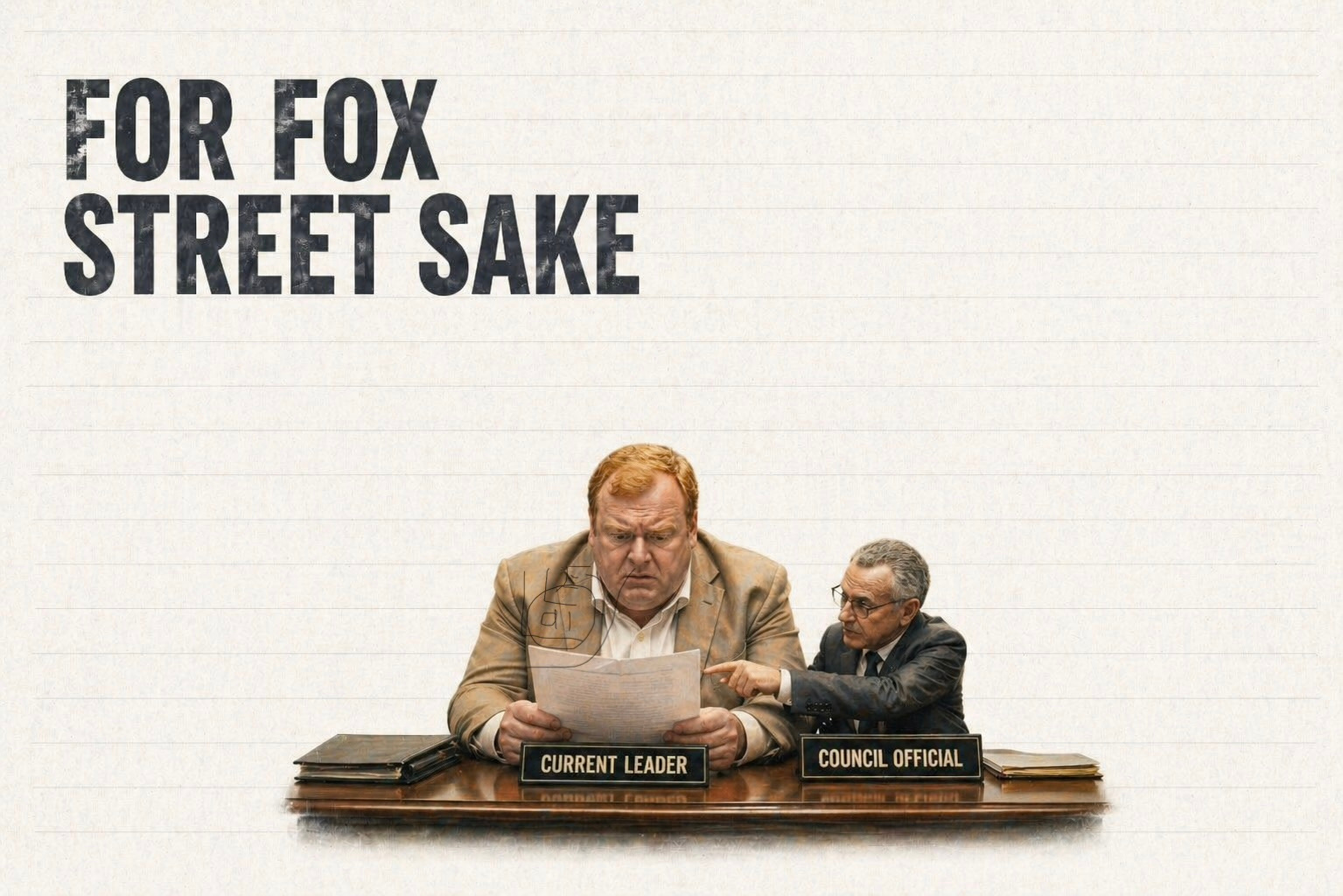
Most people never hear about scrutiny committees, and that is exactly how town halls like it. Particularly when something like Fox Street pops up.
Scrutiny sounds dull, technical and procedural, something buried in committee rooms and agenda papers that only councillors, officers and the occasional masochistic journalist ever bother to read. But scrutiny is supposed to be one of the few protections the public has when big decisions are being made behind the polished doors of the council Cabinet. It is meant to be the moment when someone asks the awkward question: are we getting value for money, is this decision being rushed, has the public been told the full story, and is the city about to lose something valuable because nobody in power wants to challenge the official script?
Cabinet makes the decisions. Scrutiny is meant to challenge them. It cannot usually stop a decision outright, but it can drag it back into the light, force reconsideration, demand better answers and expose weak arguments before the public is left paying the bill. When scrutiny works properly, it is one of the few moments democracy interrupts bureaucracy.
That is why what happened over Fox Street matters.
This is not some abandoned patch of scrubland at the edge of nowhere. This is prime council owned Birmingham land, right next to Curzon Street Station, sitting in the shadow of HS2 and the wider Knowledge Quarter regeneration zone. Land like this does not come along twice. Once it is gone, it is gone.
Cabinet approved the sale. Two councillors triggered a call-in, effectively saying: hold on, this needs another look. The matter went before the Economy, Skills and Culture Scrutiny Committee, where, crucially, Labour members were not whipped into line. They looked at the evidence, argued it properly, and after a lengthy discussion agreed something serious had gone wrong. They concluded there had not been enough proper evaluation of the risks of selling now versus holding for future value.
That is not a technical complaint. That is the entire argument. Sell too early and Birmingham could lose millions in future uplift, especially with Curzon Street and surrounding development still unfolding. Hold too long and the Council delays desperately needed capital receipts. It is a genuine strategic choice, and it demands hard evidence, not lazy assumptions.
So scrutiny sent it back. That should have been the moment Cabinet paused, reflected and genuinely reconsidered whether officers had got it right.
Instead, what appears to have happened is something depressingly familiar in Birmingham politics. Cabinet received what looked very much like an officer-written defence of the original decision, effectively a second version of the same report dressed up as reconsideration. The current Leader of the council appears to have read what one can only assume was a prepared script from the same machine that wrote the first paper, and Cabinet nodded it through like extras in a municipal pantomime. Scrutiny raised the alarm. Cabinet ignored it.
Which raises a very uncomfortable question. Is Cabinet actually a political executive making independent judgements for the city, or is it simply a body that obediently approves whatever officers place in front of it? Because if scrutiny identifies a serious defect, and the answer is simply to return with a smoother version of the same justification, then scrutiny is not scrutiny at all. It is theatre.
Councillor Robert Alden, Leader of the Conservative Group, put it more bluntly. “This land facing the entrance to the new HS2 station should be used to relocate a major firm to our city, delivering high paying jobs for Brummies. Instead Labour are flogging it for other uses, for a quick buck, in their dying days and in doing so ignoring the need for jobs in our city, and leaving the council without future income streams from neither business rates or council tax.”
Whether one agrees with the politics or not, the central question is unavoidable. Is this strategic regeneration, or simply distressed selling dressed up as policy?
The Cabinet report itself is revealing. The so-called reconsideration relies on what it describes as only “further high-level scenario-based analysis.” Not detailed modelling. Not transparent valuation testing. Not quantified future land value scenarios. Not a serious public explanation of why selling beside Curzon Street today is better than holding for uplift tomorrow. Just “high-level analysis.” That is not accountability. That is bureaucratic fog.
Even more revealing is the Commissioners’ intervention. Most people hear the word “commissioners” and imagine wise civic guardians protecting the city’s future. The reality is rather less romantic. These are not elected representatives. They were sent in by Whitehall after Birmingham’s financial collapse and the Section 114 disaster. Their formal job is to oversee improvement. In practice, they are the emergency managers of a council government no longer trusted to run itself.
They do not answer to Birmingham voters. They do not knock on doors in Erdington, Ladywood or Kingstanding asking for support. They answer to ministers, and they are very well paid for the privilege. Birmingham City Council’s own published figures show the Lead Commissioner receives £1,200 per day, while the other commissioners receive £1,100 per day, with the council also covering travel, hotels and meals. Not per week. Per day.
What the council is far less keen to publish is the true cost of those expenses. The hotel bills, the train fares, the overnight stays, the restaurant tabs, the travel claims and the small comforts of life for people managing Birmingham’s decline are kept conveniently vague. The public gets the principle, but not the bill. At GRIT, we strongly suspect the commissioners are not taking advantage of Premier Inn, meal deals and two-for-one breakfast vouchers.
That matters because when the Fox Street report blandly states that “Commissioners support the officer recommendation,” the public should stop and ask: support it on whose behalf? As stewards of Birmingham’s future, or as accountants of immediate disposal? Their paragraph tells the story. The council needs capital receipts. Equal pay liabilities are huge. Exceptional Financial Support must be balanced. Asset sales must continue. That is the language of liquidation, not regeneration.
And we have seen this film before.
Birmingham City Council sold the NEC Group in 2015 for £307 million. That included the NEC, the ICC, the arena and some of the city’s most significant commercial assets. Officials assured everyone it was sensible, strategic and necessary. Just three years later, the same asset was sold on again for around £800 million. Now the same group is reportedly being lined up for a further sale approaching £1 billion.
Read that again. £307 million became £800 million in three years. That is not market magic. That is a warning. Officials were confident then too. They were certain. They had reports, valuations, advisers and polished presentations explaining why Birmingham should be grateful. Yet within a remarkably short period, someone else made hundreds of millions from what Birmingham had just let go.
Confidence is not competence.
Fox Street feels dangerously familiar. One is almost tempted to rename it Fax Street, because what keeps arriving is the same old message from officers: sign here quickly, trust us, and do not ask too many questions. Or perhaps it is less Fox Street and more chasing the fox, with Cabinet galloping behind officers while the real value disappears over the hill.
Then there is the absurd logic in the Commissioners’ defence of rejecting residential development. They argue that residential schemes may generate council tax, but residents also create service demand. By that logic, councils should avoid people altogether. Apparently homes are now a financial inconvenience.
In the middle of a housing crisis, in a city desperate for high-quality urban regeneration, that argument is not merely weak, it is intellectually embarrassing. One half expects the next report to recommend removing citizens entirely for budget efficiency.
The report also admits the transaction is not even a straightforward sale, but a 255-year lease. That should trigger immediate questions. Where are the overage protections? Where is the clawback? If planning uplift dramatically increases land value because of Curzon Street and wider regeneration, does the public benefit, or does the private purchaser walk away with the jackpot? If there is no serious uplift protection, this is not asset management. It is public wealth transfer dressed up in committee language.
And then we come to secrecy.
Nearly everything that matters is hidden in exempt appendices: the valuation, the disposal strategy, the financial modelling, the heads of terms and the independent valuation. Scrutiny already said there was insufficient information. Yet the answer is apparently: trust us, but you cannot see it. That is not the governance model Birmingham deserves.
It is especially rich from a political culture that endlessly lectures on transparency, equality and virtue. Which brings us to the Equality Impact Assessment. They rely on one dated February 2024. This is a 2026 decision on a strategic city-centre disposal beside one of the largest regeneration zones in Britain, and they are leaning on a two-year-old EIA.
The same political machine that performs endless ceremonial devotion to Equality, Diversity and Inclusion cannot even be bothered to refresh its own equality assessment. A stale report. A stale defence. A stale process. And they expect applause.
Even the procurement section says there are “no procurement implications.” Really? Strategic public land beside Curzon Street, multiple bidders, underbidders mentioned, preferred purchaser selected, yet apparently no public transparency problem whatsoever.
It stinks. The whole thing stinks.
And hanging over all of this is the small matter of politics. In a matter of days, the current Cabinet may well disappear. If the polls are to be believed, Labour could be out of power in Birmingham altogether. The people now nodding through officer reports may soon be packing boxes and clearing desks.
That raises one final and rather delicious question. Will the next set of politicians simply read out the same scripts handed to them by council officials, or will they actually act like elected representatives and look properly at what is happening to Birmingham’s assets? Will they ask whether Fox Street was handled properly? Will they ask why scrutiny was ignored? Will they ask whether the city is being managed or merely dismantled?
Because perhaps the scrutiny committee saw something Cabinet chose not to.
Perhaps the real danger is not one land sale, but a civic culture where strategic assets are treated as balance sheet entries rather than pieces of Birmingham’s future.
That is the real story.
And Birmingham should be asking it loudly.