


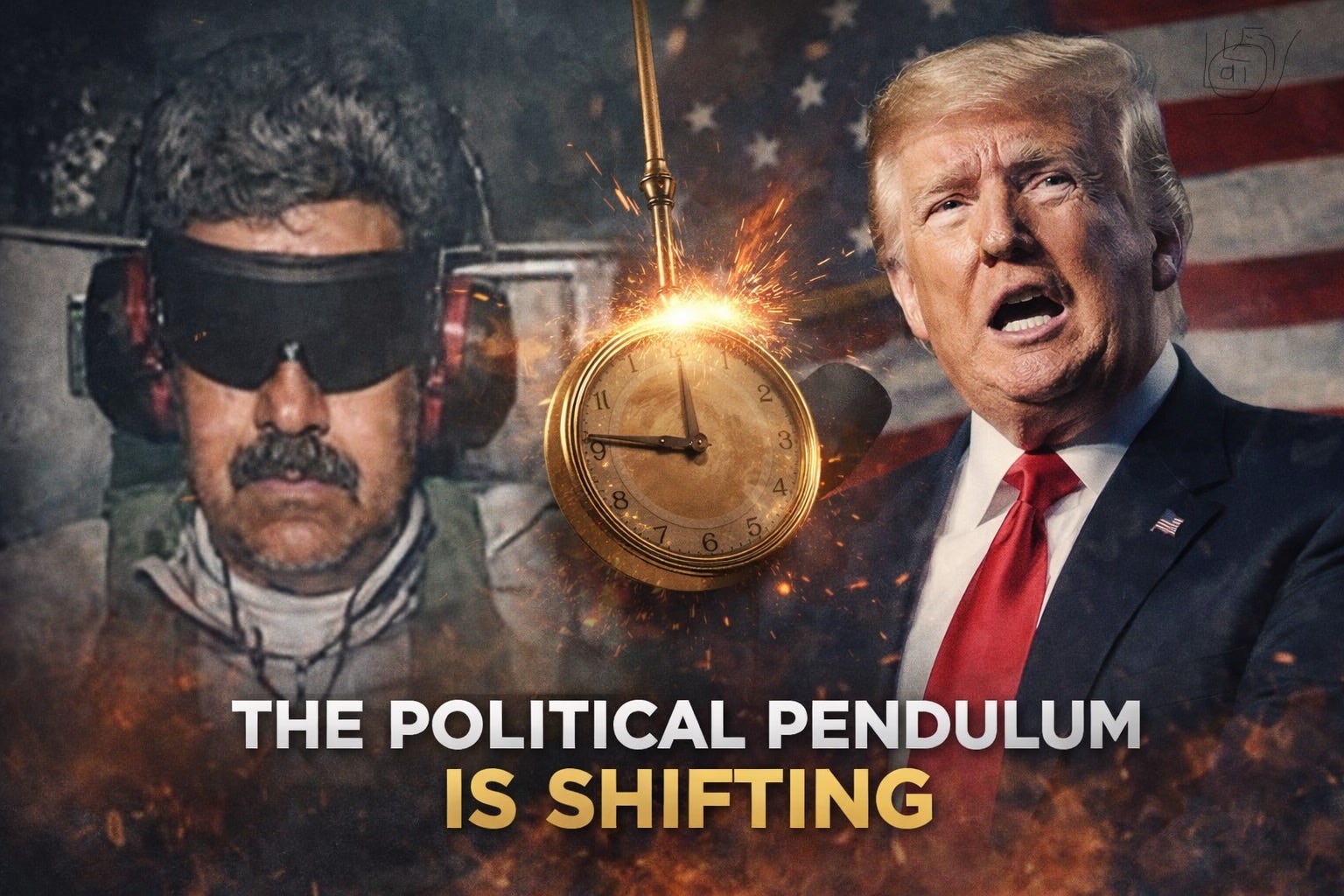
Like it, loathe it. At Mar-a-Lago, flanked by flags and television cameras, Donald Trump did something modern Western politics has almost forgotten how to do. He acted.
No taskforce. No consultation paper. No choreography of concern designed to soften the language before anything actually happened. A sitting head of state, long accused of running a criminal enterprise, was arrested by force, and the United States announced it would take control of the aftermath. Take control of Venezuela indeed.
Within minutes, the familiar chorus began. International law. Precedent. Escalation. Complexity. The language of caution, rolled out on cue.
But something else was happening too. Millions of people, watching from cities a long way from Caracas, felt a different reaction entirely. Not approval, not triumph, but a jolt of recognition. Power, for better or worse, had stopped asking permission.
Whether you cheer it, recoil from it, or simply stare at the screen in disbelief, the arrest of Nicolás Maduro is not just a foreign policy event. It is a cultural one. A signal flare fired straight through thirty years of Western political habit.
And if you think that has nothing to do with Birmingham, Walsall, Coventry, or Dudley, you are missing the point.
Because this is not really about Venezuela.
It is about the end of pretending that process is the same thing as morality.
When power stops asking permission
For decades, Western governance has been dominated by a particular tone. You hear it everywhere once you start listening for it. Council chambers. Press conferences. Public inquiries. The mouths of people who never quite decide anything.
“What I’m concerned about is…”
“We need to be careful…”
“This is complex…”
“There are no easy answers…”
That language flourished in a world where delay carried little cost. Where the consequences of inaction were distant, abstract, or fell on somebody else. It allowed institutions to feel virtuous while doing very little. It rewarded caution over judgement, and process over outcome.
Then the costs arrived anyway.
Drugs. Disorder. Migration pressures. Hollowed public services. Cities that look and feel neglected. Councils that talk endlessly while the basics decay.
What Trump has done, for better or worse, is rip through that habit and remind everyone of something uncomfortable: authority ultimately rests on the willingness to act and bear the consequences.
You do not have to admire him to see why that resonates.
The argument polite people hate
Let’s say the quiet part out loud.
International law, without enforcement, is often just language. Important language. Civilising language, sometimes. But language nonetheless. It restrains power only when power agrees to be restrained.
That is not cynicism. It is how the system has always worked.
For years, Venezuela was treated as a “complex political situation”, even as it was accused, formally, in US courts, of operating as a narco-state. Cocaine shipped. Institutions hollowed. Criminal revenue braided into governance. And yet the ritual continued. Statements. Sanctions. Expressions of concern.
Trump has torn up the ritual and said: if you are running a criminal enterprise behind a flag, we will treat you as a criminal enterprise.
That logic is dangerous. It sets precedents. It invites abuse. It will be copied by others with far worse intentions.
But it is not incoherent.
And that is why it has landed with such force.
Birmingham: paralysis with paperwork
Bring that mindset home.
Birmingham City Council did not become bankrupt overnight. Its Section 114 notice was not an act of God. It was the end point of years of managerial drift, deferred decisions, and a culture that treated warning signs as inconveniences rather than alarms.
Equal pay liabilities were known. When I left the council in 2005 they were being talked about. IT failures were known. Structural overspend was known. And still the machine rolled on, producing reports, strategies, consultations, and reassurances.
When the cupboard finally lay bare, the tone barely changed.
Even now, under commissioners, with effective bankruptcy declared, Birmingham struggles to do the basics cleanly. Waste disputes drag on. Public spaces degrade. Residents are told, again, that things are complicated.
This is not about malice. It is about a system trained to avoid decisive responsibility. A system that mistakes caution for virtue and paperwork for governance.
And the public is no longer buying it.
The West Midlands pattern
This is not a Birmingham pathology. It is regional.
Walsall: hiding choices behind uncertainty
In Walsall, budget papers speak openly about looming pressures running into tens of millions. Demand growth. Service stress. Future gaps.
And yet the language remains abstract. “Prevailing uncertainty”. “Medium-term challenges”. The numbers exist, but the choices are blurred.
A no-nonsense approach here would not be dramatic. It would be brutally simple.
Tell residents, plainly:
what the top ten cost pressures are,
what the top ten spends are,
and what will stop, change, or shrink as a result.
Name owners. Set dates. Accept unpopularity.
Instead, the instinct remains to soften, to defer, to manage expectations rather than make decisions.
Coventry: accountability delayed
Coventry prides itself on competence. And in many ways, it is better run than Birmingham. But even here, the same habits show through.
Audits that drag on for years. Accounts signed off long after the fact. Complaints recurring in familiar patterns. Scrutiny that exists, but arrives late.
None of this is scandalous in isolation. Collectively, it creates a fog in which responsibility is always slightly out of focus.
Decisive governance does not mean ignoring process. It means insisting that process serves accountability rather than postponing it.
Dudley: the tram as a metaphor
In Dudley, the tram line meant to symbolise regeneration has become a running joke. Deadlines slide. Openings move. Explanations multiply.
At the same time, glossy regeneration plans stretch a decade into the future, heavy on vision, light on delivery discipline.
This is not about trams. It is about credibility.
A no-nonsense council treats infrastructure like a construction firm would: milestones published, delays owned, reasons stated, new dates fixed and defended.
The May elections: the hinge
This is why the May local elections matter so much.
They are not ideological contests. They are referenda on competence. On whether voters are still willing to accept managerial theatre in place of results.
A “new broom” feels inevitable not because people crave disruption, but because patience has been exhausted.
The risk, of course, is mistaking bluntness for wisdom. Decisiveness can curdle into recklessness just as easily as caution curdles into paralysis.
But the greater danger right now is stasis.
What “no nonsense” must actually mean
If this moment is to amount to anything locally, it will not look like imported slogans or borrowed bravado. It will look boring, uncomfortable, and deeply unfashionable.
It will mean:
fewer strategies and more timetables,
fewer consultations and more decisions,
fewer apologies and more consequences,
fewer press releases and more outcomes.
It will mean councillors backing officers who act, not just those who comply.
It will mean officers telling politicians uncomfortable truths early, not defensively late.
And it will mean accepting that some people will always be unhappy, because governance is about trade-offs, not universal approval.
The closing truth
Trump’s action in Venezuela may yet unravel. It may provoke blowback. It may age badly. History will decide that.
But the cultural shock it has delivered is already real.
It has punctured the idea that endless concern is a substitute for judgement. It has reminded people that power unused is power wasted. And it has exposed how thin the moral authority of dithering has become.
Birmingham does not need foreign policy theatrics.
It needs courage at street level.
Because the truth is this: nothing changes until somebody is willing to be unpopular on purpose.
This is the trimmed-down take. The full piece, with every thread of political stitching intact, runs on midlandsGRIT, where the words have space to breathe and the seams are left deliberately unpolished.