

From Cast Iron to the Ivory Tower
Cllr Julien Pritchard a first-rate local champion who demanded cast-iron guarantees on affordable housing. Then he became Birmingham’s Deputy Leader. Funny what a promotion can do.

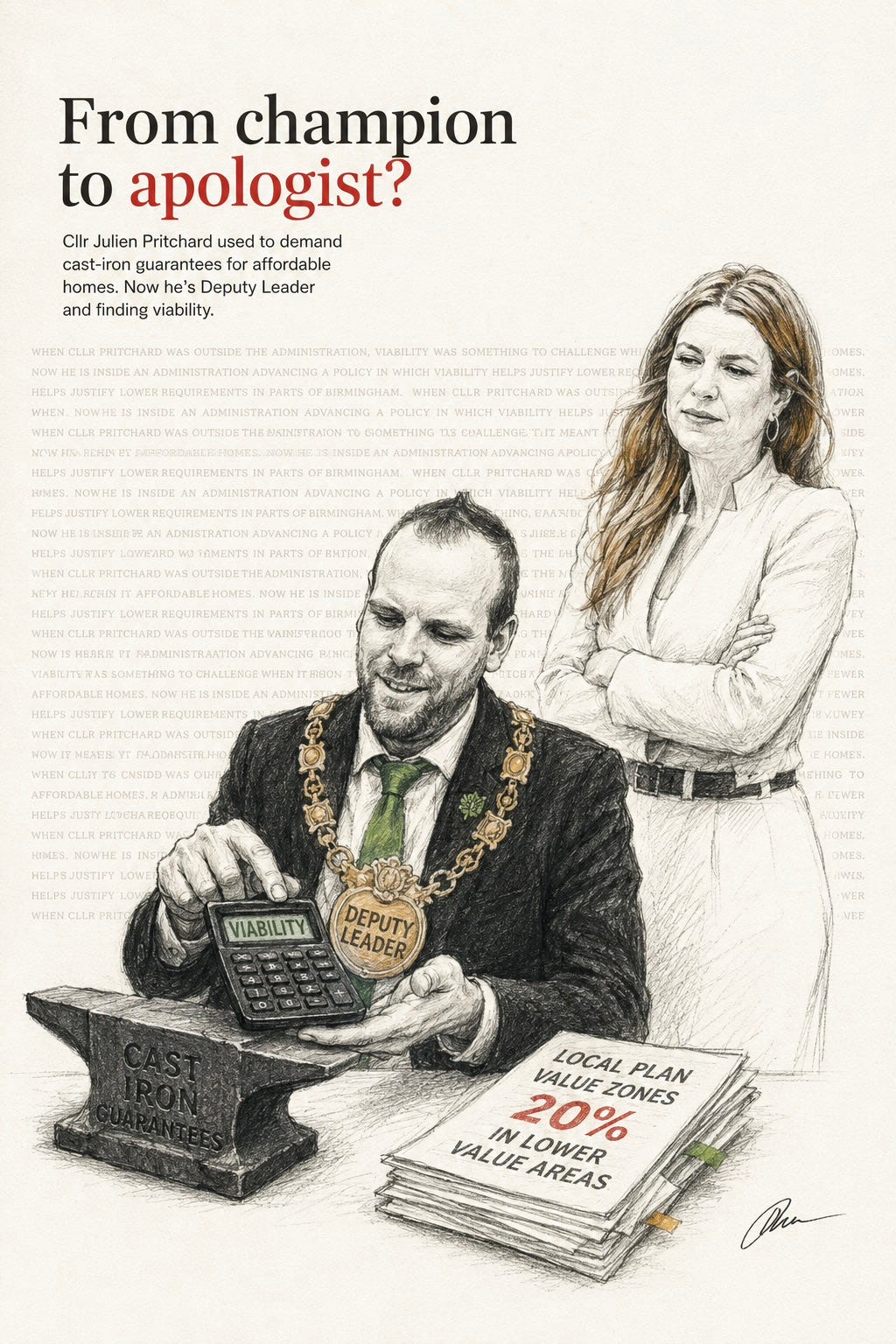
I have always rated Cllr Julien Pritchard. There, I have said it, and I mean it. He has been one of Birmingham’s better local councillors: energetic, awkward, visible and prepared to work jolly hard for the people of Druids Heath and Monyhull. I even have relatives who are about as naturally Green as I am naturally inclined to take up synchronised swimming, yet they have voted for him because he has been such a good local councillor. It is almost cheating. Forget the rosette, knock enough doors, answer enough emails and sort enough problems and eventually people start voting for the bloke rather than the party. That is exactly how local democracy ought to work, and Cllr Pritchard earned it.
Which is why his elevation troubles me rather more than it would if he had been mediocre to begin with. There is a familiar disease in local government whereby councillors begin as representatives of the people who elected them and, somewhere after acquiring a title, a Cabinet paper and a seat nearer the front, gradually become representatives of the Council to the people who elected them. Instead of demanding to know why something is not working, they begin explaining why it cannot possibly work any better. Instead of rattling the cage, they start issuing helpful guidance on why the cage is necessary. I do not know that this has happened to Cllr Pritchard and sincerely hope it has not. Birmingham is short enough of decent local councillors without losing one to the strange institutional ivory tower that council officers are remarkably adept at constructing around those who achieve high office.
Cllr Pritchard is now Leader of the Green Group, Deputy Leader of Birmingham City Council and Cabinet Member for Economy and Sustainability. With such magnificence come Cabinet meetings, officer briefings, strategy sessions, civic engagements and presumably occasional evenings spent talking earnestly to people holding glasses of warm white wine. All terribly important. But before becoming Deputy Leader, Cllr Pritchard also had the charming habit of replying when I wrote to him. I recently wrote again, asking a perfectly reasonable question about affordable housing. This time, silence. Perhaps promotion interferes with broadband.
The question concerns the Cllr Pritchard of Druids Heath who was wonderfully robust about affordable and social housing. When viability arguments appeared during regeneration proposals, he was not inclined simply to accept them. He complained there were nowhere near enough affordable homes, challenged reductions in social rented housing and demanded cast-iron guarantees for residents. Cast iron! Magnificent stuff. None of your flimsy political MDF, aspirations, directions of travel or commitments subject to market conditions. Proper industrial cast iron. You could almost smell the foundry.
Then Cllr Pritchard became Deputy Leader and Birmingham’s emerging Local Plan came along. The existing adopted policy seeks 35 per cent affordable housing on qualifying developments. The emerging plan takes a value-zone approach and, in lower-value areas, the requirement falls to 20 per cent. Why? Among the reasons is that old familiar friend: viability. Insisting upon a percentage which prevents developments being financially viable can mean they simply do not get built. Better, the argument goes, to secure a smaller percentage of an actual development than a larger percentage of something existing only on a planning officer’s computer.
Before somebody reaches for the outraged email, Cllr Pritchard did not invent this policy after becoming Deputy Leader. The value-zone approach was being developed before the present administration took office, and Druids Heath regeneration is not identical to setting planning policy across Birmingham. Those are legitimate distinctions. But they do not make the question disappear. When Cllr Pritchard was outside the administration, viability was something to challenge when it meant fewer affordable homes. Now he is inside an administration advancing a policy in which viability helps justify lower requirements in parts of Birmingham. Opposition Cllr Pritchard reached for the cast iron. Deputy Leader Cllr Pritchard appears to have found the calculator.
And perhaps the calculator is right. Thirty-five per cent of a development that never gets built is thirty-five per cent of bugger all. If 20 per cent makes schemes happen and ultimately produces more affordable homes, there is a perfectly respectable argument to make. Politicians are allowed to change their minds when confronted by evidence. All I asked Cllr Pritchard was whether his view of viability had changed, whether these were materially different circumstances or whether evidence now available to him in office had altered his thinking. I practically provided the escape ladder and held it steady. Still nothing.
Labour Group Leader Nicky Brennan, a former Birmingham Cabinet Member for Housing, put it rather more soberly: “Housing is full of difficult choices, and anyone who has held the portfolio understands the tension between securing affordable homes and getting developments built. Julien was previously very clear that viability should not become an excuse for reducing affordable housing. He is now part of an administration advancing a policy which relies heavily on viability to justify lower requirements in parts of Birmingham. I respect that governing brings difficult decisions, but I think residents are entitled to hear from Julien what has changed between the position he argued so strongly before and the one he is now being asked to defend.”
And that is the point. This need not be a story about hypocrisy. It is about something more interesting: whether office changes politicians, or merely introduces them to realities they previously had the luxury of denouncing. The danger is not that Cllr Pritchard suddenly became a bad councillor on receiving a grander title. It is that Birmingham takes a very good one, promotes him, surrounds him with officers, civic invitations and strategic priorities, and gradually sands away the inconvenient edges which made him useful. One minute you are demanding cast-iron guarantees for residents; the next somebody is explaining why 20 per cent represents a sophisticated, evidence-led, deliverable outcome.
Cllr Pritchard’s constituents rewarded him because he fought his patch and was prepared to be inconvenient on their behalf. Being Green Group Leader and Deputy Leader ought to make that voice louder, not smoother. The crucial transition is whether he remains principally their representative to the Council, or starts becoming the Council’s apologist to them.
So come on, Cllr Pritchard. Perhaps the evidence changed. Perhaps the circumstances changed. Perhaps you changed. All are perfectly respectable possibilities. Just come down from the ivory tower for five minutes and tell us.
After all, you always used to.