


Saturday night at the Birmingham Hippodrome, the lights dimmed and Black Power Desk began. What followed wasn’t just a play, it was a reckoning. The kind of theatre that drags truth out of the shadows and makes you sit with it. Loud, soulful, angry and alive, this was art doing what art should: shaking the complacent awake.
The story pulled us straight back to 1970, to the era of the Mangrove Nine, those nine extraordinary Black men and women who stood in a London courtroom and forced Britain to face itself. Their protest was against relentless police harassment of the Mangrove restaurant in Notting Hill, a vibrant Caribbean hub. The police couldn’t stand what that place represented: self-respect, pride and community. So they raided it, again and again.
The protest that followed led to clashes, arrests and one of the most important trials in modern British history. Inside the Old Bailey, the defendants turned accusation into defiance. They exposed police racism and made a judge admit, for the first time, that there was evidence of racial hatred within the Metropolitan Police. That was fifty-five years ago, half a century of “lessons learned” and “new beginnings”. Yet somehow, the story keeps looping back on itself.
And I’ll be honest, as a white bloke sitting there, this isn’t an abstract conversation. My skin in this game is my beautiful wife from Erdington, whose parents both came from Jamaica, and a well-formed set of mixed-race twins who carry the story of modern Britain in their DNA. So when I see a play like Black Power Desk, I don’t watch it from the outside. I watch it as a father who wants his kids to live in a country where history finally moves forward instead of round in circles.
Because here we are again. In 2025, the BBC’s Panorama reveals undercover footage from inside a London police station, officers joking about shooting immigrants, sneering at rape victims, and mocking Muslims. It’s not grainy 1970s footage, it’s today. The same force, the same culture, the same casual hatred hiding under the uniform.
The Met Commissioner, Sir Mark Rowley, looked grim on camera and called the behaviour “vile”. He said he wouldn’t resign because he was “the man to fix it”. Funny how every Commissioner says the same thing just before the next scandal breaks.
“That’s not a pattern. That’s a pathology.”
Let’s count the milestones in this long, embarrassing saga of denial.
1971 – The Mangrove Nine. Racism acknowledged in open court.
1981 – Brixton Riots and the Scarman Report. “Racial disadvantage is a fact of British life.”
1999 – The Stephen Lawrence Inquiry. The Met officially declared institutionally racist.
2023 – The Casey Review. Institutionally racist, misogynistic and homophobic.
2025 – Panorama. Racist, sexist officers filmed laughing about it all over again.
That isn’t evolution. That’s endurance.
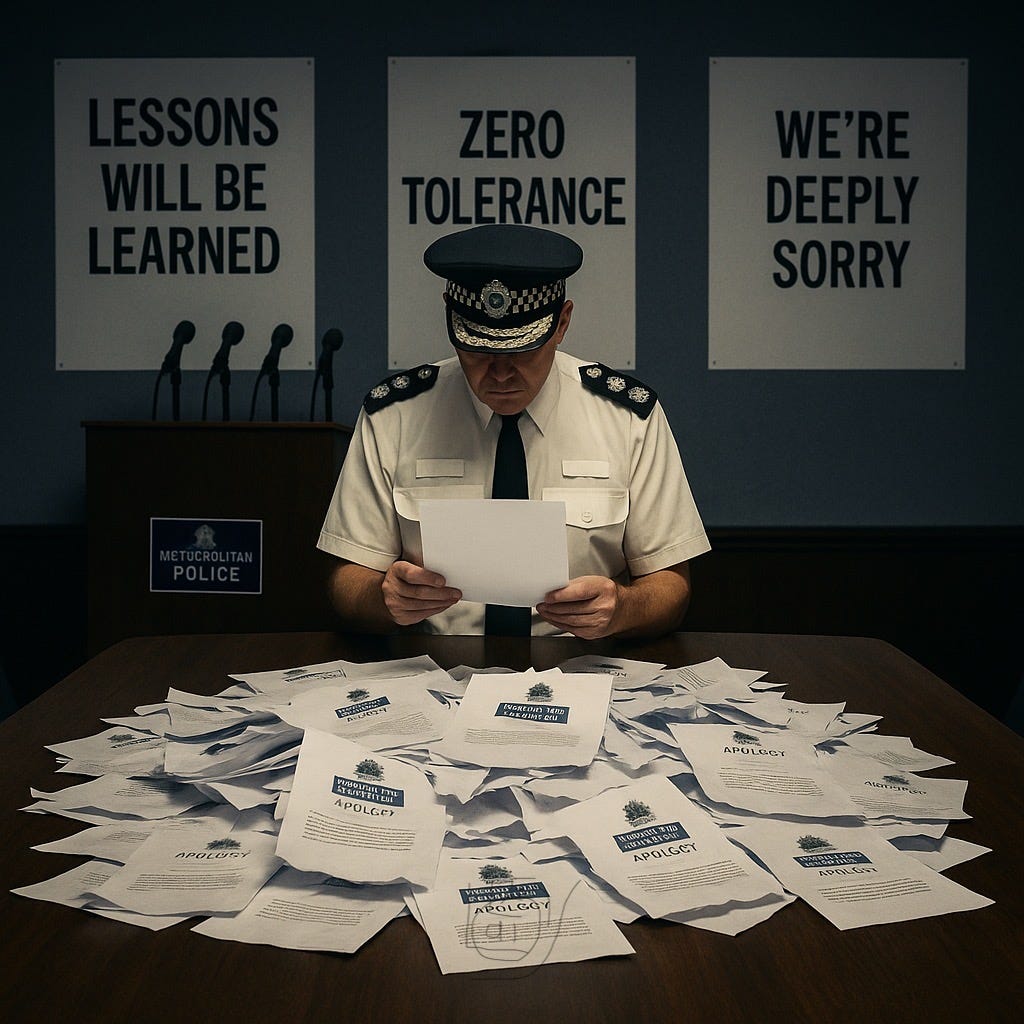
We’ve created a culture where every generation of officers gets a new manual on inclusion, a new commissioner promising reform, and the same public apology rehearsed like a press-release prayer. Britain doesn’t confront institutional racism; it manages it. Smooths it over, papers it up, turns outrage into policy paperwork and hopes the public gets bored.
Black Power Desk refuses to let us get bored. It reminds us of what courage looked like in the 1970s: people who had nothing but truth to arm themselves with. The sisters at the heart of the play, Celia and Dina, channel the spirit of Altheia Jones-LeCointe and Darcus Howe, the firebrands of that movement. They weren’t just fighting for dignity; they were fighting to be seen as human in a system that had already decided they weren’t.
And now, fifty-five years later, we’re still seeing new evidence that the same system hasn’t fully learned what humanity looks like. You can change the uniforms, the training, even the slogans, but until you change the culture, the attitudes baked into the bricks, the results will stay the same.
This isn’t about bad apples. When your orchard’s been poisoned for decades, it’s time to stop blaming the fruit and look at the soil.
The Met’s story is a mirror held up to Britain’s own reflection. We’re a nation that congratulates itself for progress while ducking the reality that progress has to be maintained, protected and fought for. We keep saying “things are better now”, but every fresh scandal proves that’s just the lie we tell to sleep well.
What Black Power Desk delivers, and what this country still needs, is moral discomfort. It doesn’t let you clap and walk away feeling good. It makes you angry, sad, proud and determined, all at once. Because the Mangrove Nine didn’t march for sympathy; they marched for change. And change, real change, demands consequence.
We don’t need another inquiry. We don’t need another headline promising root-and-branch reform. We need accountability that bites. If an officer acts with hate, they should face the same justice as anyone else. If a senior figure covers it up, they should lose their badge, not get promoted to a desk job.
As I left the theatre, I thought of those twins. I want them to grow up in a Britain that’s done with excuses, a Britain that can look itself in the eye and finally say we’ve stopped talking about racism and started eradicating it.
Because until that happens, the Mangrove story isn’t history. It’s prophecy.
And I, for one, am done waiting for another generation to prove the same point all over again.
Credit to Urielle Klein-Mekongo, the creative force behind Black Power Desk, for daring to write a piece that refuses comfort and demands courage. Her words, her music and her vision remind us that the fight for equality doesn’t belong to the past — it belongs to now.